Questar’s latest maintenance platform uses AI to flag potential failures, recommend repairs, and estimate the cost of waiting, helping fleets prioritize maintenance and save money and downtime.
Predictive maintenance isn’t a new concept. But knowing something might fail and knowing what to do about it are two different things.
Questar Auto Technologies says it can help with the latest version of its Total Fleet Health platform, now rolling out in North America with a new integration on the Geotab Marketplace. The system uses artificial intelligence to analyze vehicle data, flag potential failures, and recommend specific actions, along with the estimated cost of delaying needed repairs.
According to Questar, fleets spend about $26,000 per vehicle annually on maintenance, repairs, and downtime, with unplanned downtime alone averaging nearly nine days per year.
The company says its platform can reduce those costs by more than 20% by helping fleets address problems earlier and more strategically.
“This is a market that has to be fixed,” said CEO Vered Mandelboum Josef.
“We are living in an era where AI can truly transform the way fleets maintain vehicles.”
Questar’s technology, she said, “supports fleet managers every step of the way, from understanding what happened, to seeing what is going on right now, anticipating what is likely to happen next, and ultimately, what to do about it, all in clear, actionable language.”
What’s In a Name?
But as more vendors roll out AI-driven maintenance tools, the terminology — and expectations — can get blurry.
Aaron Howell, Questar’s vice president of sales for North America, told reporters in a virtual briefing that definitions in the area of predictive maintenance aren’t always clear or used consistently.
At Questar, predictive maintenance means identifying what is likely to fail based on the data. Prescriptive maintenance goes a step further, recommending what actions to take.
Questar adds a third layer: “agentic,” using AI agents that can interpret context, generate insights without prompts, and help prioritize decisions.
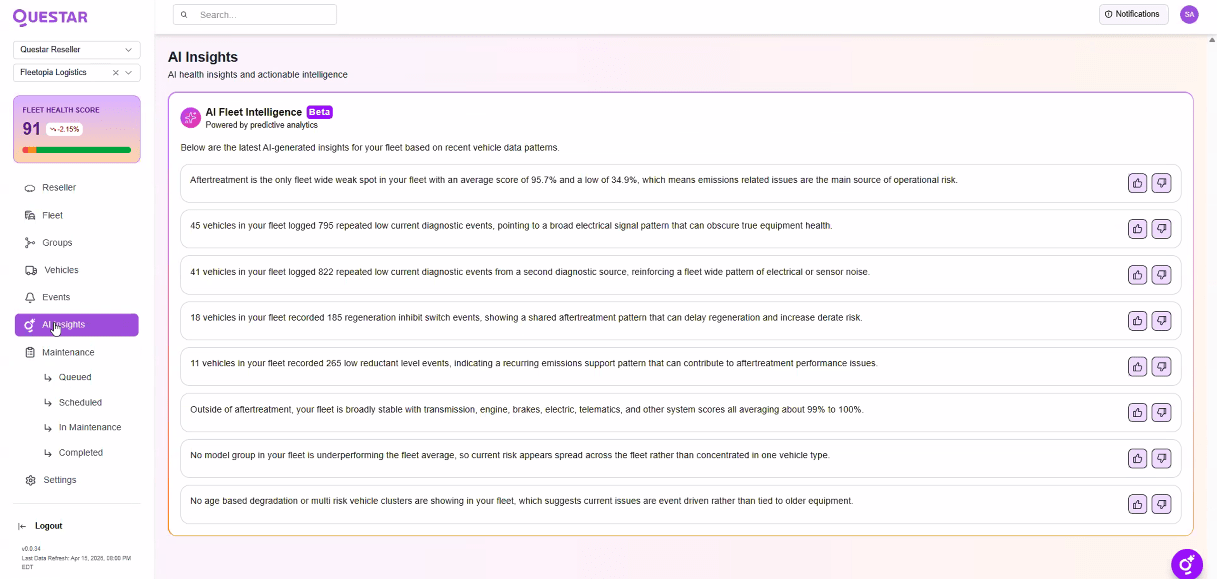
That means fleet managers aren’t just receiving fault alerts or probability scores. They can ask questions in plain language and get explanations, recommendations, and insights into trends.
“Fleets are inundated in terms of their tech stack,” Howell said. “Questar sits in the middle, ingesting that data and helping them understand what they need to do — and what to prioritize.”
How it Works
The platform is designed to bring users information at a glance on what needs attention first, and translate those insights into day-to-day maintenance decisions.
The system uses historical and real-time data to assess vehicle health, resulting in:
- Early warnings of potential failures
- Identification of likely root causes
- Assessment of the risk of further damage
- Recommended repair actions
- Estimated cost of delaying those repairs
“Rather than reacting to isolated fault codes,” Josef said, “Questar applies data-driven prediction models to calculate failure probability and estimated cost of inaction, giving fleets foresight into what is likely to fail and when.”
That approach is reflected in how the system presents information to users. The dashboard is designed to be easily accessible not just to the maintenance department but also to others in the company, such as those in management, finance, and operations.
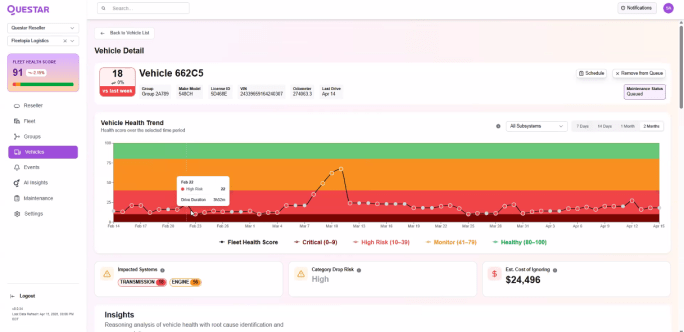
From the main dashboard, fleet managers can go to individual vehicle pages for more insights.
At the center of the dashboard is an overall vehicle health score, along with a breakdown of how many trucks fall into different risk categories — from critical issues requiring immediate action to vehicles that are operating normally.
From there, fleet managers can drill down into individual vehicles to see which systems are affected, the likely root cause, and the recommended repairs. The system also estimates the cost of delaying those repairs, giving fleets another data point to weigh when scheduling work.
It also suggests lower-priority preventive actions that can be handled in-house to help avoid more serious issues later such as topping off fluids or initiating a diesel particulate filter regeneration.
Vehicles needing attention can be added to a repair queue and tracked through the maintenance process, allowing the platform to function as both a diagnostic and workflow tool.
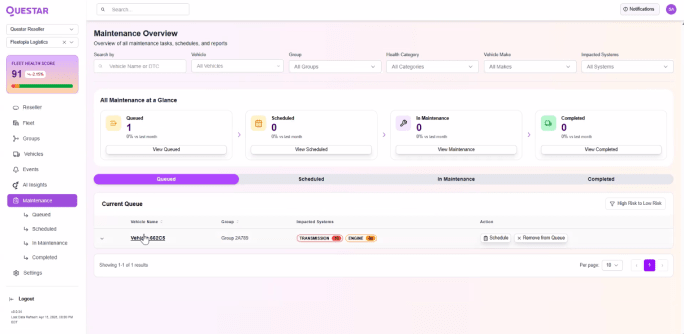
When a fleet manager decides to get a vehicle into the shop, he or she can easily add it to the queue and track it in the system directly if they don’t have a separate maintenance management platform.
Where Does the Data Come From?
Underlying the platform is a continuous stream of vehicle and operational data, both from Questar’s vast amount of data and the fleet vehicles’ telematics, combined with pattern recognition across the fleet.
Questar says that ability to learn from both historical and real-time data is what allows the platform to move beyond reacting to individual fault codes and toward identifying emerging issues earlier — and with greater accuracy.
“Prediction is not enough,” Josef said. “You have to be able to translate that into action.”
The latest version of the platform is available as a cloud-based solution or paired with Questar’s telematics hardware, and can also integrate with existing telematics systems.
In North America, Questar has added new partnerships, including Geotab and Atmus’ Fleetguard division, as it expands its presence in the market.
The system does not currently use the Vehicle Maintenance Reporting System (VMRS) codes developed by the American Trucking Associations’ Technology & Maintenance Council, but Howell said the company is exploring how to incorporate them, recognizing their widespread use across the industry.
Credit: Source link