“I realize this is a bit of a moonshot.”
Barrie Kirk, steering committee chairman for the recently formed non-profit Canadian Automated Vehicle Initiative (CAVI), was telling me about an ambitious plan to run an autonomous truck from coast to coast in Canada.
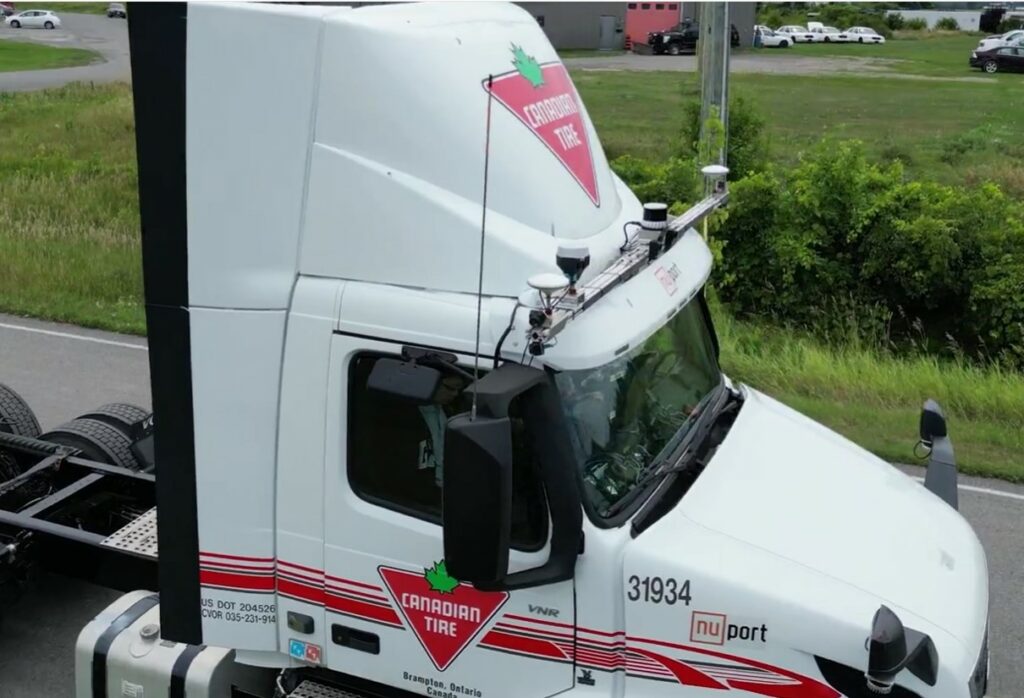
The 6,000-km (3,728-mile) journey would be the longest such trip completed autonomously in the world and would cement Canada’s position on the global stage of vehicle automation, he said. The Trans-Canada Autonomous Truck Demonstration Project would take place in 2028, already has an active steering committee in place and has begun fundraising efforts.
“The biggest hurdles ahead are funding the project, and achieving regulatory harmonization across provinces,” CAVI said in its recently published terms of reference.
For Kirk, the project is a passion that will elevate the work being done by Canadian developers of autonomous trucking technology. Companies such as NuPort Robotics, Waabi and Gatik.
“I’ve been involved in self-driving vehicles for about 10 years,” Kirk told trucknews.com. “When I first started, people thought I was a nerd who had overdosed on science fiction.”

Autonomous trucking technology, however, has continued to be developed and is being used to handle actual freight in the U.S. today. Ontario recently launched an autonomous commercial vehicle pilot project, showing a willingness to be among the earliest jurisdictions to embrace the technology.
That’s why CAVI was born, with an interest in advancing self-driving vehicles, including cars, trucks and robots, but not drones or marine vessels.
“If it has wheels or feet on the ground, we’re interested,” Kirk said. CAVI was formed in March 2024 and soon after the Trump administration disrupted trade between Canada and the United States, leading to a renewed focus on interprovincial trade within Canada.
“Obviously, automation is a key option there. And so, we came up with this idea of organizing a project where a tractor-trailer will drive itself from Halifax to Vancouver,” Kirk said.
The initiative is loosely based on a similar undertaking in Europe dubbed the MODI (Moving Towards Highly Automated Physical and Digital Infrastructures) Project. There, a related demonstration looks to showcase autonomous vehicles along a 1,200-km (746-mile) corridor crossing four international borders between the Netherlands and Norway.
“They’re ahead of us by about two to three years,” Kirk said, adding the European Union is funding the project.
Kirk feels the Trans-Canada Autonomous Truck Demonstration Project should be considered a nation-building project and he’s seeking about $40 million in federal funding.
“If and when we do it, we can raise the flag and say Canada has a world record for the longest autonomous truck drive,” Kirk said.
Phase 1 was meant to determine whether or not there’s interest in the project. Having determined there is, the project is now entering Phase 2, which will include planning. Kirk said the technology is not the biggest challenge to overcome, but rather fundraising and getting the provinces onboard.
“Ontario’s way ahead,” Kirk said of the provinces’ receptiveness to autonomous driving. “But the other provinces are not really in the game yet. We need to bring them to the table and get something in place from a regulatory point of view for this. But getting the provinces aligned in Canada is never easy.”
Priority will be given to Canadian manufacturers for participation in the demo, and the demonstration isn’t necessarily limited to just one company.
In addition to demonstrating the capabilities of the trucks themselves, Kirk said ancillary requirements such as vehicle monitoring will also be highlighted. A safety driver will be involved, though it hasn’t yet determined whether they’ll be in the cab or in a chase vehicle.
Credit: Source link