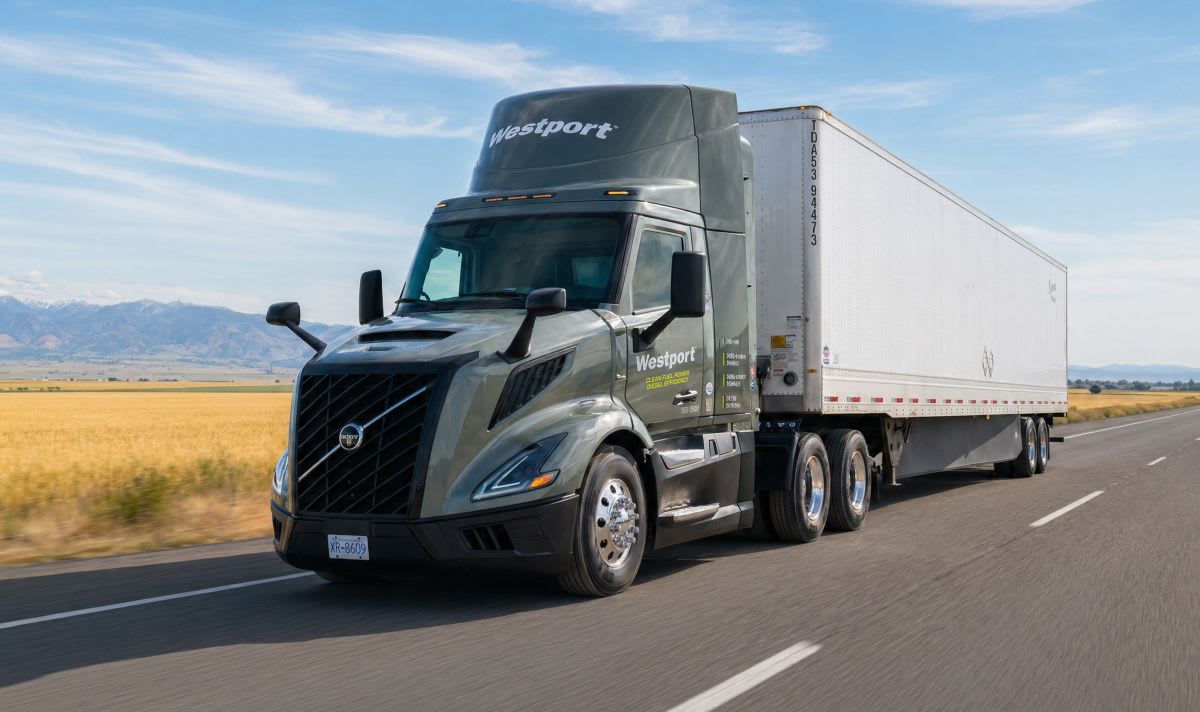
Another high-horsepower natural-gas engine system may soon be available from Westport and Volvo, with fuel efficiency comparable to diesel and the potential to run on hydrogen in the future.
At the Advanced Clean Transportation Expo in Las Vegas May 4-7, Westport is showcasing the first North American demo of its compressed natural gas storage system paired with Cespira’s on-engine HPDI fuel system.
Cespira is the joint venture between Volvo and Westport.
Why is HPDI Significant for Natural Gas Fuel Adoption?
HPDI, High Pressure Direct Injection, is a technology where a small amount of ignition fuel is injected at high pressure to enable compression ignition before gaseous fuels such as natural gas or hydrogen are added. The components are designed to handle CNG as well as natural gas-hydrogen blends.
In contrast, current natural gas engines use spark ignition.
Westport’s technology only requires changes to the HPDI injectors and the associated fuel system. No modifications are needed to the engine, transmission, or cooling system, and there are no changes to maintenance schedules.
With Cespira’s HPDI, fleets can achieve efficiency comparable to the latest generation of diesel trucks while running on CNG or renewable natural gas (RNG), according to the company — up to 10 mpg equivalent, with a driving range of more than 600 miles.
For the first time, Westport is showcasing the system in real‑world operation in a demonstration truck.
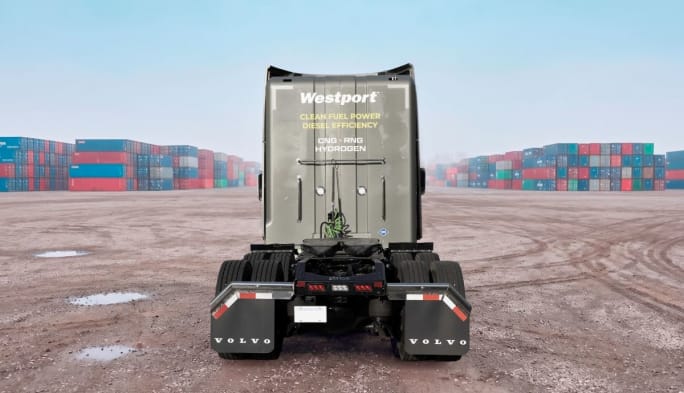
The latest Westport system is installed on a latest-generation Volvo VNL 300 truck with 500 horsepower and 1,850 lb-ft of torque. Fuel efficiency on CNG is comparable to that of the VNL running on diesel fuel, according to the company.
Westport said in a news release that this marks “a critical step toward adoption of HPDI technology for the North American heavy‑duty market.”
It also noted that CNG prices are lower and more stable than fluctuating diesel prices.
More About the Technology
Westport’s CNG solution uses advanced high-pressure storage technology to maximize the performance that HPDI fuel systems are capable of. The fuel storage system maximizes usable fuel mass to extend driving range.
The high‑pressure (~700 bar) CNG platform is engineered for diesel combustion engines that require in‑cylinder, high‑pressure gaseous fuel injection, including engines equipped with Cespira’s HPDI fuel system.
While HPDI is commercially available in more than 30 countries, powering over 10,000 trucks worldwide using liquefied natural gas, North America’s preference for CNG has limited adoption in this market.
Westport’s new CNG fuel storage system removes that barrier, according to the company.
A New Pathway for Hydrogen
The HPDI engine can run on a variety of fuels, including natural gas, hydrogen, or a blend of both.
That means truck makers can integrate natural-gas HPDI in the near term and later leverage those HPDI engineering and manufacturing investments to extend the technology to other fuels.
Westport believes that the fuel adaptability of the HPDI on-engine fuel system will provide a more practical path for the use of hydrogen in heavy-duty transportation.
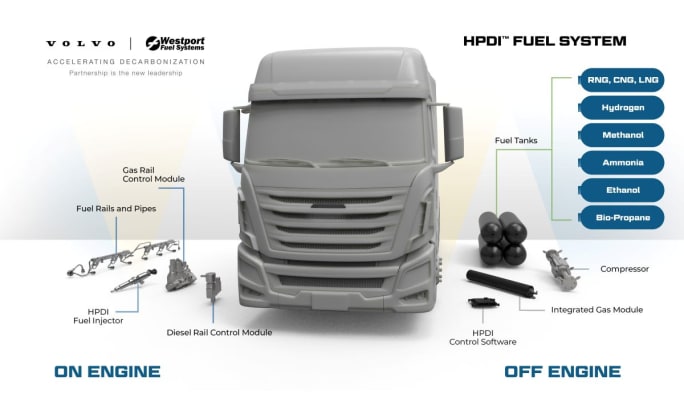
In HPDI, High Pressure Direct Injection, a small amount of ignition fuel is injected with high pressure to enable compression ignition before gaseous fuels such as natural gas or hydrogen are added.
Unlike fuel cells, an engine equipped with the HPDI fuel system does not require hydrogen to be 99.999% pure, according to Westport. This means hydrogen for HPDI-equipped engines does not need a dedicated, super-clean distribution system and can avoid the high cost of liquefying hydrogen and transporting it in cryogenic trailers.
That also means trucking fleets could start running on low-cost CNG or renewable natural gas, Westport said, then introduce hydrogen as desired in the future. Hydrogen could be gradually adopted, initially as a blend with natural gas, then evolving to 100% hydrogen as the fuel becomes increasingly affordable.
Credit: Source link