

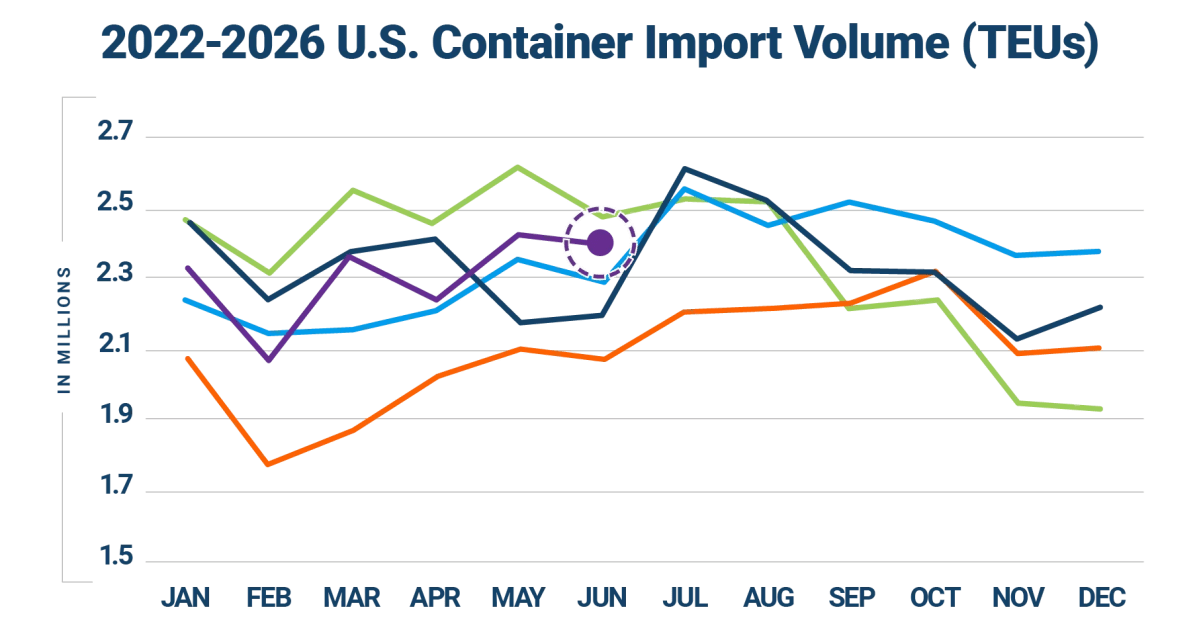
There was an early start to peak season this year at the nation’s gateway ports, as retailers brought in merchandise ahead of tariff changes in late July and responded to other supply chain uncertainties,
This year’s peak shipping season is coming to an end following a busy summer at some U.S. gateway ports. Import volume at the nation’s major container ports is expected to remain high this month before starting to decline for the rest of 2026, according to the Global Port Tracker report from the National Retail Federation and Hackett Associates.
Port of Los Angeles Executive Director Gene Seroka said in an interview with the Wall Street Journal that big-box retailers have been driving heavy volumes of clothing, electronics, and furniture through the ports of Los Angeles and Long Beach this summer.
“The peak is lasting longer than many of us thought, even going back a couple of months ago,” Seroka said.
What’s Driving Changes to Peak Shipping Season?
The peak shipping season, which historically came in late summer or fall, has shifted earlier and become smoother in recent years, driven by factors ranging from supply chain disruptions to expected tariff increases.
There was an early peak season this year, as retailers brought in merchandise ahead of tariff changes in late July and responded to other supply chain uncertainties, such as the ongoing disruption caused by the conflict in Iran, explained Jonathan Gold, NRF vice president for supply chain and customs policy.
“One round of tariffs has been replaced with another, but retailers will be well stocked for the coming holiday season. Retailers know how to adapt to shifting situations and are well prepared to meet consumers’ demand for affordability and choice.”
The early start of peak season led many to expect an earlier end to the season.
Temporary 10% Section 122 global tariffs that took effect in February expired on July 23, but a new round of 10% to 12.5% Section 301 tariffs regarding forced labor covering 60 economies and affecting 99% of U.S. imports took effect the next day.
“Consumers might have been expected to become more cautious as cost-of-living pressures persist,” Hackett Associates Founder Ben Hackett said. “Even so, consumer spending has remained resilient despite persistent geopolitical uncertainty.”
Data on Container Imports
U.S. ports covered by Global Port Tracker handled 2.23 million Twenty-Foot Equivalent Units — one 20-foot container or its equivalent — in June, the latest month for which final numbers are available.
That was up 13.2% from a year earlier, when imports were down sharply because of last year’s “Liberation Day” tariffs, but down 0.7% from May. The first half of 2026 totaled 12.7 million TEU, up 1.1% from the same period in 2025.
Another report, Descartes’ Global Shipping Report, said U.S. containerized imports reached 2.4 million TEUs in June, dipping 1.2% from May but remaining 8.2% above June 2025 levels, suggesting import demand remains resilient despite ongoing trade and tariff uncertainty. For the first six months of the year, volumes were down slightly by 0.3% but remained 22.2% above the same period in pre-pandemic 2019.
While the southern California ports were buzzing, Descartes reported that June import volumes were mixed across major U.S. ports.
Mixed Results in Other Ports
Container volumes across the top 10 U.S. ports fell by 18,533 TEUs in June, a 0.9% month-over-month decrease, with six of the 10 major gateways posting lower volumes compared to May.
Los Angeles recorded the largest volume increase, rising 16.1% (70,495 TEUs), followed by New York/Newark, up 1.7% (5,813 TEUs).
In contrast, Houston posted the steepest decline, falling 21.7% (42,137 TEUs), followed by Savannah, down 8.2% (20,951 TEUs), and Long Beach, down 4.5% (18,717 TEUs).
The mixed results suggest that June’s slight pullback in import activity was not evenly distributed, with gains at Los Angeles and New York/Newark helping to offset sharper declines at several Gulf Coast and West Coast gateways.
With the increase in imports into southern California, it’s not surprising that at the Port of Los Angeles, port transit delays increased from 2.9 days in May to 5.8 days in June, the highest delay among major gateways, according to Descartes.
NRF’s Import Forecast
Ports have not yet reported July numbers, but Global Port Tracker projected the month at 2.21 million TEU, down 7.6% year over year.
August is forecast at 2.22 million TEU, down 4.2% year over year.
Imports are expected to decline steadily each month for most of the rest of the year, although volumes will be above 2025. The report’s forecasting projects:
- September: 2.16 million TEU, up 2.8% year over year
- October: 2.13 million TEU, up 2.7% year over year
- November: 2.03 million TEU, up 0.3%
- December: Should pick up slightly at 2.06 million TEU, up 2.5% over last year.
While ports have remained busy this summer and spread out the peak season, this year’s busiest month appears to have arrived in May, when they handled 2.24 million TEU.
While a whole-year total is still pending, 2026 is expected to total 25.5 million TEU, up 0.1% from last year. Imports totaled 25.4 million TEU in 2025, down 0.3% from 25.5 million TEU in 2024.
Global Port Tracker, which is produced for NRF by Hackett Associates, provides historical data and forecasts for the U.S. ports of Los Angeles/Long Beach, Oakland, Seattle and Tacoma on the West Coast; New York/New Jersey, Port of Virginia, Charleston, Savannah, Port Everglades, Miami and Jacksonville on the East Coast, and Houston on the Gulf Coast.
Hackett Associates provides expert consulting, research and advisory services to the international maritime industry, government agencies and international institutions.
The National Retail Federation advocates for retailers, the nation’s largest private-sector employer.
Credit: Source link


