No oil changes. No diesel exhaust fluid. No exhaust aftertreatment. But NACFE battery-electric trucks still require specialized maintenance procedures.
Released in late June, the North American Council for Freight Efficiency’s Messy Middle Powertrain Service & Maintenance report examines how truck maintenance is changing as fleets experiment with an expanding mix of fuels, powertrains and emissions-reduction technologies.
This is the fifth installment in HDT’s continuing series examining the report.
Part 1 looked at maintenance for modern diesel engines.
Part 2 explored renewable diesel fuel maintenance procedures.
Part 3 focused on biodiesel.
And Part 4 examined renewable natural gas truck engine maintenance.
Now we come to battery-electric trucks — arguably the technology that most dramatically changes the maintenance equation for fleets today.
Battery-electric vehicles eliminate the diesel engine, transmission, fuel system and exhaust aftertreatment. In their place are high-voltage battery packs, inverters, electric motors or e-axles, thermal-management systems, power electronics and miles of orange-jacketed high-voltage cabling.
That means many of the dirty, time-consuming maintenance tasks fleets have dealt with for generations simply disappear.
But they are replaced by an entirely new set of procedures, tools and safety requirements that cannot be treated as an extension of conventional diesel maintenance.
Fewer Moving Parts Does Not Mean No Maintenance
The basic maintenance advantage of a battery-electric truck is easy to understand.
There is no engine oil to change. No diesel particulate filter to clean. No diesel exhaust fluid to refill. No fuel filters, injectors or turbochargers. And regenerative braking significantly reduces wear on brake pads, drums and rotors.
Consequently, NACFE cites fleet modeling indicating that BEV maintenance costs can be 30% to 50% lower than those of comparable internal-combustion vehicles.
But that does not mean BEVs are maintenance-free.
Instead, maintenance shifts away from combustion-related systems and toward electronics, cooling systems, software and high-voltage integrity.
Core preventive maintenance tasks include inspecting high-voltage cables and connectors for damage or chafing, checking low-voltage support batteries, verifying inverter and DC-to-DC converter performance, and monitoring the thermal loops that cool the batteries, motors and power electronics.
In practical terms, the technician’s toolbox begins to look less like one built for an engine overhaul and more like one assembled for advanced electrical diagnostics.
High Voltage Changes Shop Safety
The most important maintenance difference with battery-electric trucks is safety.
Heavy-duty BEV battery systems commonly operate between 600 and 900 volts. At those levels, technicians cannot rely on experience, intuition or informal shop practices.
Every high-voltage circuit must be treated as energized until it has been disconnected, locked out and tested to verify the absence of voltage.
NACFE emphasizes that fleets need formal lockout/tagout procedures, insulated tools, electrically rated personal protective equipment and clearly defined high-voltage work zones.
A typical de-energization process includes securing the vehicle, following the OEM shutdown procedure, removing the manual service disconnect, applying lockout/tagout devices, allowing capacitors time to discharge and verifying the circuit through a “live-dead-live” test using an approved meter.
That process is not optional.

Proper safety gear is essential for electric truck maintenance.
As NACFE’s Rick Mihelic noted in the report, heavy-duty battery voltages can kill. Technicians must have the proper certification, procedures and equipment before working on these vehicles.
Even seemingly routine diagnostic work carries risk. Fleets need meters rated for the voltage and electrical environment in which they will be used, along with insulated gloves, face protection and electrically rated footwear.
Bringing a BEV into a conventional shop without those tools and procedures is not merely inefficient. It puts technicians in danger.
Training Must Come Before the Truck
One of the clearest messages in NACFE’s report is that fleets should not acquire battery-electric trucks first and figure out training later.
Technicians need to understand not just how to perform a procedure, but why the system behaves as it does.
Battery-electric trucks use inverters to convert direct current from the battery into alternating current for the traction motor. Regenerative braking reverses that energy flow and sends electricity back into the battery pack. DC-to-DC converters step high voltage down to power conventional 12-volt accessories and control systems.
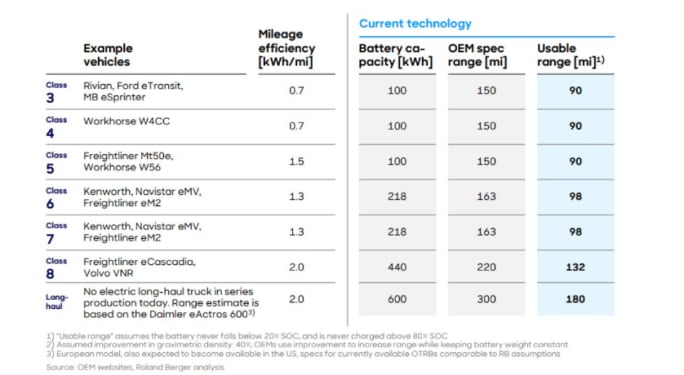
Typical operational ranges of current technology.
A technician does not need to become an electrical engineer to perform every preventive maintenance task. But diagnosing a propulsion fault, battery imbalance or thermal-management problem requires far more electrical and software knowledge than traditional truck service.
That knowledge also varies by manufacturer.
Shutdown procedures, disconnect locations, battery chemistries and diagnostic tools can differ significantly from one OEM to another. Training therefore needs to be vehicle-specific and tied directly to the trucks a fleet operates.
NACFE recommends making access to OEM diagnostic software, special tools and technician training part of the vehicle purchasing agreement rather than negotiating for those capabilities after the trucks arrive.
Preventive Maintenance Becomes More Diagnostic
BEV maintenance intervals still exist, but the work performed at those intervals looks different.
Freightliner’s eCascadia, for example, uses a tiered maintenance schedule that begins with routine inspections and progresses toward increasingly detailed electrical and thermal-system checks.
Early inspections focus on items such as brakes, tires, wheel fasteners, air compressors and visible cable condition. Later intervals add high-voltage component inspections, wiring checks, coolant replacement and drivetrain-fluid service.
Volvo Trucks likewise specifies periodic battery inspections, electric air-compressor service and extended coolant and axle-oil intervals for its VNR Electric.
The important point is that BEV trucks still use conventional truck systems.
They still have tires, suspension components, wheel ends, steering systems, air compressors and hydraulic brakes. Those systems continue to require regular service.
What changes is the increased emphasis on inspection and measurement.
A loose electrical connection, small coolant leak or damaged high-voltage cable may not produce the same obvious symptoms as a failing diesel component. Detecting those issues requires scan tools, thermal cameras, insulation testers and disciplined inspection procedures.
Thermal Management Protects Battery Life
Cooling-system maintenance becomes especially important on a battery-electric truck.
Battery packs, inverters and electric motors operate best within relatively narrow temperature ranges. Uneven cooling can create hot spots, accelerate battery degradation and eventually reduce vehicle range and performance.
NACFE notes that even small temperature differences between battery cells can significantly affect long-term pack life.
That makes coolant pumps, hoses, heat exchangers and thermal-management software critical maintenance items.
Thermal imaging can help technicians identify hot connections, blocked coolant flow or uneven battery-module temperatures before those problems become expensive failures.
This is one area where BEV maintenance begins to move from preventive to predictive. Instead of waiting for a component to fail, fleets can monitor temperature, resistance and battery-health trends to identify developing problems.
Battery Health Is About More Than Mileage
Perhaps the biggest long-term maintenance question surrounding electric trucks is battery life.
NACFE cautions that heavy-duty fleets are still building the real-world data needed to determine exactly how battery packs will age under different duty cycles.
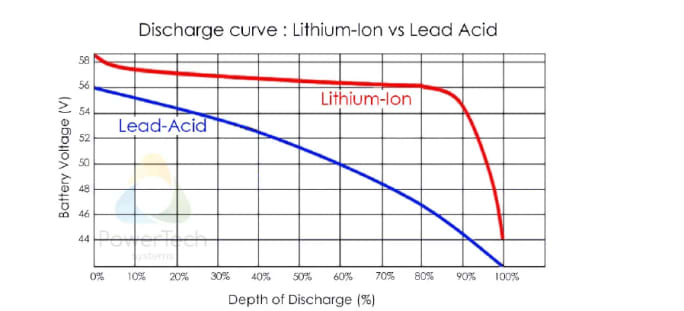
Lithium-Ion vs lead acid battery discharge curves.
What is already clear is that mileage alone does not determine battery health.
Charging behavior, operating temperature, depth of discharge and fast-charging frequency all influence battery degradation.
Fleets that routinely operate batteries at extreme states of charge or outside their preferred temperature range may shorten pack life. By contrast, trucks with high daily utilization can maintain strong battery health if charging and thermal conditions are carefully controlled.
That makes state-of-health monitoring an essential part of BEV maintenance.
Telematics platforms increasingly allow fleets to track battery condition over time, compare degradation between vehicles and forecast when a pack may fall below an acceptable operating threshold.
For maintenance managers, this data will become critical for planning repairs, managing residual value and avoiding unexpected battery replacement costs.
The Shop Must Change with the Truck
Battery-electric maintenance requires more than adding a charging station and buying insulated gloves.
Shops may need dedicated high-voltage work zones, controlled access, specialized battery lifting equipment and secure storage areas for damaged or compromised packs.
Class 8 battery packs can weigh several thousand pounds, requiring purpose-built lifts, carts or cranes for safe removal.
Emergency planning must evolve as well.
OEM emergency response guides should be kept both in the shop and in the truck so technicians and first responders can quickly identify disconnect points, battery locations and proper fire-response procedures.
These changes represent a significant investment. But they also reflect the central lesson of NACFE’s Messy Middle maintenance report: New propulsion technologies do not eliminate maintenance. They redefine it.
Battery-electric trucks may require fewer consumables and fewer mechanical repairs than diesel vehicles. But keeping them safe and productive requires technicians with strong electrical skills, access to OEM data and an unwavering commitment to high-voltage procedures.
The full NACFE report goes into far greater depth on battery chemistry, inverter diagnostics, shop tools and battery-health analysis.
Credit: Source link