NACFE’s latest Messy Middle Powertrain Service & Maintenance report says renewable diesel gives fleets an opportunity to reduce carbon emissions without changing trucks, fueling infrastructure or maintenance practices. But technicians still need to understand several important operational differences.
The North American Council for Freight Efficiency (NACFE) has released a comprehensive new report examining how truck maintenance is evolving during what it calls the “Messy Middle.” That’s a period of transition in the commercial vehicle industry as fleets evaluate increasingly efficient diesel engines, renewable fuels, battery-electric trucks, hydrogen fuel cells and other emerging propulsion technologies.
The purpose of NACFE’s Messy Middle Powertrain Service & Maintenance report is to help fleets, technicians and service providers understand how these new technologies are changing vehicle maintenance, shop operations and technician training today, not years down the road.
This article is the second installment in HDT’s continuing series examining the report’s findings.
In our first installment, NACFE looked at Modern Diesel Engine Maintenance in the Messy Middle.
After exploring how maintenance has evolved for today’s advanced diesel engines, this installment focuses on renewable diesel, one of the industry’s most practical near-term strategies for reducing greenhouse gas emissions.
A True Drop-in Fuel
Unlike battery-electric trucks or hydrogen-powered vehicles, renewable diesel fuel requires virtually no changes to existing trucks or fueling operations, making it one of the easiest technologies for fleets to adopt during the industry’s transition to lower-carbon transportation.
Renewable diesel, also known as hydrotreated vegetable oil (HVO), is produced by processing vegetable oils, animal fats and recycled cooking oils with hydrogen to create a fuel that is chemically identical to petroleum diesel.
Because it meets the same ASTM D975 specification as ultra-low sulfur diesel, renewable diesel can be used in concentrations up to 100% without modifying engines, fuel systems, storage tanks or dispensing equipment.
That “drop-in” capability is what distinguishes renewable diesel from biodiesel.
According to Jeff Seger, NACFE’s clean energy consultant, renewable diesel’s compliance with the ASTM D975 diesel specification allows fleets to adopt the fuel without concerns about warranty compatibility or fueling errors. Biodiesel, by comparison, is governed by a different ASTM specification and typically must be blended according to engine manufacturers’ recommendations.
For mixed fleets operating trucks of different ages and engine platforms, that flexibility minimizes operational disruption while allowing companies to reduce the carbon intensity of their fuel.
Matt McLelland, vice president of sustainability and innovation at Covenant Logistics, summarized renewable diesel’s appeal in the report: “This is available today,” he said. “This is affordable. And just because it is not a zero-emission solution does not mean that it is not a great thing we should start doing right now.”
Maintenance Benefits Without Major Changes
Although renewable diesel behaves much like conventional diesel fuel, NACFE says fleets can expect several maintenance advantages.
Renewable diesel typically has a cetane number between 65 and 80—well above the ASTM minimum requirement of 40. The higher cetane rating promotes quicker ignition, smoother combustion and improved cold starting.
Cleaner combustion also produces less soot entering the diesel particulate filter, reducing exhaust backpressure and helping extend regeneration intervals. While the report cautions that renewable diesel does not eliminate DPF maintenance, lower soot loading can reduce the frequency of regeneration events compared with conventional diesel.
Storage stability is another significant benefit.
Unlike biodiesel, renewable diesel can remain stable in storage for up to a year without significant degradation. That reduces concerns about clogged filters, microbial growth and fuel deterioration for fleets operating seasonal equipment, emergency generators or reserve vehicles.
NACFE describes renewable diesel as a practical bridge technology because fleets can realize environmental benefits while largely maintaining existing service procedures and infrastructure.
Technicians Still Need to Watch the Details
Despite its operational simplicity, renewable diesel is not entirely maintenance-free.
The report notes that certain elastomer seals and gasket materials may swell or shrink as renewable diesel blend ratios change. Fleets transitioning to renewable diesel should include seal inspections as part of preventive maintenance programs and ensure replacement components are compatible with the fuel.
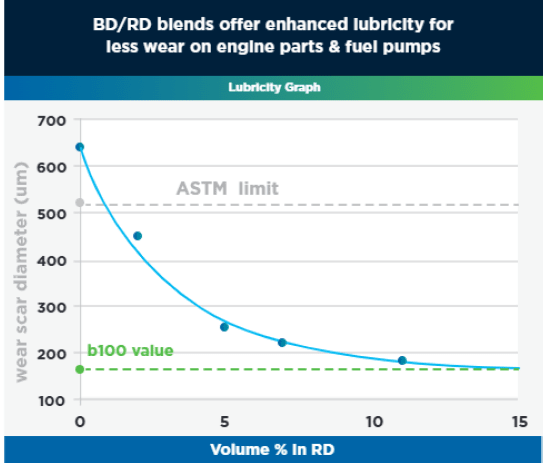
Lubricity improvement in RD/biodiesel.
Cold-weather operation also deserves attention. While renewable diesel performs well in most climates and offers excellent cold-flow characteristics, NACFE says additional validation is still needed for sustained operation in extreme Arctic conditions below approximately minus 20 degrees Celsius. Fleets operating in severe winter environments should continue following established winterization practices.
The report also points out that selective catalytic reduction (SCR) systems still require sufficient exhaust temperatures to function properly. Aggressive idle-reduction strategies can lower exhaust temperatures below the level needed for efficient NOx reduction, limiting aftertreatment performance regardless of fuel type.
A Practical Step Toward Lower-Carbon Freight
Perhaps renewable diesel’s greatest advantage is that it asks very little of fleets.
Unlike battery-electric trucks that require charging infrastructure or hydrogen vehicles that depend on new fueling systems, renewable diesel integrates seamlessly into existing operations using the same trucks, storage tanks, fueling equipment and technician training already in place.
That combination of operational familiarity and measurable emissions benefits makes renewable diesel one of the most immediately deployable technologies available to fleets navigating NACFE’s Messy Middle.
For fleet managers looking to reduce carbon emissions without sacrificing uptime or making significant infrastructure investments, renewable diesel may represent the industry’s most practical bridge between today’s diesel-powered operations and tomorrow’s increasingly diverse mix of propulsion technologies.
Credit: Source link