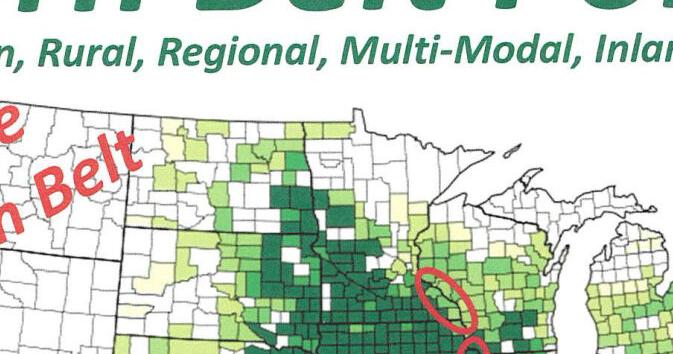
Just six years ago, there was no federally recognized port system between St. Paul, Minnesota, and St. Louis, Missouri. Likewise between St. Louis and Chicago.
That has since changed with over 51 counties along the Mississippi River signing on to form the Cornbelt Ports Authority.
“It has been an unqualified success,” Sinkler said.
Burlington was host last week to the Mid-America Ports Commission annual meeting.
Bob Sinkler, Corn Belt Ports’ executive director, said before 2019 the Mississippi River corridor had no national recognition for the value the waterway adds to the gross domestic product of the United States.
The recognition paved the way for $2 billion in additional transportation and natural infrastructure investment starting in 2021. The investments assist in reducing transportation costs and risk to the farmers who rely on the waterway system to get their products to market.
“It has made us more competitive for federal dollars,” Sinkler added.
The designation has attracted grants from the National Science Foundation and the Environmental Protection Agency, and an increase in the amount of investment in the Upper Mississippi River lock and dam system from the Army Corps of Engineers.
One of the organizations projects has also been the expansion of broadband connectivity in the port region, Sinkler said.
The Corn Belt Ports region, which includes ports in Iowa, Illinois, Missouri, Wisconsin and Minnesota, contributes approximately $100 million in freight tonnage of agricultural products that eventually meet global markets.
The annual meeting of the Mid-America Port Commission, of which the Corn Belt Ports is a part of, was an opportunity for commission and ports board members, and staff to meet with federal agencies, economic developers and one another to share best practices and emerging issues of interest.
Followed by a welcome from Burlington Mayor Jon Billups, and opening remarks from Doug Aeilts, vice-chair of Mid-America Ports Commission, and Amy O’Brien, president and CEO of the Greater Burlington Partnership, attendees learned about economic development resources, and federal updates from the U.S. Army Corps of Engineers and the Department of Transportation.
The Corn Belt Ports is the Navigation and Ecosystem Program enabler that interfaces with local riverfront counties, cities and communities, and is a catalyst for congressional community project funding at the local, riverfront community level.
NESP is a long-term, dual-purpose program that integrates navigation improvements and ecosystem restoration together to provide Upper Mississippi River System once in a generation-type positive impacts.
The primary goals of the program are to increase the capacity and improve the reliability of the inland navigation system while restoring, protecting and enhancing the environment.
Locally, Mike Norris, executive director of the Southeast Iowa Regional Planning Commission, serves as the executive director of the Southeast Iowa Regional Economic and Port Authority, the only port authority in the state of Iowa.
The Iowa legislature enabled port authorities in Iowa in 2005 and Lee County, the city of Fort Madison and Keokuk, approved resolutions creating SIREPA in 2006.
Credit: Source link