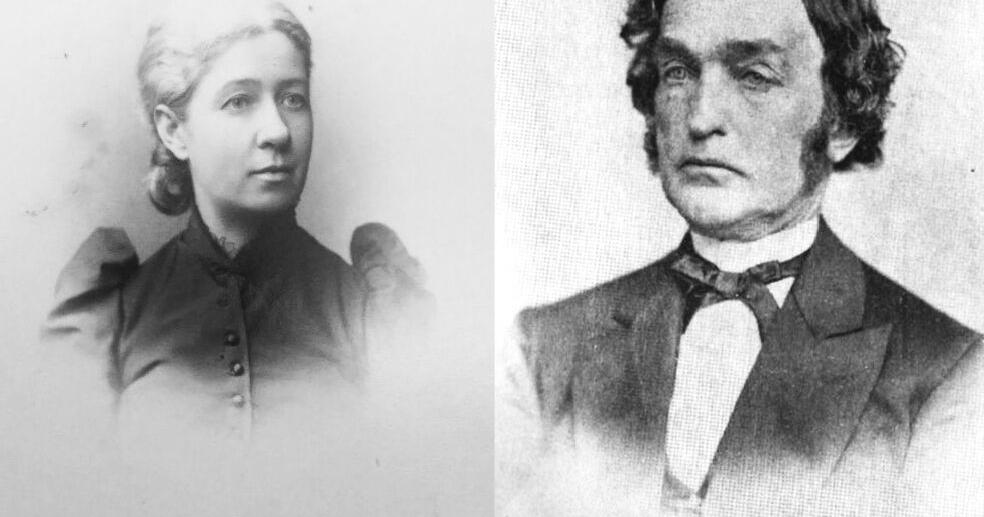
Charles Mears was a Michigan lumber businessman, Senator, a Chicago capitalist, and a developer of the western part of Michigan. To some he was known as the “Christopher Columbus of the West Coast.”
Charles was the second of five children born to Nathan Mears (1775-1828) and Lucy Livingston (1788-1827) on 16 March 1814 in Billerica, Massachusetts. His siblings included Edwin (1812-1863), Nathan (1815-1896), Lucy Ann (1818-1897), and Elbert (aka Albert) (1821-1901).
Mears and his siblings were left orphans very early in their lives by the death of their mother in January 1827 and their father in June 1828. Guardians were appointed to take care of the Mears children. Charles Mears went to country schools for his basic education, and then went to trade school in Lowell, Massachusetts to learn the cabinet trade.
In September 1836 Mears’ sister married and the brothers felt they were no longer obligated to stay in Massachusetts so they decided to move to the newly opened western territory of Michigan. Mears and his brothers went to Paw Paw, Michigan where they started a general merchandise business which they called E. & C. Mears & Co.
In 1837, Charles, Edwin, and younger brother Albert along with Charles Herrick and Benjamin True left Paw Paw with plans to survey the coastal inlets as they traveled north to Manistee. Two weeks after leaving Paw Paw, they decided to build a sawmill where the Silver Creek met the White River. By 1838 a mill was operating there cutting timber.
Within the next 25 years, Charles Mears would purchase about 40,000 acres of land in Michigan, construct and operate 15 mills, and build five harbors along the west coast of Michigan for the transport of his lumber.
They came to White Lake in late 1837 where they build a sawmill on the south side of White Lake. It was the first waterpower sawmill. The site technically belonged to the Federal Government at the time he was working there. The land did not get surveyed and become available for sale until 1840. As soon as it was available, Mears bought 200 acres for $1.25 per acre.
In 1845 Charles Mears purchased land at the outlet of Duck Lake through a tax abatement sale. Having paid the taxes of the previous land holder, he built a mill. The mill settlement included a warehouse, store, blacksmith shop, boarding house and several cabins. A fire in 1859 destroyed much of the settlement but it was quickly rebuilt. The last time the mill property caught fire was in December 1893, which burned the mill, lumber, the dock and trainway. There was no insurance to cover the loss. It was probably caused by tramps or hunters. This time it was not rebuilt. Ownership of the property remained with the Mears family.
Also in 1845 Charles Mears made his way to Mason County and found most of the land around Pere Marquette Lake had been purchased. However, the lands north were still available so he purchased as much property as he could around Lincoln Lake and Hamlin Lake.
In 1847 Charles Mears built a mill at Black Creek, calling it Little Sable and later known as Lincoln (near modern day Lincoln Hills Golf Club on Lincoln Lake in Hamlin Township). A log house and blacksmith shop were built first. Mears changed the name to Lincoln in 1861 after Abraham Lincoln was inaugurated as President. In 1856 he built a settlement at the mouth of Big Sable Lake and called it Big Sable. It was later changed to Hamlin – named after Lincoln’s Vice President Hannibal Hamlin. In March 1855 Charles Mears was appointed Postmaster at Little Sable in Mason County.
In June 1854, Mears sold the White Lake mill to John P. Brown and Ziba Grist for $6,000, and a cash payment of $850. In February 1860, Brown decided to leave and area and gave Mears a quit-claim deed for the mill site as well as various parcels of land in the area. Mears then sold the mill to Alexander M. Thompson in 1863. It was bought and sold a number of other times over the years. The waterfall that powered the mill remains to this day.
Mears built a sawmill on the north bank of Pentwater Lake in 1855. He also built a store and boarding house for his mill employees. In addition, he dug a wider, more direct channel for the Pentwater Lake outflow as the channel wandered through the sand dunes. While digging he discovered a deposit of clay, so he diversified his business interests and built a tile and brick factory.
In 1858 Mears had a ferry service across the channel. He also built a 660-foot pier out into Lake Michigan from the north bank of the channel so that large boats on the Lake could haul lumber to his yards in Chicago and drop off cargo for the village. Mears called this site Middlesex. This area was absorbed into Pentwater when the village was formed in 1867. In 1920, Carrie deeded 600 feet of the beach north of the channel to the State of Michigan as the beginning of the present-day Charles Mears State Park.
In 1856 Mears had purchased an additional 810 acres at the outlet of White Lake. A year later, Charles Mears and Giles B. Slocum began platting the village of Whitehall, originally named “Mears”. In 1862 the name changed to Whitehall. It was incorporated as the Village of Whitehall in 1867 and later incorporated as a city in 1943.
Mears was elected a Michigan Senator in 1863 and served one term. One of his first actions was to move the Mason County seat to his town, Black Creek (later Lincoln), a town near Ludington. The Mason County courthouse was also moved to Lincoln. He also worked hard on important bills about rivers, harbors and swampland. These bills were approved by voters and passed.
Mears built many boarding houses for his workers, as did other lumbermen. The difference was that other lumbermen tended to build crude structures strictly for the mill hands. Mears’s mills were built close to Lake Michigan and saw a fair amount of traffic pass by. Thus, Mears opened his boarding houses to the general public. To attract the public, the boarding houses were of higher quality construction.
One such house was the Silver Lake Boarding House which was built in 1866 at the outlet of Silver Lake near Mears. It is a two-story rectangular structure 70 feet by 28 feet with a one-story kitchen wing 25 feet by 25 feet. The exterior is covered in clapboard and the roof is asphalt shingles. The windows are two-over-two double hung.
The interior walls are lath and plaster, and the floors are wood. There are four rooms on the main floor, two of which are large public spaces – one sitting room and the other a dining room. The two smaller rooms were used by the innkeeper. The upper floor contained one large bunkroom for use by the mill hands and six smaller bedrooms for travelers.
After the lumber trade declined his former mill foreman served as innkeeper. When Mears died his daughter Carrie became the owner. She closed the boarding house but retained ownership until her death in 1957. Her will indicated she wanted the house and property to go to the State of Michigan. Part of it became Mears State Park and part was added to Silver Lake State Park. Other portions were sold off. The boarding house was renovated and is part of “The Family Place”, a private membership club.
In 1871, Mears built a home in Michigan. He called it “The White House” as it was between Whitehall and Ludington on the shore road. It was during this time that he had a housekeeper. Her name was Caroline (ne Robinson) Middleton, the widow of Captain Willliam Arthur Middleton. She had two daughters, Caroline Adelia (1851-1894) and Ellen Jane (1856-1913). Mears cared for the family after the captain’s death.
Charles Mears, along with Samuel Odell, purchased land and platted the town of Mears in 1873. It started as a settlement around a sawmill and a junction point on the Chicago & West Michigan Railroad, with a branch line extending to Hart. The town grew as a shipping point for lumber and later for agricultural products like fruit, especially apples. The community thrived due to the lumber industry, with mills, a boarding house, and other businesses established by Mears and others.
In late 1873, 59-year-old Charles Mears fell in love with 23-year-old Caroline Middleton and they were married in Pentwater on 20 January 1874. At the time, Charles was living in Lincoln, Mason County, and Caroline in Silver Lake. His occupation was listed as merchant and manufacturer. The Rev. Leroy Warren officiated at their marriage, and their witnesses were John B. Westendorf of Whitehall and Fanny L. W. Warren of Pentwater.
Records indicate that Charles and Carrie had four children during their marriage: Two died as infants in 1875 and 1877 respectively (one being a boy). They also had two daughters: Carrie Ellen (1880-1957) and Lucy Livingston (1883-1897).
Mears retired from lumbering in 1883. The family moved to Chicago. Mears’ wife Carrie died in Chicago on 21 June 1894 at the age of 43. Charles Mears died there on 23 May 1895 at the age of 91. When he died, he left his estate to his two daughters. At the time, Carrie was 15 years old, and her sister Lucy was 12. Unfortunately, Lucy died on 13 November 1897 leaving Carrie the sole survivor of her father’s estate.
Mears’ estate included Chicago real estate, Michigan pine lands, general stores, and stocks and bonds. There was also real estate in Mason and Oceana counties and in Mear’s addition to Pentwater.
Carrie had been educated in private schools in Chicago. She was trained by her father in business from the time she was ten years old. At the time of his death, she was already well aware of her responsibilities of managing his fortune which was estimated to be $1,000,000 in that day.
Records indicate that Carrie lived with her mother’s sister, Ella Jane Middleton, and a couple of servants in Chicago, until her death in Pentwater on 16 October 1913. Ella was returned to Chicago where she was buried in the Mears family plot in Rosehill Cemetery and Mausoleum.
Carrie devoted her life to the management of her father’s estate which consisted mostly of vast property holdings in Western Michigan and Chicago. Through the years she disposed of much of her Michigan property. Some of it was given to the State of Michigan for public use and the creation of Charles Mears State Park.
While the Mears family home was in Chicago, they returned to Michigan every summer maintaining a home in Pentwater. For approximately 50 years, Carrie made Pentwater her year-round home, going to Evanston, Illinois for the winter months.
In 1920 Carrie donated 25 acres on the east side of Silver Lake for a park. In 1926, the federal government transferred 900 acres of land to the state which then became Sand Dune State Park in 1949. The two merged in 1951 to become the current Silver Lake State Park.
Although the mill was long gone, Carrie had retained ownership of the Duck Lake property until 1921 when it was sold to a Chicago area Boy Scout troop and it became known as Camp Wabaningo. Later a Grand Rapids Boy Scout troop purchased some of the property which became Camp Shawondossee. The two groups maintained their separate camps until 1970 when they became part of Duck Lake State Park.
Carrie had saved all her father’s papers, books and diaries, and published a book entitled “Charles Mears – Pioneer of the White Lake Area”. All the Chicago-related items are at the Chicago History Museum, and all the Michigan-related items are at the University of Michigan.
Carrie Mears died in Pentwater on 13 August 1957 at the age of 77. She is buried in the family plot in Rosehill Cemetery and Mausoleum in Chicago.
Credit: Source link