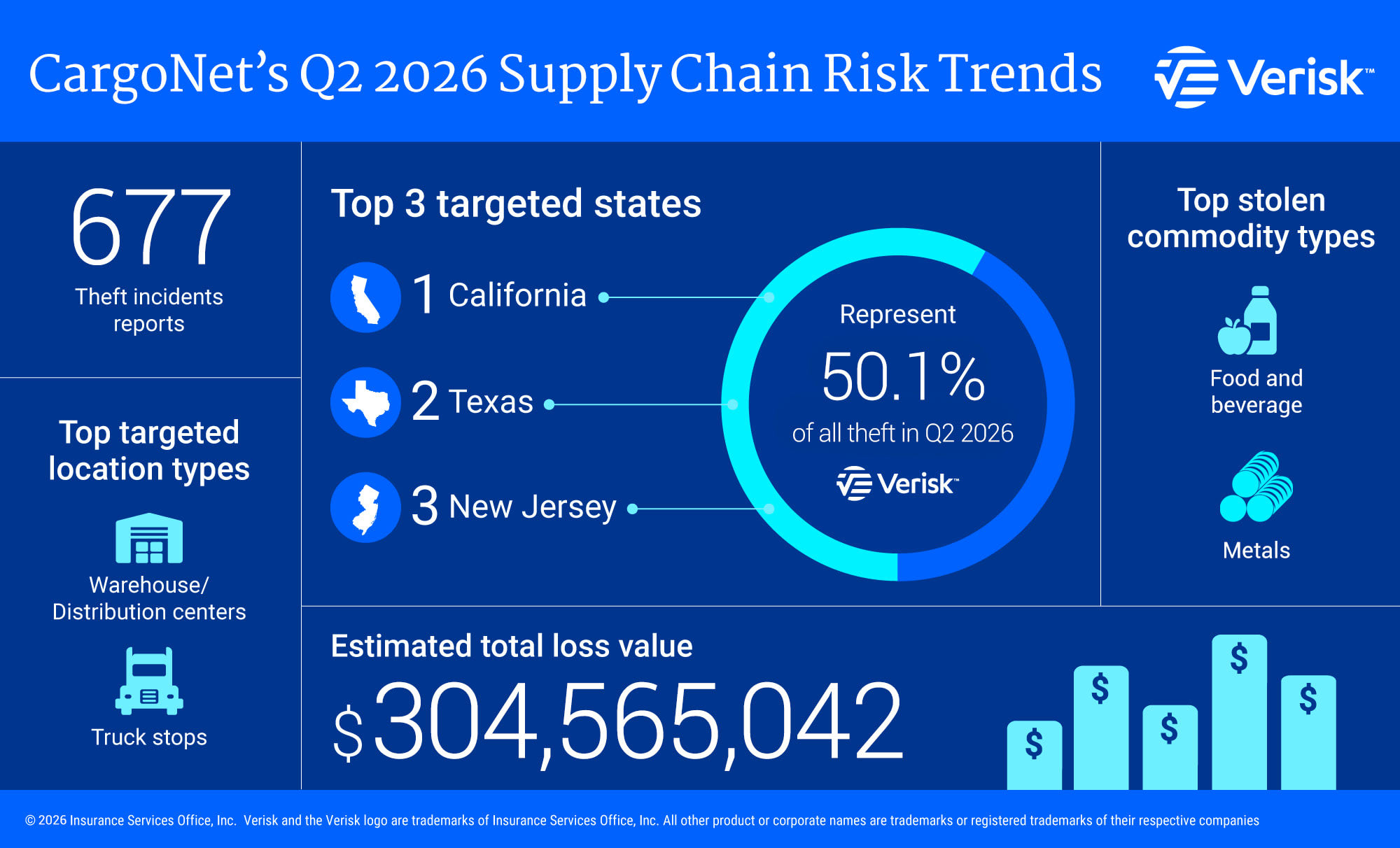
Although the number of cargo theft incidents fell in the second quarter of 2026, organized thieves increasingly targeted higher-value freight, driving estimated losses to more than $304 million, according to new data from Verisk CargoNet.
CargoNet documented 677 cargo theft incidents in the U.S. and Canada during the quarter, down 26% from the same period in 2025 and 14% from the first quarter of 2026. However, estimated losses climbed to $304.6 million, more than double the $135.7 million reported a year earlier.
“The groups driving the largest losses are not necessarily trying to steal more freight; they are trying to identify the right shipment,” said Keith Lewis, vice president of operations at Verisk CargoNet. “Their focus on metals and enterprise technology shows how closely organized cargo theft now follows value, demand and resale opportunity.”
Cargo Theft Tactics are Shifting
One notable improvement was a drop in the number of thefts using schemes in which criminals acquire existing motor carriers, book loads under the carrier’s authority, then disappear with the freight.
Organized thefts of unattended trailers and containers also decreased, particularly in California, Texas, South Florida and the Dallas-Fort Worth area.
However, more sophisticated fraud involving business email compromise and shipment misdirection remained steady.
The report suggests organized theft rings are relying less on stealing unattended equipment and more on infiltrating companies’ communication systems to identify and redirect valuable shipments.
High-Value Freight Theft Drives Higher Losses
The increase in losses was driven by several multimillion-dollar thefts involving industrial metals and technology products.
Metal thefts rose from 54 incidents in the second quarter of 2025 to 80 this year. Copper remained the most frequently stolen metal, while thefts involving aluminum, nickel, tungsten, and other specialty metals also increased.
CargoNet also reported continued thefts of enterprise computer equipment, networking hardware, and cryptocurrency mining equipment. These shipments often move as ordinary dry freight despite being worth several million dollars.
Food and beverage thefts declined overall, although seafood thefts increased. CargoNet also reported fewer thefts involving auto parts, tires, dietary supplements and over-the-counter medications.
Cybersecurity’s Role in Cargo Theft
Business email compromise continued to play a central role in many of the quarter’s largest thefts, underscoring the ongoing challenge of cybersecurity in cargo theft.
According to CargoNet, criminals who gain access to a company’s email or transportation management systems can monitor shipment information, impersonate employees or business partners, and redirect loads without raising immediate suspicion.
The company said organized theft groups increasingly use a single compromised account to gain access to multiple parts of the shipping process, allowing them to identify and target high-value freight more effectively.
Bottom Line for Fleets
While overall cargo theft activity declined during the quarter, CargoNet said fleets, brokers and shippers should not interpret that as lower risk. Instead, cargo thieves appear to be focusing on fewer, more valuable shipments and relying on cyber-enabled fraud rather than traditional theft techniques.
Credit: Source link