BeyondTrucks says its new RateAgents can turn plain-language rate logic into working code, starting with fuel surcharges — a critical but notoriously complex piece of carrier revenue.
BeyondTrucks is rolling out a new generative AI capability aimed at tackling one of the most persistent pain points in trucking operations: managing complex rate tables.
RateAgents is a new set of AI-powered tools that lets carriers build and manage rate logic with plain language instead of custom code or spreadsheets.
The first application focuses on fuel surcharges. This is a foundational but highly variable component of carrier pricing that can account for a significant share of revenue.
Fuel Surcharges: Critical, Complex, and Costly
Fuel surcharges exist to stabilize relationships between shippers and carriers when diesel prices fluctuate, ensuring freight keeps moving even as fuel costs rise.
“They came up with a mechanism to say, ‘We don’t want fuel price volatility to disrupt our relationship,’” BeyondTrucks CEO Hans Galland said in an interview with HDT.
In practice, that mechanism is anything but simple.
Carriers often operate under contract rates that remain fixed for months or longer. Fuel surcharges are layered on top, using formulas tied to fuel price indexes, regional averages, or custom calculations negotiated with each shipper.
Galland said those surcharges can represent 15% to 20% of a carrier’s revenue, making accuracy critical.
But each customer may define fuel surcharge calculations differently. Fleets use unique formulas, geographic indexes, or timing rules. And this creates a patchwork of rate logic that fleets must manage simultaneously.
“It’s a mess, it’s spaghetti,” Galland said, describing the variability across customers.
Why Traditional TMS Falls Short
Transportation management systems (TMS) have long attempted to handle rate calculations, but Galland said they rarely cover every scenario.
As a result, fleets often rely on spreadsheets, manual processes, or expensive custom development work to fill the gaps.
“You very soon come to a point where you need an engineer to code it,” Galland said.
That creates both cost and risk. Billing teams may process hundreds of loads per day, increasing the likelihood of small errors that can add up financially — especially given the size of fuel surcharge revenue.
“A significant amount of these calculations get done in Excel,” he added, noting that manual processes remain common across the industry.
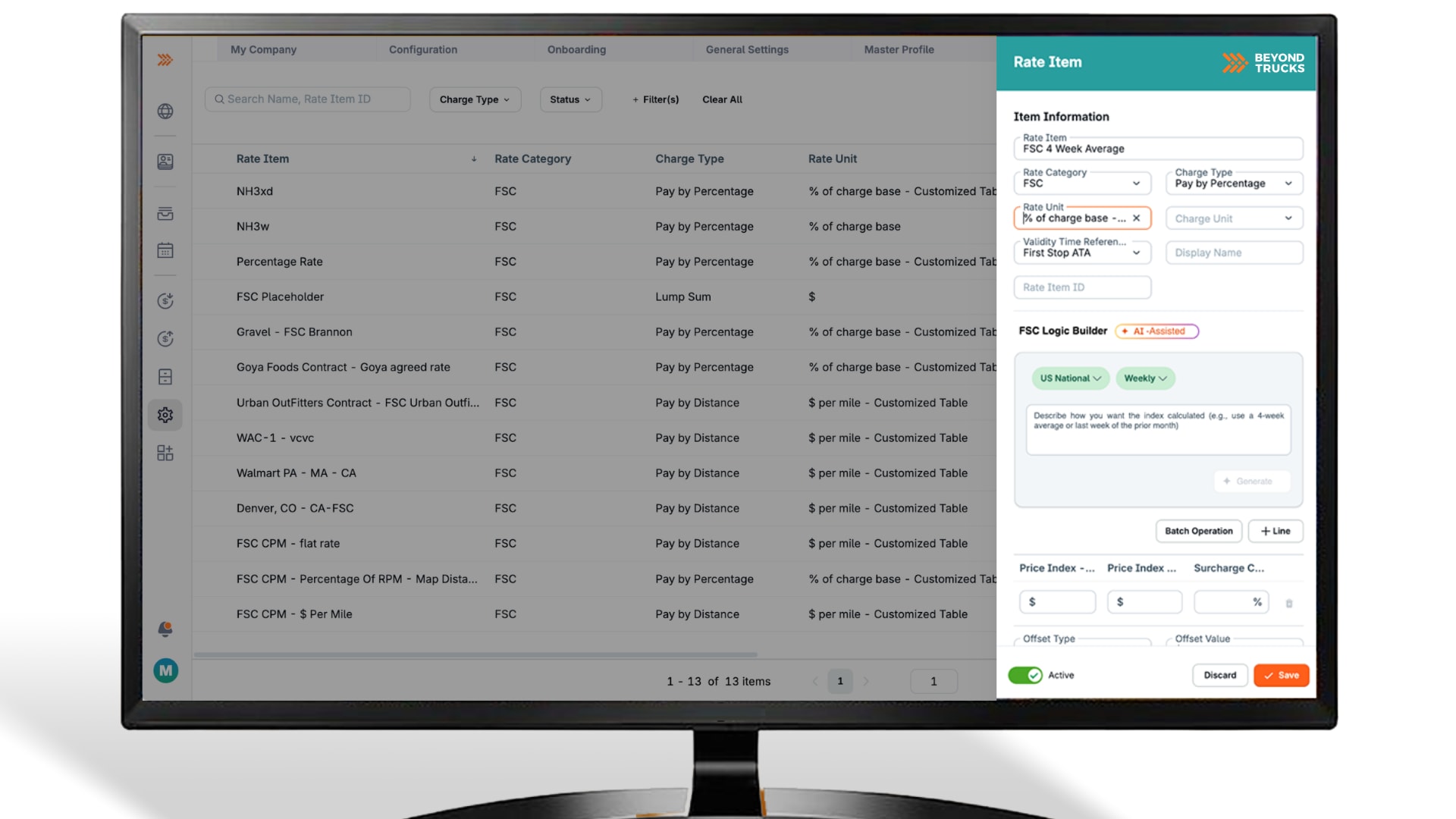
BeyondTrucks says RateAgents addresses that gap by using large language models (LLMs) to translate natural-language descriptions of rate logic into working software inside its platform.
Instead of writing code, a user can describe a formula — such as calculating a moving average of regional fuel prices — and the system generates, tests, and deploys the logic automatically.
The company describes the tool as a “coding agent” embedded directly in its TMS, allowing non-technical users to build and modify rate tables without engineering support.
The initial release focuses on fuel surcharges, where variability is especially high.
“Virtually every fleet customer calculates fuel surcharges differently,” the company said in its announcement, noting that no traditional system has been able to fully standardize those permutations.
A Shift in Who Controls the Logic
BeyondTrucks positions RateAgents as part of a broader shift in enterprise software — moving technical capabilities closer to operations teams.
“This puts power directly in the hands of the operators themselves,” Galland said, contrasting the approach with legacy systems that rely on custom engineering services.
The company also frames the technology as potentially disruptive to long-established TMS providers, which have historically monetized custom rate logic and built barriers around proprietary systems.
By automating code generation, RateAgents could reduce both the cost and time required to support complex customer-specific pricing.
RateAgents is the first in a planned series of AI tools from BeyondTrucks, which focuses on dispatch planning and operational management for complex fleets.
Galland said generative AI represents a fundamental shift in what enterprise software can do. This is particularly true, he said, in areas like rate management, where variability has long limited automation.
“LLM-powered coding agents are fundamentally changing what’s possible,” he said.
For fleets, the immediate value may be less about automation hype and more about reducing administrative burden, minimizing billing errors, and protecting margins tied to fuel costs.
And with diesel prices remaining volatile, that’s a problem unlikely to go away anytime soon.
Credit: Source link