Corporate mergers are a lot like marriages. I’ve seen plenty of both in the trucking industry over the past 30 years, and from the outside, it’s not always easy to know how well things are really going behind the scenes.
For every merger that fulfills its promise, there’s another where the cultures never quite mesh and the two sides struggle to find common ground.
That doesn’t appear to be the case with ZF and Wabco.
Since ZF completed its acquisition of Wabco in 2020, the two companies seem to have settled into exactly the kind of partnership corporate executives always promise but don’t always achieve.
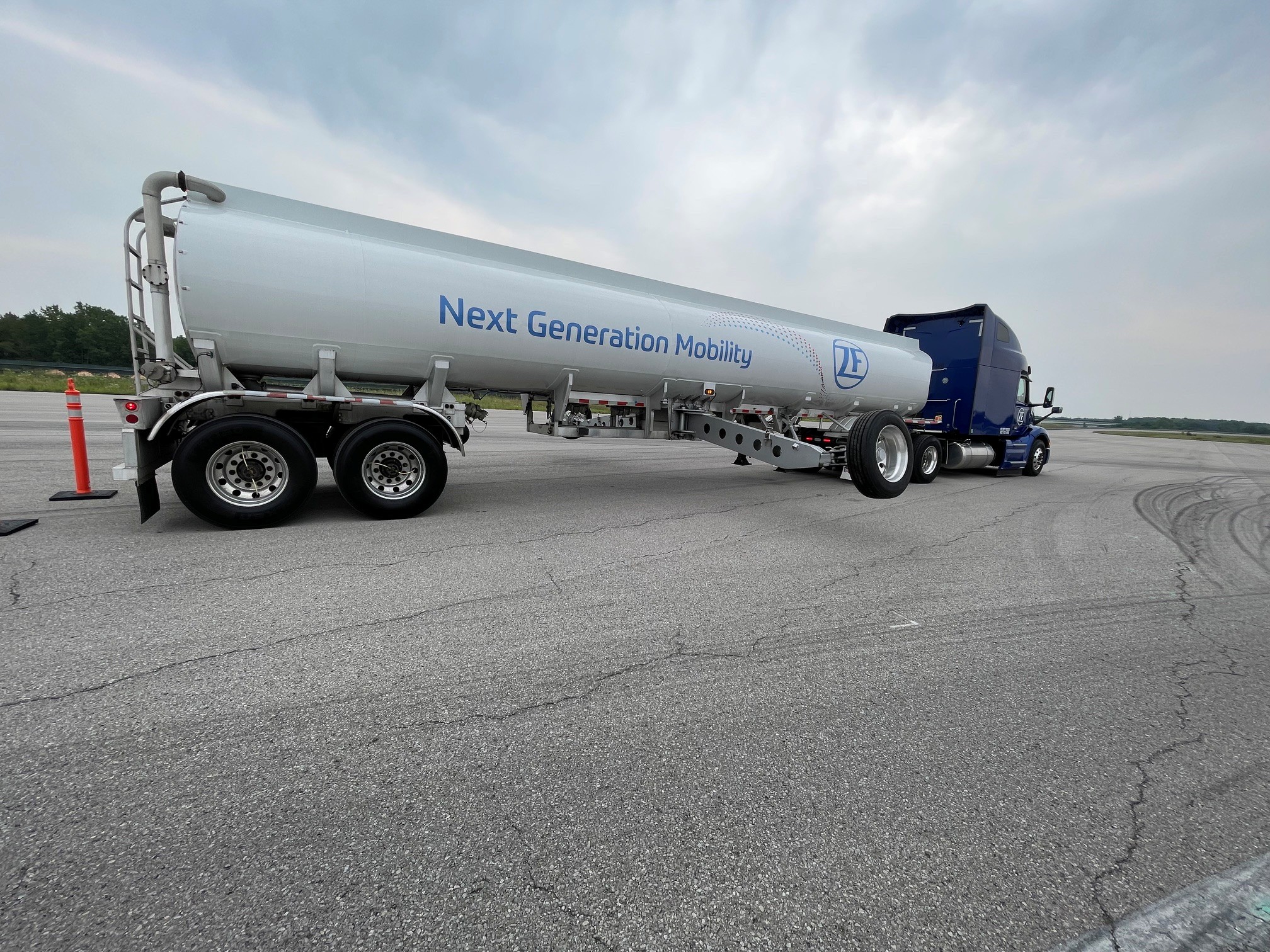
During ZF’s recent trailer technology demonstrations at the Transportation Research Center (TRC) near Marysville, Ohio, there was a genuine sense of enthusiasm from both longtime ZF employees and former Wabco veterans.
ZF executives seem proud to have Wabco’s reputation for trailer braking and safety technology firmly embedded within the company’s global commercial vehicle portfolio. That pride appears to be shared by longtime Wabco employees, who now have access to ZF’s extensive driveline, chassis and vehicle control technologies. And why not?
The two organizations share remarkably similar DNA, including European engineering traditions and cultures built around technological innovation, with solving engineering problems serving as a constant lodestar for both.
Wabco spent decades establishing itself as one of the industry’s premier trailer braking companies. ZF brought an equally impressive portfolio of driveline, chassis and vehicle control technologies along with a truly impressive global reach. Put the two together, and the result is something much larger than the sum of its parts.
At the Ohio ride-and-drive, ZF demonstrated that it isn’t simply developing better trailer components.
It’s designing and building what company officials describe as an intelligent trailer — one capable of improving braking performance, preventing rollovers, avoiding backing accidents, communicating electronically with the tractor and, increasingly, becoming an active partner in vehicle propulsion.
“Our focus is on complete vehicle systems,” explains Dirk Wohltmann, one of ZF’s senior engineering leaders. “Individual components can perform well, but they deliver their greatest value when they’re integrated into a complete system.”
Better braking starts now
Once the usual product overviews and safety briefings were out of the way, we headed onto the TRC track where the ZF demonstrations began with what seemed like a relatively simple comparison.
Since trailer ABS became mandatory in 1998, the minimum braking configuration has remained a two-sensor, one-modulator (2S/1M) system. It meets federal requirements and continues to serve fleets well. But according to ZF, considerably more capability is available today.
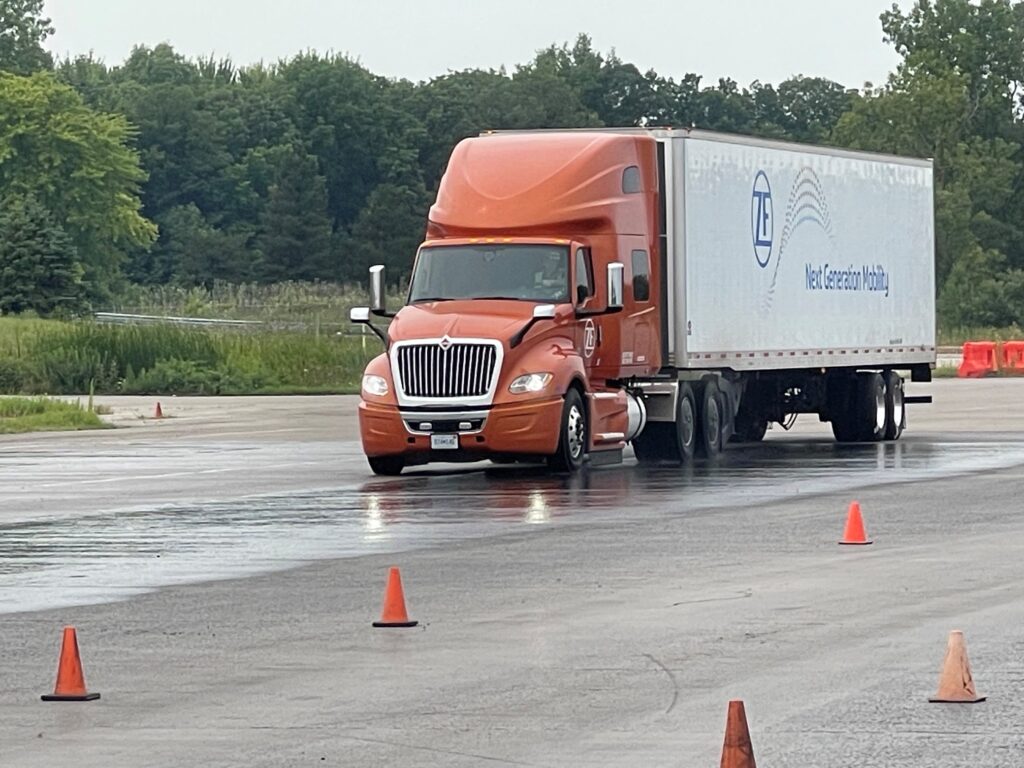
To demonstrate the difference, ZF engineers conducted identical split-friction braking exercises using two trailer configurations.
The first utilized the standard 2S/1M arrangement. The second upgraded the trailer to a four-sensor, two-modulator (4S/2M) system.
On paper, the difference sounds minor.
But Chuck Brodie, field team service leader for ZF, explained the advantage in straightforward terms: A conventional one-modulator system must control braking pressure for all four trailer wheel-ends together. Add a second modulator and the system can independently manage the left and right sides of the trailer to react to specific and unique dynamic inputs.
Put another way, the trailer no longer has to assume every wheel needs exactly the same braking effort at any given moment. Instead, it can respond independently to changing traction conditions on each side of the trailer.
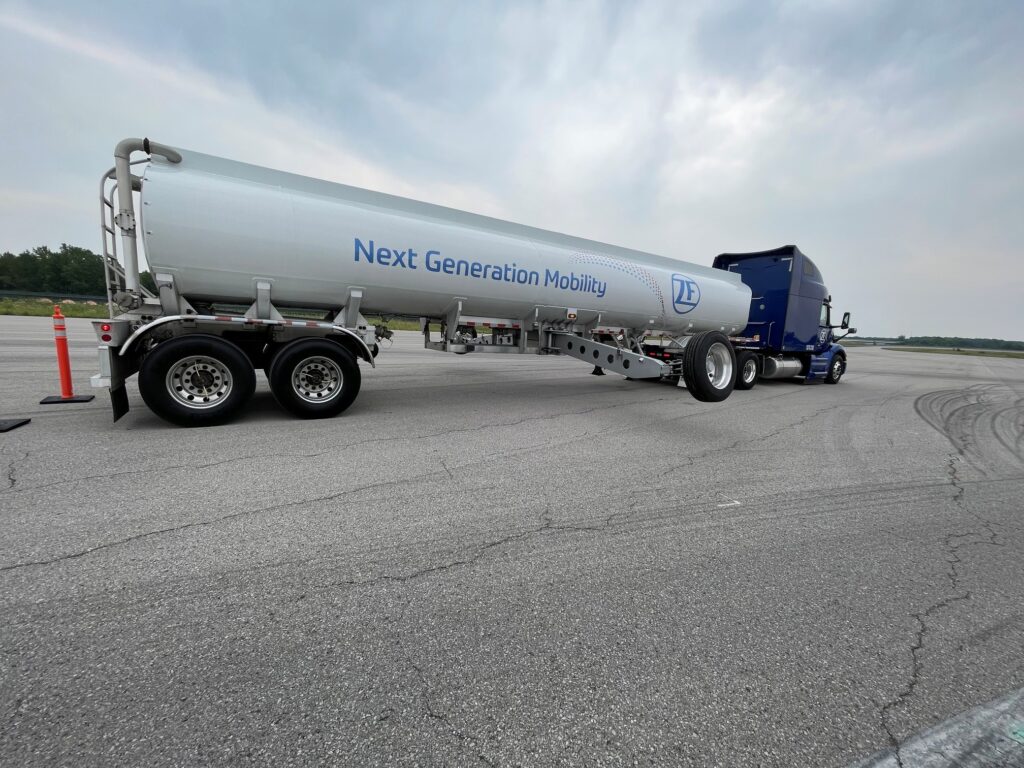
Watching the demonstrations, the upgraded system maintained noticeably better stability during the split-surface braking exercise. The truck — in this case an International RH pulling a loaded 53-ft. trailer — stopped more smoothly and in a noticeably shorter distance with the two-modulator system engaged, even though the trailer’s braking system was reacting to two dramatically different road surfaces at the same time.
It’s one of those improvements that’s difficult to appreciate from a specification sheet but immediately obvious once you see it performed back-to-back.
Toward smarter trailers
The day’s remaining demonstrations built on that same idea. Increasingly, ZF trailer technology isn’t simply reacting to the driver. It’s making decisions on its own.
ZF’s Roll Stability Support (RSS) continuously monitors wheel speed, trailer loading and lateral acceleration. If the system determines rollover conditions are developing, it automatically applies trailer braking without waiting for driver input.
For tankers, bulk haulers and other high-center-of-gravity applications, those fractions of a second can make the difference between a close call and a rollover.
ZF’s TailGuard applies the same safety philosophy while backing.
Using ultrasonic sensors mounted at the rear of the trailer, the system monitors objects behind the vehicle. Drivers receive increasingly urgent warnings as obstacles get closer. If no corrective action is taken and a collision becomes imminent, the trailer automatically applies its own brakes.
Anyone who has spent time around loading docks knows that backing incidents remain among the industry’s most common — and expensive — accidents.
Like RSS, TailGuard quietly works in the background until it’s needed.
Looking beyond today’s trailer
The demonstrations concluded with a look toward the next generation of electronic trailer control.
This, ultimately, is where ZF believes the future of trailer technology is headed.
ZF’s Integrated Electronic Braking System (iEBS) illustrates how electronically transmitted braking commands can reduce response times once the industry adopts improved tractor-trailer communication standards.
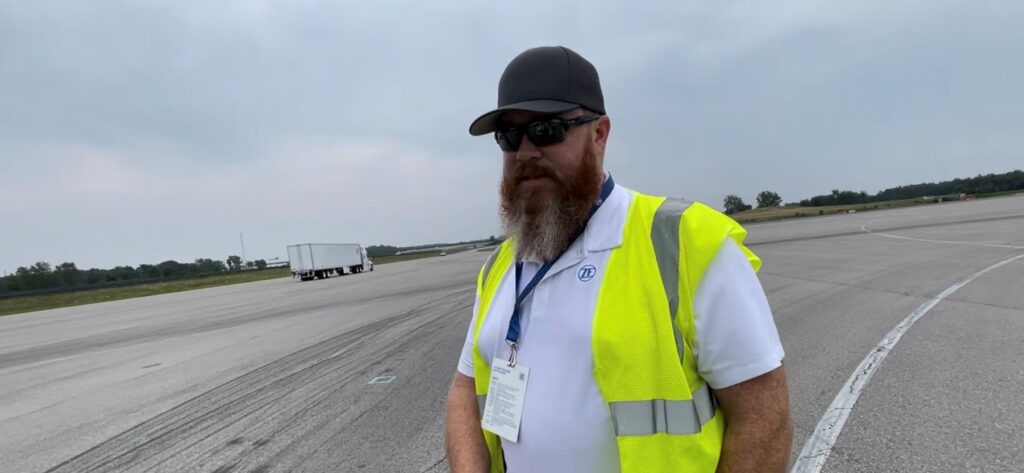
Wohltmann and Jason Paauwe, ZF’s head of trailer sales for North America, believe the technology itself is largely ready.
The limiting factor — as always — is the communication architecture connecting tractors and trailers.
As trailers become more sophisticated — with electronic braking, telematics, diagnostics and electrified axles — the decades-old communication standards between the tractor and trailer are approaching their practical limits.
ZF believes the industry needs to move toward a more capable electronic connection that will support future safety systems while maintaining compatibility across mixed fleets.
Which is one reason Paauwe repeatedly brought the discussion back to fleet operations.
The trucking industry has heard plenty of promises about autonomous vehicles, connected equipment and smart trailers. ZF is focused on delivering technologies that meet fleets where they operate today, Paauwe said. That means introducing technologies that can be implemented using today’s equipment.
“Our focus is delivering real-world solutions,” Paauwe said. “Technologies must improve safety and efficiency without requiring fleets to dramatically alter their operations or equipment specifications.”
Ultimately, he said, every new technology is judged by the same criteria fleet managers have always used. Did the freight arrive safely? Did the equipment remain operational? Did the fleet make money?
After spending a day at TRC watching these demonstrations, one conclusion was obvious: trailer technology has quietly become one of the fastest-moving areas of commercial vehicle development.
Whether the rest of the industry moves as quickly remains to be seen. But after watching ZF’s demonstrations first-hand, it’s clear the trailer is no longer simply something being pulled down the highway. Increasingly, it’s becoming an intelligent vehicle in its own right.
Credit: Source link