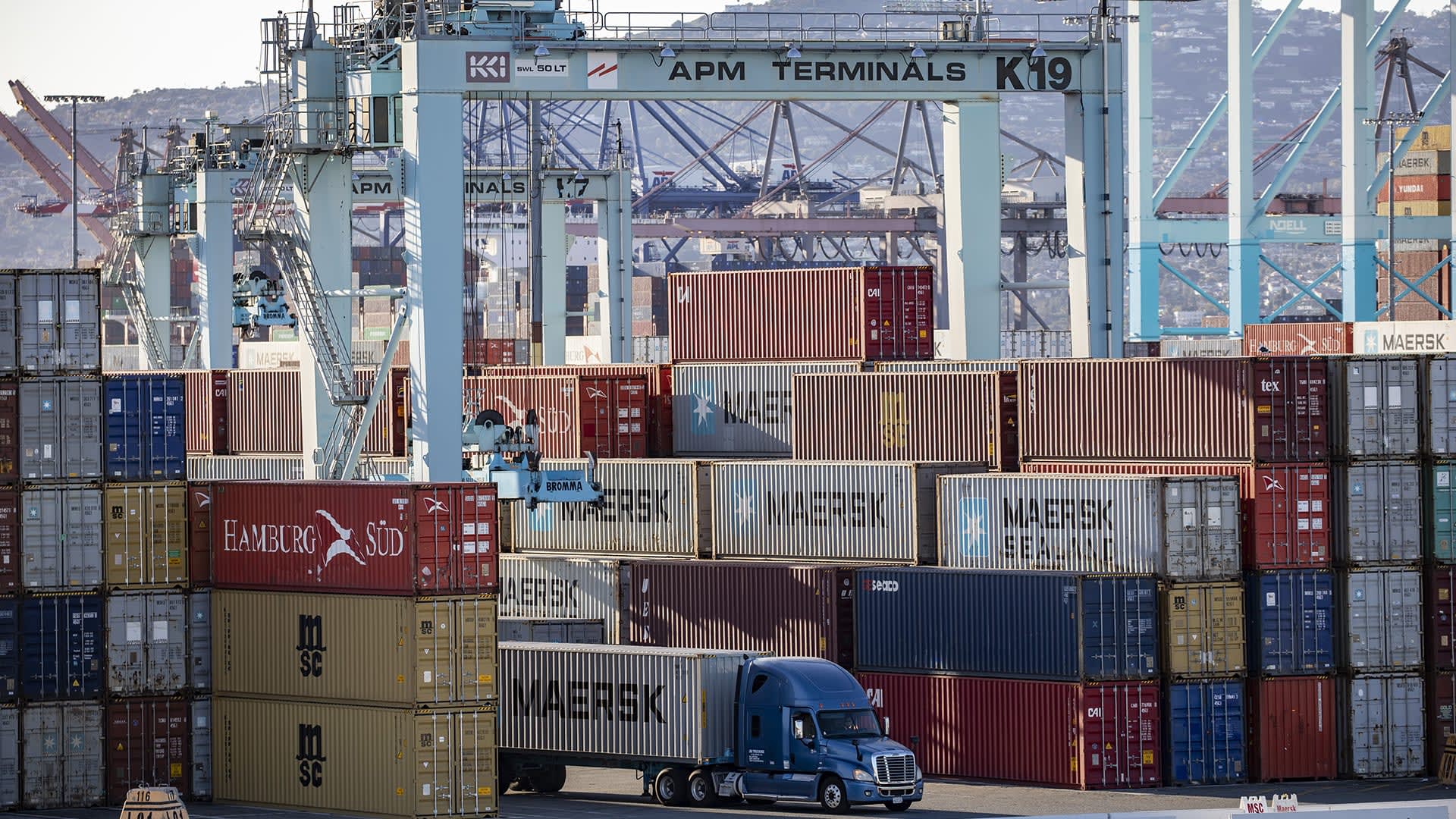
Import volumes at major U.S. container ports are expected to see a skewed year-over-year bump in June in anticipation of more tariffs and rising fuel prices, but then remain below last year’s levels into the fall, according to a new report.
The conflict in Iran continues to cause higher inflation and economic uncertainty, according to the Global Port Tracker report from the National Retail Federation and Hackett Associates, which is expected to lead to lower imports.
“We expect to see a year-over-year increase this month that’s partly driven by retailers bringing in merchandise early because of higher costs from tariffs or fuel prices that could come starting in August,” NRF Vice President for Supply Chain and Customs Policy Jonathan Gold said.
The year-over-year gain expected in June is partly due to comparisons with import levels that dropped sharply after President Donald Trump announced “Liberation Day” tariffs in April 2025.
But higher shipping costs and worries about additional tariffs imposed after those tariffs were ruled illegal by the Supreme Court are also a concern.
Importers Try to Get Ahead of Higher Costs
“We have increased our outlook for June cargo volume as retailers bring forward their peak season cargo to mitigate increasing shipping costs as carriers pass along the sharply rising cost of fuel and because of concerns about punitive replacement tariffs,” said Hackett Associates Founder Ben Hackett.
The current import surge will likely last into July, with an early peak season that resembles the more recent pattern of raised volume rather than a sharp peak, he added.
U.S. ports covered by Global Port Tracker handled 2.05 million Twenty-Foot Equivalent Units — one 20-foot container or its equivalent — in April, although the Port of New York and New Jersey has not yet reported its numbers.
Those April numbers were down 5.1% from March and down 7.3% year over year.
Ports have not yet reported May numbers, but Global Port Tracker projected the month at 2.14 million TEU. That’s up 9.7% from a year earlier, when imports were down sharply because of last year’s “Liberation Day” tariffs.
What the Cargo Import Forecast Looks Like
June is forecast at 2.25 million TEU, up 14.3%, with the increase also because of low imports a year earlier.
Forecasts through the summer into the fall:
- July: 2.19 million TEU, down 8.4% year over year
- August: 2.12 million TEU, down 8.6% year over year
- September: 2.06 million TEU, down 2.2% year over year.
- October: 2.08 million TEU, up 0.1% year over year.
Those numbers would bring the first half of 2026 to 12.6 million TEU, up 0.6% from the same period in 2025, thanks in part to the May-June increases.
What is the Global Port Tracker?
Global Port Tracker, which is produced for the National Retail Federation by Hackett Associates, provides historical data and forecasts for the U.S. ports of Los Angeles/Long Beach, Oakland, Seattle and Tacoma on the West Coast; New York/New Jersey, Port of Virginia, Charleston, Savannah, Port Everglades, Miami and Jacksonville on the East Coast, and Houston on the Gulf Coast.
Credit: Source link