
We have recently been made painfully aware of the rot that pervades the truck driver training industry. The Ontario Auditor General’s report on driver training and licensing would lead anyone to conclude that students emerging from certain schools are woefully undertrained.
The report indicated some schools provided half to two-thirds of the minimum training time required under mandatory entry-level training (MELT), while others had students sign off on instruction time they never received.
Evidence from the front lines of driver testing, Serco DriveTest Centers, bears this out.
A DriveTest examiner tells trucknews.com that students from many schools, including the type singled out in the AG report, routinely make multiple attempts at the Class A driving test before passing.
“My first-attempt pass rate for the Class A test is about 40%,” says Greg, an active Serco employee currently delivering Class A through Class F driving tests as well as G1-exit and G2-exit driver examinations in southern Ontario. “I’ve seen them come back four or five times before they are successful.”
Greg is a pseudonym. Trucknews.com is not disclosing his real name to protect him from possible retribution from his employer. Greg is well known to the author, and we have verified his employment status as an active Serco DriveTest examiner.
He has been conducting driver examinations for several years and previously worked as a longhaul driver.
Greg has a good idea of the skill set a driver should possess, but acknowledges the test is an “entry-level” test. He’s sympathetic to the pressure and stress the candidates are under during the test, but there’s much that many of them flat-out do not understand.
One of the dead giveaways, he says, is the air-brake portion of the vehicle inspection in the test.
“Students from a particular group of driving schools always arrive with their Z-endorsement [Ontario’s air brake endorsement] already completed. The schools have signing authority for the Z,” Greg says. “But about 70% of the time, they can’t answer the air brake-related inspection questions. Those questions mirror the questions from the Z endorsement, so anyone with an air brake endorsement should be able to answer them. It’s something they were supposed to have been taught in school. They obviously don’t know the material.”
Test questions are random, but standardized
The MTO Class A test consists of three parts: the daily vehicle inspection; coupling and uncoupling; and driving, which includes backing. The ministry gives the schools the guidelines for the test, so students know what they are up against before they start. The actual questions or scenarios the student will be tested on are randomly selected.
“MTO gives us a 212-page marking guide, which is the standard we have to follow,” Greg says. “We do the tests on tablets, so when we load the tests, the computer picks the questions.”
Greg is required to read a preamble to the student before the test begins, explaining how the test works and how they will be required to answer the test questions. The examiner has no latitude in how the question is asked, so there’s no opportunity to confuse or mislead the student.
The preamble goes like this:
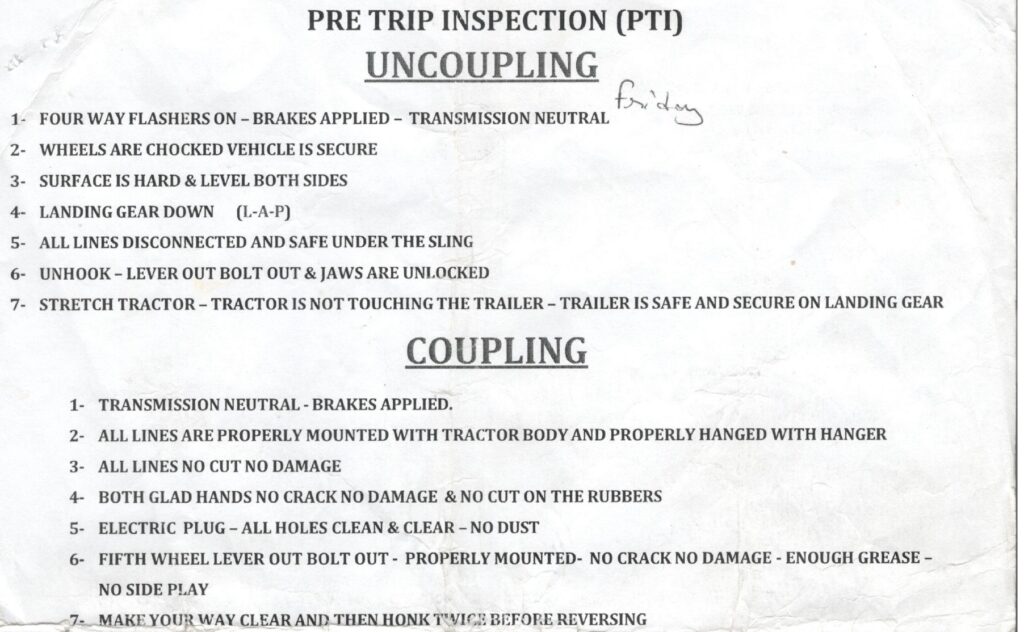
The daily inspection is the minimum check required under the law, as you will be required to inspect selected items only, we are testing your knowledge and skills in identifying prescribed defects and demonstrating the availability of the vehicle to drive. For the inspections, you will be required to, one, demonstrate and describe how you would inspect for each selected item. Two, demonstrate what the defect would be for each selected item. Three, identify the minor and major defects associated with that item, and four, determine whether the vehicle could be driven for each item.
The students are tested on one out of a possible 13 categories in the daily inspection portion, including the exterior of the tractor and the brakes, an in-cab portion, or the trailer.
Reciting the script
Typically, schools will book a block of tests at a test center for four or five candidates in a single day. The school will bring one truck for the test, and each driver gets a crack at it, usually with the same examiner.
Greg says the red flags go up when he hears the same answers, nearly verbatim — not even paraphrased — from each of the students in the group.
“It’s obvious the answers are scripted when every candidate answers the question with the exact same line,” he laments. “It’s easy to tell they are just reciting a line from a script, but if I get the correct answer, I have to accept it.”
While he’s not permitted to mark based on a follow-up question, he’ll often ask for clarification, such as identifying a certain component or explaining its function.
One of the questions requires the student to demonstrate and describe how they would inspect the frame of the truck and trailer.
“I have literally had guys raise the hood of the truck and sort of wave their hand over the engine compartment, saying the frame on the truck is good. Frame under the hood is good,” he says.
“But when I ask them to show me the frame. They wave their hand again, like a big fan, ‘frame under the hood is good,’ they repeat. They’ll identify things like the catwalk but won’t zero in on the frame. They’re learning the script that the school has given to them, but they don’t know the components. And the frame is one of the easiest ones. They tell me it’s good, but they don’t know what it is. That costs them a mark.”
Schedule 1
During the pre-trip inspection phase of the test, candidates carry a copy of the Trip Inspection Schedule 1, which identifies major and minor defects.
So, for example, Greg will say, ‘Demonstrate and describe how you would inspect your leaf springs and main spring leaf.’
To which the candidate would respond with something like, ‘Leaf spring is shifted or damaged or cracked or out of place. This is a minor defect. A major defect is the main leaf spring is cracked, broken, damaged, or shifted out of place.’
“They read that right off Schedule 1,” Greg notes. “But if I ask them to tell me which of the springs in the pack is the main leaf, they usually can’t do it. They just kind of look and point in that general direction. They don’t know what they’re looking at, and they don’t know what to look for, but they know what to say.”
Greg says examiners are told to encourage the students to use a paper print-out of the Schedule 1 list of defects, but they usually read over the sheet, first checking for crib notes.
Students are allowed one mistake on the trip inspection; if they have two, they’re done. They are allowed two errors on the uncoupling and coupling portion.
“Even if they are unsuccessful here, we still have to continue with the full test,” Greg notes.

Driving and backing
Candidates may get through the test’s inspection and uncoupling/coupling portion by adhering to a script, but take them out on the road and the safety net vanishes. They either can or cannot drive. Greg says among the group of schools we’re focusing on here, it’s generally the latter.
“You can tell they simply haven’t had enough time behind the wheel,” Greg observes. “They are not making the observations they should, they aren’t looking left, right, and left, right again at four-way stops. They’re not following their trailers through the corners or curves. They’re wandering on the road or making uncertain lane changes. It’s clear they are not at all comfortable behind the wheel.”
The Auditor General’s report called out the practice of schools shopping for testing sites with less challenging backing environments. Clearly, an offset backing maneuver is easier than a 90-degree alley docking maneuver. Guess which ones get the greater number of bookings from certain schools.
“The student gets 10 minutes to complete the maneuver. They can pull up as many times as they need. The first three pull-ups are free,” Greg points out. “After that, each one’s a mark, which is added to their driving mark. The threshold for a pass is 31 marks. Some of them burn a third of their marks on this one exercise.”
Greg compares the performance of those drivers with others from schools offering more comprehensive programs. The difference is night and day.
“We get to know a bit about the schools sending us their students; we know the type of training they offer,” he says. “The longer programs with more driving hours do a better job of getting their students prepared for the real world, not just the test.”
Closing thoughts
With the pass rate of about 40% at his DriveTest center last summer for students coming from Brampton and other Toronto-area schools, Greg acknowledges that English language skills could be a barrier.
“English is a hurdle for some students, but not all of them,” he says. “They understand when I ask them a question, but their response is directly from a script. If I tell them to stop and move on because they have already given me what I need to hear in the course of their answer, they almost always just keep on reciting the script. It’s like they do not understand what I’ve just said.”
The question of English language proficiency for commercial drivers is a sensitive topic, but at this level, Greg believes it could be holding some of the students back from passing.
“In a nutshell, I believe many of those schools are taking advantage of the students. They are teaching them a script to pass the test with no real knowledge of the safe operation of a transport,” Greg believes. “At the same time, MTO has created this perfect storm by allowing the creation of these schools without backstopping it with oversight of the school’s performance. That lack of oversight gives these schools the opportunity to scam the students and defraud the system.”
After several long conversations with Greg about how he sees the MTO testing process, he believes it’s fair, though not terribly stringent. It is, after all, an entry-level test.
It’s procedural rather than knowledge-based, it seems to me. Greg expressed a degree of frustration and certainty that his test candidates knew the ‘what’ but not the ‘why’. When it comes to marking, there’s no room for discretion or his personal thoughts.
“If they give me the correct answer to the question, I have to mark it as a pass,” he says, adding, “It’s often pretty clear they don’t understand what they are saying, they just respond as they are supposed to.”
This, of course, begs the question: Are students at certain schools actually learning something about the systems on the truck and how they work, or are they being taught to simply pass the test?
It is an entry-level test based on an entry-level instructional program, but where and when does the actual learning begin? Certainly not with many of the rag-tag carriers that will eventually employ these marginal drivers.
Greg says he has become familiar with the caliber of students he can expect from any of a few dozen driving schools. Students from some of the better schools have no difficulty getting through the test. They don’t just know the answer the examiner needs to hear; they understand the reasoning behind it.
Greg told me it’s obvious which students learn in a classroom setting compared to those who take an online course.
Amazingly, Ontario lacks a provincially-issued, standardized A/Z instructor certificate comparable to what exists in some western provinces.
Ontario requires only that the instructor hold the class of license they are teaching. Instructors teaching passenger car students in Ontario (Class G) must first take a driving instructor training course and do a criminal background check.
To see a stunning (but hilarious, really) example of an unqualified instructor, check out this YouTube video, and keep in mind, it has more than 50,000 views. That’s scary.
The Truck Training Schools Association of Ontario (TTSAO) plans to address this with a new Government of Ontario-approved commercial driving instructor program aimed at raising instructional standards across its member schools.
“I think this is one of the biggest oversights in Ontario’s MELT program,” Greg stresses. “How can there not be any criteria for instructors?”
Greg told me about MTO’s marking guidelines, a 212-page document that goes into exquisite detail on how to observe and judge a student’s competence.
But there is no room for examiner discretion in there — possibly for good reason, to reduce the chances of personal and systemic bias across the examiner pool. Consequently, if the student doesn’t execute exactly per MTO’s requirements, they do not succeed.
This revives memories of a story from highwaySTAR magazine from 2003.
Jim Rylance, then 72 years of age with 40 years and 4 million accident-free miles behind him, had failed an MTO driving test, which at the time was required annually of all commercial drivers beginning at age 65.
Rylance failed his ministry test that year because the 20-something-year-old examiner who had never worked as a truck driver didn’t recognize how he used his mirrors.
His driving skills were never in question. Rather, it was his unfamiliarity with the ministry examiner’s expectations that threatened his livelihood. That’s kind of the same thing that happens with rookie drivers, except in reverse. They may not know how to drive defensively, but if they do everything according to ministry protocol, they pass.
The fact that, according to Greg, it takes more than a few applicants four or five tries to pass the test should be indicative of some shortcoming in the training/testing chain. Simply finally passing the test tells us little about the applicant’s competency as a working commercial driver out on the roads, mixing it up with the public.
Since graduated licensing of commercial drivers isn’t practical, maybe newly licensed drivers should be retested after six months, using a more critical marking criteria than the basic entry-level test that Rylance and hundreds of other senior drivers didn’t pass all those years ago.
Damn the cost and the inconvenience. Where lives are at stake, we cannot be too careful.
Credit: Source link