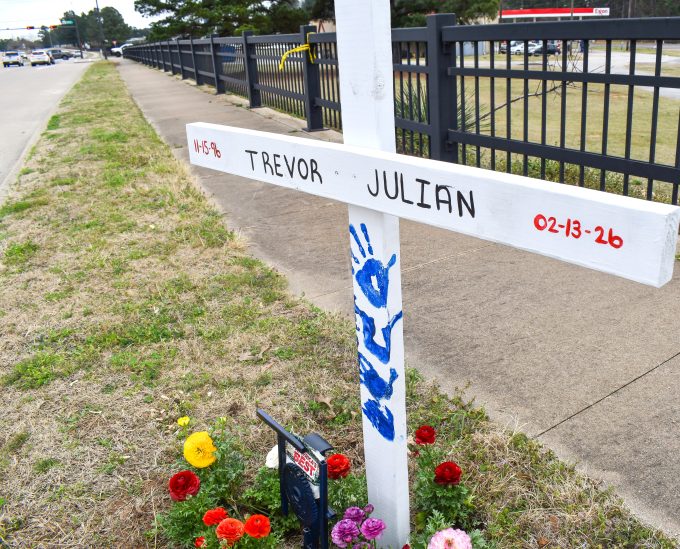
An East Texas man was killed and another is in jail after a Feb. 13 traffic altercation in Tyler turned deadly. As the investigation is ongoing, here’s a look at what to know so far about the case.
Key facts of the shooting
It was just after 5 p.m. on Feb. 13 on Grande Boulevard in Tyler when multiple people called 911 to report a shooting.
Tyler police spokesman Andy Erbaugh said preliminary investigation later that evening revealed a “road rage” incident had occurred, leaving one man dead.
Police said Trevor Julian, 29, of Whitehouse, was a passenger in a Tesla that was in front of a pickup as both vehicles were stopped at a red light on Grande at the intersection with Paluxy Drive. Erbaugh said the investigation determined Julian got out of the Tesla and approached the driver of the pickup, identified as Dayton Morgan, who was sitting inside the truck.
Morgan, 23, shot at Julian through his pickup’s driver’s side window. He fired first through the window, breaking the glass and striking Julian in the neck. He fired a second and final round in Julian’s chest. A man performed CPR until EMS arrived, but Julian was pronounced dead at a hospital.
The altercation
The altercation began after Morgan stopped his truck too close to the back of Julian’s Tesla at the Grande red light, according to an arrest warrant affidavit. Morgan was driving the pickup traveling east on Grande behind Julian and his family.
During an interview with investigators, Morgan said as both vehicles approached the
intersection of Paluxy and Grande, the light turned red and traffic began to slow to a stop. Morgan told police that’s when the Tesla came “to an abrupt stop,” and he claims he had to quickly slam on the brakes, “causing his pickup truck to come to a stop closer to the Tesla than he would like,” the document states.
Julian, who was a passenger in the Tesla driven by his wife with three children in the backseat, got out of the vehicle – unarmed – and approached Morgan in traffic. The two began yelling at each other back and forth, the affidavit states. Morgan, who was sitting in his truck, told police Julian was shouting for Morgan to back up his vehicle, while Morgan was shouting back to Julian for him to “move on.”
Morgan told police that Julian then walked to the front of his pickup and shouted at him through the windshield, pointing with his left hand. Morgan said he shouted to Julian, “What the (expletive) is your problem?” At that point, Julian reportedly walked to the front driver’s door of Morgan’s truck while the door was still half-way open.
As Julian was walking toward Morgan’s truck door, Morgan told police he opened his center console, grabbed a pistol, and wracked the slide to chamber a round, directing the pistol toward the driver’s door. According to Morgan’s account, Julian was then “standing at Morgan’s half-way open driver’s door” when Morgan shot him.
Self-defense? Police say no
When questioned, Morgan told police he wasn’t threatened by Julian, who was unarmed. Morgan did not see a weapon on Julian and said Julian did not have anything in his hands during the interaction, according to the affidavit. Morgan also told police Julian did not make any verbal threats of harm.
Blood outside Morgan’s truck was additional supportive evidence that Julian was outside it at the time of the shooting, investigators said.
Investigators ultimately determined Morgan did not have any reason to act in self-defense when he fatally shot Julian.
What does law say about ‘Stand Your Ground’
The state’s “Castle Doctrine” and “Stand Your Ground” laws serve different purposes and operate under distinct legal frameworks, according to Texas-based Sellars Trial Law firm.
The Castle Doctrine allows people to use force, including deadly force, to protect themselves against unlawful instructions into their legally occupied place – or “castle” – such as their home, vehicle or place of business. It presumes force was reasonable if someone unlawfully and forcefully enters or attempts to enter any of those three places.
Meanwhile, the “Stand Your Ground” principles go beyond that doctrine. If a person is lawfully present in any location and is not engaged in a crime, that individual is not legally required to retreat before using force if the person reasonably believes it is immediately necessary to protect his or herself.
“The word ‘reasonable’ is key here,” the Pullan Young law firm said. “It refers to what an ordinary person in your shoes would have believed under the same circumstances.”
Deadly force carries “a much higher legal bar,” the Pullan Young team said.
The Castle Doctrine applies only in specific locations whereas the Stand Your Ground law applies anywhere a person has a legal right to be, the Sellars team explained. The key: Both laws require a reasonable belief of imminent danger.
When force is justified
In subchapter C of Chapter 9 of the Texas Penal Code, a person is justified in using force against another when and to the degree the actor reasonably believes the force is immediately necessary to protect the actor against the other’s use or attempted use of unlawful force.
The actor’s belief the force was immediately necessary is presumed to be reasonable if the actor: 1) knew or had reason to believe the person against whom the force was used either a) unlawfully and with force entered, or was attempting to enter unlawfully and with force, the actor’s occupied habitation, vehicle, or place of business or employment or b) unlawfully and with force removed, or was attempting to remove unlawfully and with force, the actor from the actor’s habitation, vehicle, or place of business or employment; or c) was committing or attempting to commit aggravated kidnapping, murder, sexual assault, aggravated sexual assault, robbery, or aggravated robbery; and 2) did not provoke the person against whom the force was used; and 3) was not otherwise engaged in criminal activity, other than a Class C misdemeanor that is a violation of a law or ordinance regulating traffic at the time the force was used.
When force is not justified
The use of force against another is not justified: 1) in response to verbal provocation alone; 2) to resist an arrest or search that the actor knows is being made by a peace officer or person acting in a peace officer’s presence and at his/her direction, even though the arrest or search is unlawful, unless the resistance is justified; 3) if the actor consented to the exact force used or attempted by the other; 4) if the actor provoked the other’s use or attempted use of unlawful force, unless a) the actor abandons the encounter, or clearly communicates to the other his intent to do so reasonably believing he cannot safely abandon the encounter and b) the other nevertheless continues or attempts to use unlawful force against the actor; or 5) if the actor sought an explanation from or discussion with the other person concerning the actor’s differences with the other person while the actor was a) unlawfully carrying a weapon or b) possessing or transporting a weapon unlawfully.
Dashcam footage? Maybe
One of the vehicles involved in the incident was a Tesla, occupied by Julian and his family.
Most Teslas are equipped with dashcam, which records video footage of the vehicle’s surroundings while driving, according to tesla.com.
Dashcam video recordings are saved locally to a formatted USB flash drive’s onboard memory and are not sent to Tesla, according to the manufacturer’s website. Most models do not record videos when the dashcam is turned off.
Tesla’s website also states some vehicles may not be equipped with dashcam or the features may not operate exactly as described in the owner’s manual, depending on the market region, vehicle configuration, options purchased and software version.
It is not known whether or not Julian’s vehicle had this software installed and activated at the time of the shooting, but it is possible. If the incident was recorded and saved, it would be property of the owner of the vehicle.
The people involved
Julian, 29, was born Nov. 15, 1996, in Dallas and grew up in Carthage, where he graduated from Carthage High School in 2015. He was active in football and track and often made the honor roll, according to previous reporting by the Panola Watchman.
“He was competitive and strived to be the best,” according to his obituary published by Hawthorn Funeral home. He went on to become a sergeant in the U.S. Marine Corps, stationed at Camp Kinser in Okinawa, Japan, working as an automotive maintenance technician in 2017, according to online records.
His mother, Rebecca Lynn Chandler, said in an archived military video her son had a deep love for God and his country. He took on a lot of responsibilities and handled them well, she said. “I’m proud to be his mama,” she said in the video.
Most recently, Julian was working as a diesel mechanic for Midwest Logistics Systems (MLS). He “loved working on anything with a motor” and also enjoyed woodworking, his obituary says.
He was focused on being a family man with two children of his own and was adopting his wife’s two children.
In addition to his parents, wife and children, Julian is survived by two siblings, grandparents, cousins and other relatives and friends.
Morgan recently had a birthday on Feb. 7, turning 23. Police said he is from Ben Wheeler but was most recently living in Troup.
Morgan remained on scene after shooting Julian and later admitted to police that he shot Julian, whom he said didn’t threaten him or have a weapon on him.
After probable cause was determined, an arrest warrant was issued around 9:30 p.m. Feb. 13, and Morgan was booked just before 11 p.m. into the Smith County Jail, where he remains on $1 million bond.
Morgan has no prior arrests in Smith County, according to online jail records.
Credit: Source link