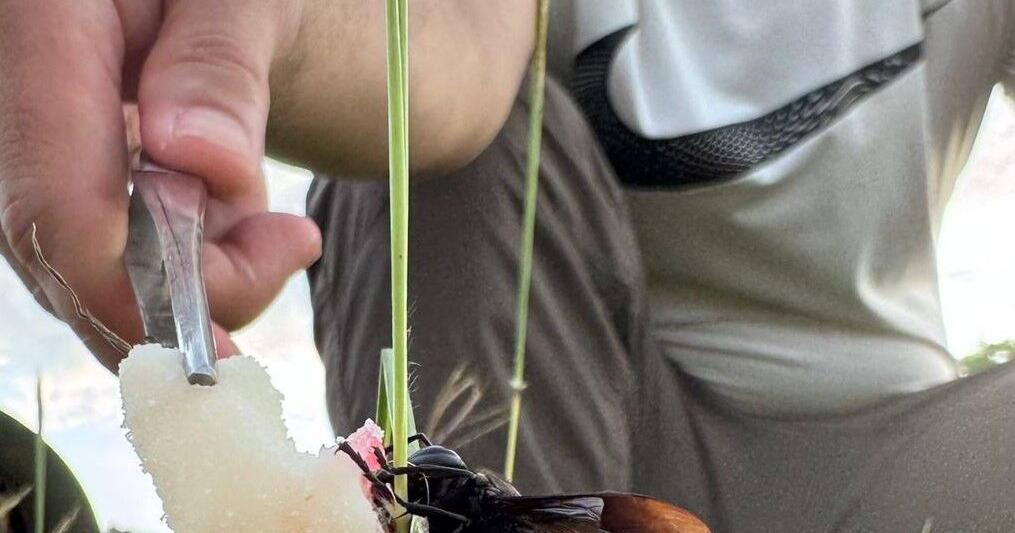
The Guam Department of Agriculture’s biosecurity division has successfully completed its first year of using advanced radio telemetry technology to track greater banded hornets, achieving key insights that could benefit both local beekeepers and the broader Pacific region’s fight against invasive species.
Chris Rosario, state entomologist with the biosecurity division, said in an interview with The Guam Daily Post that the pilot project has revealed crucial seasonal patterns in hornet behavior while laying the groundwork for a comprehensive hornet management program.
“We start to see a seasonality with hornets,” Rosario said. “The hornets are going through some kind of season. So, it’s not all year round. It’s not all year round that the colony will be predated on. It’s just a certain time of the year, which we find that basically in fall around July through October is when we see the heavy predation of these hornets.”
The technology, borrowed from Washington State’s successful northern giant hornet eradication efforts, involves attaching tiny radio transmitters to captured hornets and tracking them back to their nests. Washington State eliminated their hornet population within two years using similar methods.
“We know the technology works,” Rosario said. “But now we need to fine tune some of the techniques of being able to tag hornets and how we track them.”
The project emerged from Rosario’s collaboration with Chris Looney from the Washington State Department of Agriculture, who helped develop the tracking technology that proved successful against murder hornets in the Pacific Northwest.
“I reached out to them and said, ‘Hey, we have a similar hornet, not the same hornet, but we have a very similar hornet, just a tropical version, that is causing havoc around Guam’,” Rosario said.
While the technology shows promise, the program faces challenges in fine-tuning tracking methods. Technical details matter significantly from the type of glue used to attach transmitters to the specific radio frequencies and antennas employed.
“You got to know the frequency that you’re using. You got to know what type of antenna you’re using,” Rosario said. “It’s just fine tuning these small little nuances and then being able to teach the people how to use that technology.”
The department recently completed a two-day workshop training government officials, nonprofit representatives and community members in the tracking techniques. However, attendance fell short of expectations, particularly among Guam invasive species council members.
“We initially invited the Guam-based species council and we felt that this was the target audience,” Rosario said. “And basically, only three members showed up from the council.”
Despite the limited council participation, the workshop attracted representatives from the mayor’s councils, graduate students, members of the Guam Beekeepers Association, and soil and water districts. Rosario particularly valued the mayor’s council participation.
“The mayors for me was a highly important one only because they are the community’s eyes. The heart of the community sits with the mayor’s council,” he said.
A second workshop is planned for November, targeting University of Guam students and community members interested in citizen science projects. The program aims to build local capacity for using tracking technology beyond hornets to other invasive species like rhinoceros beetles.
The hornet tracking project represents part of a broader regional approach to invasive species management. While complete eradication may no longer be possible on Guam, where hornets have been established since 2016, Rosario emphasized the program’s value for protecting the island’s growing beekeeping industry.
“Every hornet’s nest that we kill, we are saving at least 10 to 12 colonies around the area of where those hornets are predating on,” he said. “Those hornets right now are predating on all honeybee nests.”
The program’s regional significance extends beyond Guam’s shores. If hornets spread to other Pacific islands, Guam’s experience could prove crucial for rapid eradication efforts.
“It’s too late for Guam, but it’s not too late for the region,” Rosario said. “Say for instance, Saipan or somewhere within Micronesia, if they’ve detected the hornet, we can take all this technology that we got and apply it. Go over there, fly over to Pohnpei, fly over to the other islands and then be able to use that technology to eradicate the hornet before it becomes out of control.”
The hornet program builds on previous biosecurity successes, including the complete eradication of varroa mites from Guam’s bee colonies. Rosario led that effort as a graduate student, tracking the mites through four years of surveys before achieving elimination.
“After four years of survey, (they) didn’t show up,” Rosario said of the varroa mites. “And up to 2025 this year, we have still yet to find mites.”
However, Rosario’s current workload illustrates ongoing challenges facing Guam’s biosecurity efforts. He holds dual roles as state entomologist and biosecurity chief, handling five different invasive species projects while managing administrative duties typically requiring separate positions.
Funding represents another persistent concern. While the biosecurity division operates through a dedicated invasive species fee collected from shipping containers, Rosario worries potential Department of Agriculture budget cuts could affect the program.
“With all these funding cuts and I think with the legislature… there could be a chance that the Department of Agriculture can lose some money for the upcoming fiscal year from the general fund,” he said.
The hornet tracking program receives federal funding through the USDA Plant Protection Act, but these grants require annual renewal and continuous proposal writing to maintain technician positions.
“I have to continually write these grants to ensure that the work is being carried out,” Rosario said.
Despite challenges, the program continues advancing. Federal interest has increased due to hornet problems spreading in Georgia and South Carolina, providing additional momentum for research and funding.
“The federal government is willing to put more money into it because of the fact that these hornets are continually spreading worldwide,” Rosario said.
The work carries deep personal meaning for Rosario, who reflects on missed opportunities from the past while remaining determined to protect Guam’s future. He recalls when hornets first arrived in 2016, when he was just a graduate student without the resources now available.
“I really wish back in 2016, when we first got these hornets, we received funding and the help that we have today,” Rosario said. “I feel like if we had the help and the funding that we have today, back then, I feel like we would have eradicated this Hornet.”
Despite the challenges ahead, Rosario remains committed to the fight, embodying the persistence required for invasive species management. His approach reflects both pragmatism and unwavering dedication.
“I will say though, I’m not going to give up… I’m going to just keep at it one nest at a time,” he said. “And if someday those nests don’t show up, then I can definitely say that we’ve done our job.”
Community members interested in joining this effort can contact Rosario at 671-487-1640 or call the Pest Hotline at 475-7378.
Credit: Source link