Here is an example of how greenhouse gas (GHG) emissions credits, or a shortage of them, can impact fleets’ spec’ing decisions. Under current emissions reduction regulations, truck manufacturers earn GHG credits for fuel-efficient vehicles they sell. If an OEM doesn’t sell enough of the right type of vehicle, they can run up a credit deficit.
Such an example was a leaked Truck Sales Bulletin bearing Kenworth’s letterhead. It has been circulating on social media channels for the past few weeks.

The bulletin notes that the truck maker will limit manual transmission sales to 10% of its overall Canadian heavy-duty sales volume and introduce engine horsepower restrictions based on a truck’s gross combination weight (GCW) rating.
I’ve seen similar ‘bulletins’ and other bits of questionable reporting on social media, so I contacted Kenworth to confirm the providence of that bulletin.
In an emailed statement, Kenworth confirmed the bulletin’s legitimacy and said the move is necessary to comply with increasingly stringent Canadian GHG emissions standards.
“Kenworth and other OEMs are faced with increased compliance regulations. At the beginning of 2024, there was a step-change in the CO2 standards per the GHG Phase 2 regulations making the vehicle CO2 standards 5-8% more stringent than last year,” the statement read.
“To meet those and reduce greenhouse gas emissions, some spec’ing options need to be considered. With automated transmissions being more fuel-efficient, manual transmission options will be fewer, and this is starting to apply in the Canadian market. Kenworth is committed to working closely with our dealers and customers to provide the best truck for their business while meeting regulatory compliance.”
Kenworth claims these measures are required to comply with Environment and Climate Change Canada’s (EEEC) GHG emissions standards for Canadian chassis. The changes will be effective Jan. 1, 2025, and may impact orders taken prior to that date.
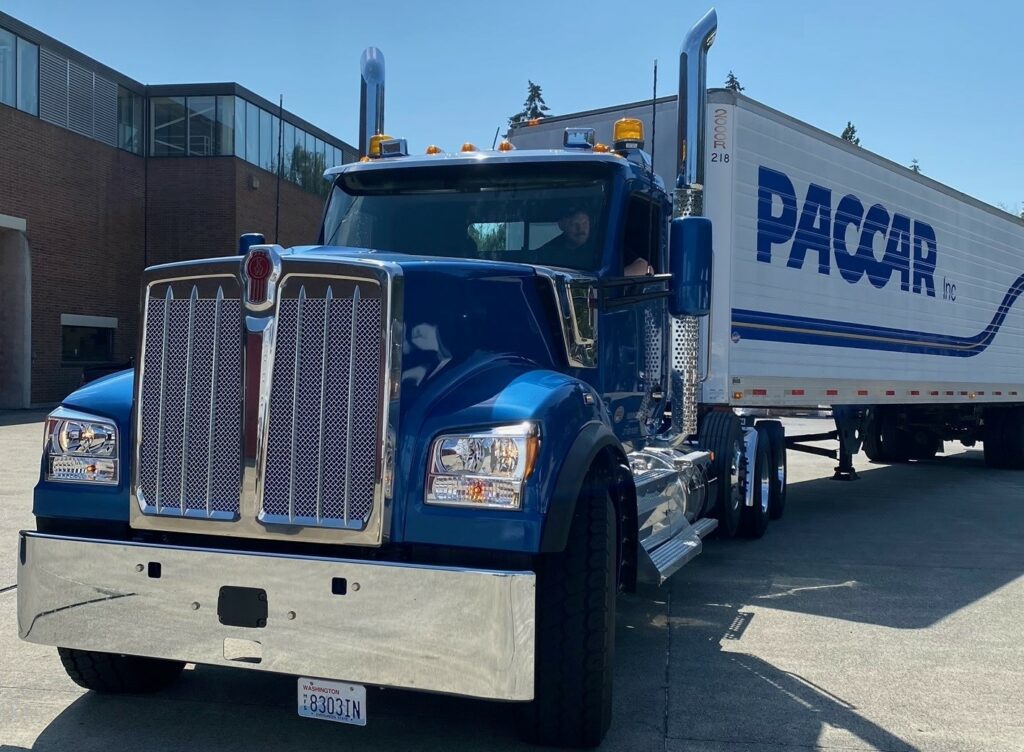
Manual transmissions are out
According to the bulletin, Canadian T680 day cab and sleeper tractors will be offered solely with automated manual transmissions (no manual transmissions available).
Also, “Canadian T880 and W990 day cab and sleeper tractors designated for linehaul and regional haul services will only be available with automated manual or automatic transmissions with Allison’s neutral-at-stop feature.”
The bulletin doesn’t speak to heavy-haul, logging or oilfield trucks specifically, but one dealer source, not authorized to speak publicly on the matter, told TruckNews.com customers now spec’ing manuals in some of those applications will have to switch.

The bulletin is silent on how the transmission allocations will be managed, aside from saying, “This limitation will be managed at the dealer group level, meaning that only 10% of total heavy-duty sales within each dealer group can consist of manual transmission vehicles.”
In other words, it will be up to the dealers to decide which of their customers gets a manual, and which will have to take an automatic or automated manual transmission instead.
“Moving forward as a dealer, we’re only going to be able to order 10% of the trucks we want with manual transmissions,” said one Kenworth dealer rep who prefers to remain unnamed because he’s not authorized to speak publicly on the matter. “If a customer called up and said, ‘Hey, I need a T680 highway tractor, and I want to build it with a 13- or 18-speed in it,’ we can’t sell it.”
Horsepower cutbacks
The bulletin also references restrictions to engine horsepower ratings based on gross combination weight ratings (GCWR). The GCWR is derived from various frame, axle, and suspension ratings that enable a truck to carry a given amount of weight.
The bulletin notes, tractors with engine ratings of 485-509 hp will be available only on chassis with a GCWR greater than 97,000 lb. or 43,998 kg.
Further, engine ratings of 510 hp or higher will be available only with GCWR ratings higher than 120,000 lb., or 54,431 kg.
This means, essentially, that tractors with typical U.S. lightweight specs (13K steer and 40K drives) will not be eligible for engines over 485 hp. That’s more than adequate for the U.S., but preferences, especially among owner-operators, tend to run somewhat higher.
A Canada-only conundrum
Both changes apply only to Canadian orders. As far as we have been able to determine, the caps on manual transmission and horsepower restrictions will not apply in the U.S.
Also, from what I have discovered, this situation appears to be unique to Kenworth, possibly Paccar, but Peterbilt did not respond to requests to confirm their position by the deadline.
As Kenworth noted in its response to our inquiry, “Vehicle CO2 standards [are] 5-8% more stringent than last year.”
Nothing in the regulations has changed, but I’ve since learned that Canada applies GEM modeling mechanism in a slightly different way than does the U.S.
The GEM model (Greenhouse Gas Emission Model) is a regulatory tool developed by the U.S. Environmental Protection Agency (EPA) and adopted by Canada to evaluate compliance with GHG emission standards for heavy-duty vehicles. It calculates the GHG emissions performance of specific vehicle configurations, ensuring they meet regulatory standards.
GHG emissions credits for new heavy-duty trucks are part of regulatory systems aimed at reducing emissions in the transportation sector. These credits are awarded to manufacturers that produce vehicles emitting less than the allowable GHG limits.
Using a series of inputs that yield an ‘on-paper’ calculation of a truck configuration’s fuel efficiency, truck makers report what vehicle components and accessories are included in the spec to arrive at a number that provides a specific GHG credit total.
These include aerodynamic features, tire rolling resistance, vehicle weight and payload capacity, engine displacement, and horsepower ratings, manual or automated/automatic transmissions, speed limiters, idle shut-down timers, tire pressure monitoring systems, and other fuel-saving measures.
Historically, manufacturers offered pricing incentives and other means of persuading customers to take these options — thus building up the OEM’s credit bank.
These emissions credits are earned according to trucks sold, but they can be banked and/or traded to offset deficits for other, maybe future, vehicles that exceed the limits. It’s a common practice and it has been going on for years.
Is Kenworth a victim of its own success?
GHG credits are accrued by the OEM based on the mix of trucks they deliver to the market. For example, as of the end of September, Freightliner had sold 6,082 trucks while its sister brand, Western Star sold 2,925, for a combined sales of 9,007 trucks in Canada. Peterbilt and Kenworth, combined, sold 5,849 units.
“The government’s just driving it so hard that OEMs have no choice but to make some rash decisions and say, here’s what you have to work with now.”
The mix of on-highway and vocational chassis is not reflected in these sales figures, but it’s safe to presume that Freightliner sold more slippery on-highway trucks than did the Paccar companies, and most likely Peterbilt and Kenworth sold more vocational trucks, combined, than Western Star.
It’s not surprising that the company selling more on-highway trucks would chalk-up credits faster than a company with a higher mix of vocational heavy-haul, and severe-duty trucks.
In Canada, Kenworth is somewhat disadvantaged from a GHG credit perspective. That’s because it sells fewer highway trucks than its major competitors do, plus its lineup includes a larger slice of vocational and heavy-duty vehicles.
There’s a good reason why Kenworth sells so many of these trucks, but the GEM calculations are taken company-wide over the entire vehicle portfolio, so they do Kenworth no favors.
Here’s a vastly exaggerated and terribly over simplified example to illustrate the point.
- Brand A builds 1,000 highway trucks with 10 GHG credits each, and 500 vocational trucks at 5 GHG credits each. Total credits = 12,500
- Brand B builds 500 highway trucks with 10 GHG credits each, and 1,000 vocational trucks at 5 GHG credits each. Total credits = 10,000
The company with the most credits due to its mix of on-highway and vocational trucks is in a more comfortable credit position. The one with the fewer credits may have to make some changes to how they build trucks — which is exactly what Kenworth is doing.
The worst is yet to come
As the GHG restrictions tighten even further heading towards 2030, that mix will become even more critical. The regulators designed the system to force OEMs to sell more of a particular spec’ (more fuel efficient), regardless of customer preferences.
And while there’s acknowledgment in the standards that vocational trucks are less focused on fuel efficiency, that doesn’t thwart the hand of big government from influencing truckers’ buying decisions. And it’s likely to get worse.
“The government’s just driving it so hard that OEMs have no choice but to make some rash decisions and say, here’s what you have to work with now,” one unnamed dealer source told TruckNews.com.
So far in the U.S., 10 states have opted to follow California’s Advanced Clean Trucks (ACT) regulation. Among other things, ACT brings a requirement that OEMs sell a certain number of zero-emissions trucks alongside any orders for diesel trucks.
Just how many is determined by a complex formula, but this is scheduled to begin in 2025 in some jurisdictions, including Massachusetts, New Jersey, New York, Oregon, and Washington. Other states will follow in 2026 (Vermont) and 2027 (Colorado, Maryland, New Mexico, and Rhode Island.)
I haven’t been able to unearth anything that speaks to Canada’s approach to CARB’s ACT rule, but sources in the know tell me Quebec is working on a bill that looks a lot like ACT.
Cue the wailing and the gnashing of teeth.
I think what we see from Kenworth in its bulletin is the thin edge of the wedge. I expect as GHG requirements tighten and the new NOx reduction rules come into force, it will become increasingly difficult – read, expensive — to get the truck you think you want.
There’s a good case for making trucks more fuel efficient, but at some point, we run up against the law of diminishing returns. The technology we’re forced to spec’ may just get in the way or humble us in the way we do our jobs. Or become too expensive. Or in some cases, cause customers to switch allegiances to another OEM with additional credit flexibility.
With the transmissions, I learned from one dealer source the list price on one 18-speed automated manual was close to $18,000. Even though they’re already paying a markup on the manual transmission, that upcharge is going to affect fleets significantly.
Another automatic transmission, I’m told, comes with a $25,000 list price. But there’s no need to worry about that because you won’t get one for at least two years. That supplier is built out thanks to an order from the U.S. military for its tank fleet.
The 10% allocation proposed by Kenworth will hurt some fleets. But given the inroads automated manuals are making in the market, (they are now at 90-95% penetration for on-highway fleets and somewhere between 75-90% on the vocational side), 10% could be enough to cover the market segments that really need manuals — like the heavy-haulers dragging around loads of 200,000 lb. and more.
This is definitely a case of environmental regulators leveraging their rules to influence customers’ spec’ing decisions. And it’s likely to become more prevalent as we steer into 2027, 2030 and beyond.
Today it’s manual transmissions, at Kenworth’s choosing. Tomorrow, under California’s ACT rule, it could be a case of having to buy one battery-electric truck for every 10 diesels you want to buy. We don’t know if ACT is coming to Canada, but I think it could if Canada’s environment minister, Steven Guilbeault, has anything to say about it.
TruckNews.com reached out for comment to other OEMs for this story but none chose to comment on the matter.
Credit: Source link