In April, U.S. President Donald Trump issued an executive order titled Enforcing Commonsense Rules of the Road for America’s Truck Drivers.
The purpose of the executive order is to improve the safety, reliability and efficiency of the U.S. motor carrier industry, by emphasizing and enforcing the existing English language proficiency (ELP) threshold for commercial vehicle drivers who operate in the U.S.

Specifically, the executive order required existing FMCSA guidance on ELP testing and enforcement to be rescinded and replaced with new guidance that would ensure compliance with the U.S. Code of Federal Regulations, 49 C.F.R. § 391.11:
A person shall not drive a commercial motor vehicle unless he/she is qualified to drive a commercial motor vehicle. Except as provided in § 391.63, a motor carrier shall not require or permit a person to drive a commercial motor vehicle unless that person is qualified to drive a commercial motor vehicle…
A person is qualified to drive a motor vehicle if he/she…can read and speak the English language sufficiently to converse with the general public, to understand highway traffic signs and signals in the English language, to respond to official inquiries, and to make entries on reports and records.
On May 20, U.S. Secretary of Transportation Sean P. Duffy signed an order announcing new guidelines for all FMCSA enforcement personnel pursuant to Trump’s executive order.
Two-step roadside assessment
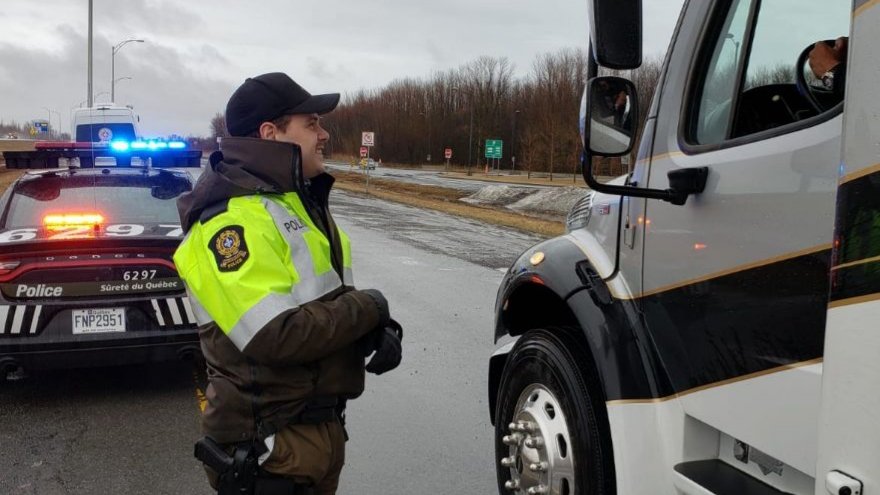
The revised guidance, which was implemented with immediate effect, prescribes a new two-step roadside assessment that inspectors should now administer on commercial motor vehicle drivers to assess their English language proficiency. This assessment consists of: a driver interview; and a highway traffic sign recognition assessment.
The driver interview is an evaluation of the driver’s ability to respond sufficiently to official inquiries and directions in English. If the driver demonstrates compliance with the regulation’s requirements, the inspector will then conduct a Highway Traffic Sign Assessment.
During this step, driver will be asked to identify highway traffic signs and electronic display message signs that they may encounter while operating a commercial vehicle.
A driver who fails to meet the ELP threshold for either step can be cited for a breach of the regulation. Additionally, the FMCSA’s new guidance now recommends that an inspector who cites a driver for a breach should take follow-on action, which may include: placing the driver immediately out-of-service, once a breach of the regulation is incorporated into the CVSA’s Out-of-Service Criteria; and when warranted, initiating an action to disqualify the driver from operating commercial motor vehicles in interstate commerce.
Concerns from drivers and operators
Both drivers and fleet operators have expressed concerns about how the new two-step ELP assessment will be administered, and the practical challenges with ensuring they will be able to satisfy the prescribed ELP threshold.
As the new guidelines enter their second month of implementation, it will be important for commercial motor vehicle operators in the U.S. to monitor how the assessment is administered, and what policies and procedures may be required to ensure that drivers can demonstrate sufficient English language proficiency to FMCSA personnel.
Credit: Source link