The national average price of a gallon of diesel is now nearly $1.81 higher than it was a year ago, as of March 30 Department of Energy numbers, and has topped $7 per gallon in California.
The Energy Information Administration reported the average on-highway diesel fuel price, including all taxes, at $5.401 per gallon, up 2.6 cents from last week.
California’s average diesel price was $7.219 per gallon, which is up 35 cents from a week ago (the largest jump in the country) and is $2.44 per gallon more than a year ago.
The Lower Atlantic, Midwest, and Gulf Coast regions all saw prices dip slightly from last week, while all other regions saw increases.
How Diesel Prices are Affecting Trucking
According to Dean Croke, Industry Analyst, DAT Freight & Analytics, truckers are responding to fuel prices by cutting deadhead miles, looking for lighter loads, and slowing down.
At current diesel prices, slowing from 75 to 65 mph saves roughly 8 to 9 cents per mile in fuel — the equivalent of a significant per-mile pay raise without hauling a single extra load, he explained.
Carriers are also sitting on the sidelines or declining unprofitable loads.
The national average fuel surcharge for dry van freight rose from 44 cents to 60 cents per mile in the two weeks following the strikes on Iran, according to DAT data.
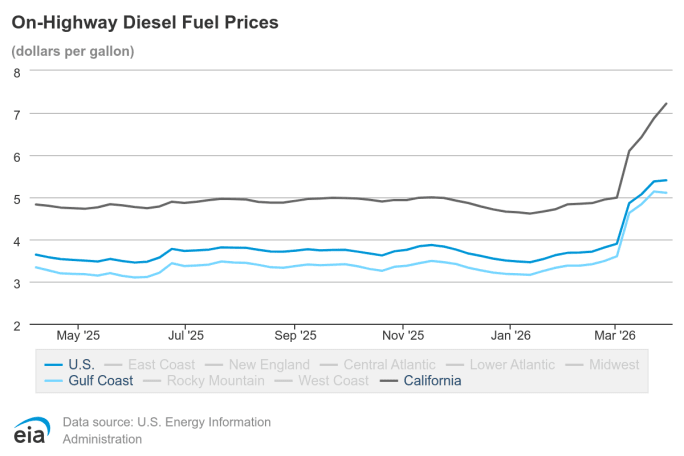
California’s average price for a gallon of diesel fuel was the highest in the country at $7.219 per gallon.
U.S. Energy Information Administration
The Iran War and Oil Prices
Crude oil futures prices continue to be volatile, with mixed signals coming from the White House and other sources about the war in the Middle East.
Before the U.S. and Israel attacked Iran in late February, 20% of the world’s oil and natural gas went through the Strait of Hormuz. Since the attacks, Iran has severely limited the number of ships that can get through as it tries to extract concessions from the U.S.
Crude oil futures on March 31 dropped slightly on signs of hope for the end of the war but were still over $100 per barrel. U.S. oil futures for West Texas Intermediate oil rose 51% in March and 77% during the first three months of 2026.
Even if the Strait of Hormuz were fully opened today, it will take time for petroleum facilities to come fully back online, leaving the world facing energy shortages that affect the U.S.
Credit: Source link