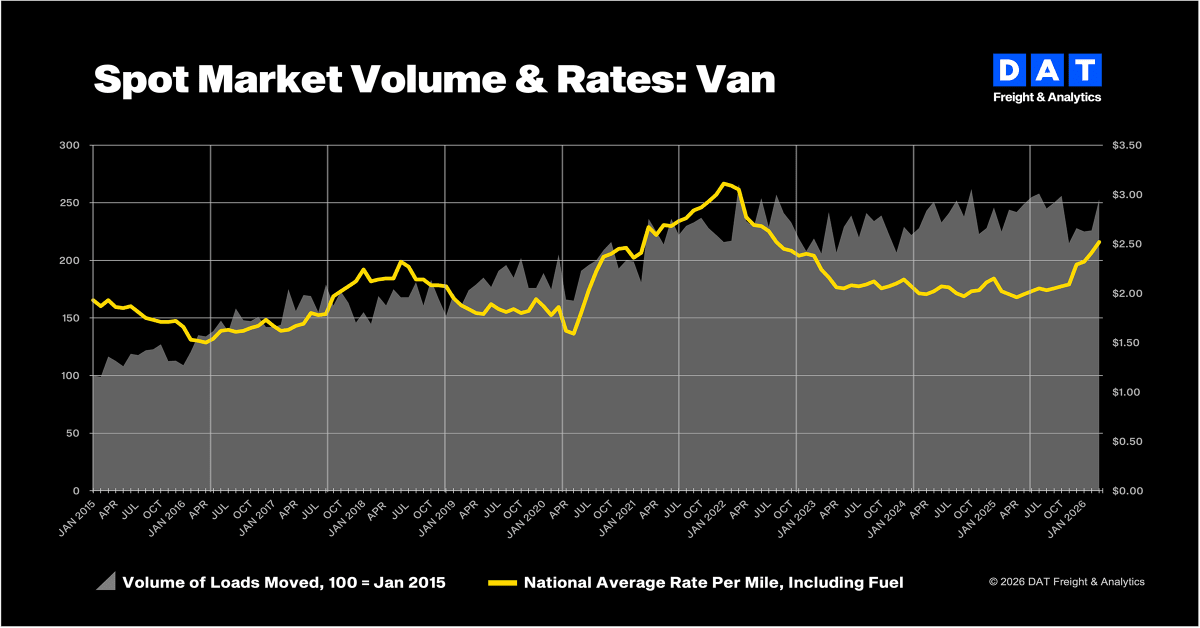
Truckload freight volumes climbed across all major equipment types in March. However, while sharply higher diesel costs drove spot and contract rates to multi-year highs, according to DAT Freight & Analytics.
The DAT Truckload Volume Index (TVI) rose month over month, reflecting strong early-season demand tied to retail restocking, produce harvests, and construction activity.
- Van TVI: 253, up 12% from February
- Reefer TVI: 196, up 7%
- Flatbed TVI: 314, up 18%
Spot Pricing: Fuel Drives Freight Rates Higher
National average spot rates increased across all equipment types in March, largely due to fuel cost recovery rather than underlying pricing strength.
- Van: $2.52 per mile, up 11 cents
- Reefer: $2.97 per mile, up 9 cents
- Flatbed: $3.09 per mile, up 37 cents
Year over year, gains were even more pronounced, with van rates up 53 cents, reefer up 70 cents, and flatbed up 56 cents compared to March 2025.
Despite higher all-in rates, linehaul pricing — the portion excluding fuel — told a more nuanced story. Van and reefer linehaul rates declined month over month by 9 cents and 13 cents, respectively, while flatbed rose 13 cents.
“Linehaul rates were still under pressure through most of March, which tells you demand hasn’t fully caught up yet,” said Ken Adamo, DAT chief of analytics.
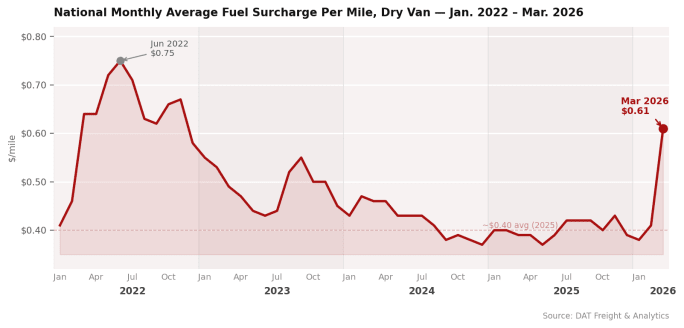
Fuel surcharges surged significantly, tightening carrier margins. The average van fuel surcharge jumped from 41 cents to 61 cents per mile. Adamo said that is the highest since late 2022. Reefer climbed to 67 cents, and flatbed reached 73 cents per mile.
“For context, monthly average van fuel surcharges averaged around 40 cents per mile throughout most of 2025,” Adamo noted. “The March reading represents a 50% increase from that baseline.”
Contract Rates: Moving Higher with Fuel
DAT Freight & Analytics
Contract rates followed a similar upward trajectory, also driven largely by fuel dynamics.
- Van: $2.72 per mile, up 20 cents
- Reefer: $3.10 per mile, up 22 cents
- Flatbed: $3.43 per mile, up 30 cents
As the industry moves through bid season, pricing strategies are evolving in response to volatility.
“Right now, the smartest players are pricing contracts based on where they believe the market is going and being transparent about those assumptions, leaving room to adjust if conditions change,” Adamo said.
About the Truckload Volume Index
The DAT Truckload Volume Index measures monthly changes in loads with a pickup date during that month, using a January 2015 baseline of 100.
It is based on data from DAT RateView within the DAT iQ platform, which tracks rates paid on actual shipments. Benchmark spot rates reflect invoice data for hauls of 250 miles or more across the U.S. and Canada.
Credit: Source link