NACFE’s new Messy Middle Powertrain Service & Maintenance report says keeping modern diesel engines running now depends as much on software, diagnostics and data as traditional mechanical service.
The North American Council for Freight Efficiency (NACFE) has released a comprehensive new report examining how truck maintenance is evolving during what it calls the “Messy Middle.”
The phrase, coined by NAFCE executive director Mike Roeth refers to the current period of transition in the commercial vehicle industry. With environmental issues and fuel costs mounting, many truck fleets today are evaluating advanced powertrains, renewable fuels and emerging propulsion technologies while continuing to rely on conventional diesel equipment.
The purpose of NACFE’s Messy Middle Powertrain Service & Maintenance report is to help these fleets, along with their technicians and service providers understand how these new technologies are changing vehicle maintenance, shop operations and technician training today, not years down the road.
This article is the first installment in HDT’s continuing series examining the report’s findings. We begin the series with the technology that still powers the overwhelming majority of North American Class 8 trucks: the modern diesel engine.
Today’s Diesel Engines Are Software-Defined Machines
While diesel remains the industry’s dominant powerplant, maintaining today’s engines has become far more complex than changing oil and replacing filters.
Advanced electronic controls, sophisticated emissions systems, connected diagnostics and predictive maintenance have transformed the diesel engine into a software-driven machine that demands an entirely new approach to keeping trucks on the road.
For technicians who cut their teeth on the mechanical diesel engines of the 1980s and 1990s, today’s engines require an entirely different approach.
Where horsepower once depended largely on displacement, turbochargers and fuel delivery, today’s engines rely on sophisticated electronic control modules, advanced fuel injection, selective catalytic reduction systems and complex aftertreatment technologies working together in carefully calibrated harmony.
Those systems continuously communicate across the truck’s Controller Area Network using industry-standard protocols that allow engine controllers, emissions systems and other electronic modules to exchange diagnostic information in real time.
That means maintenance has become as much about verifying software calibrations, monitoring electronic fault codes and ensuring component compatibility as replacing worn mechanical parts.
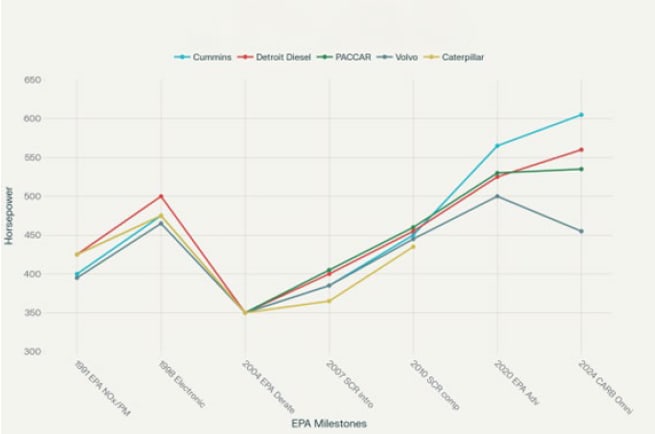
The evolution of OEM engine maximum horsepower.
NACFE notes that engine manufacturers have steadily recovered — and in many cases exceeded — horsepower lost during the first wave of EPA emissions regulations. This has been done mainly by refining combustion, fuel injection and selective catalytic reduction technology. Rather than viewing emissions equipment only as a performance penalty, fleets are increasingly benefiting from engines that are cleaner, more fuel efficient and more durable than their predecessors.
Oil Management Becomes a Critical Maintenance Strategy
One of the biggest changes highlighted in the report involves something every fleet performs routinely: oil changes.
Rather than simply changing oil at predetermined mileage intervals, today’s maintenance programs increasingly revolve around lubricant chemistry, oil analysis and digital validation.
Modern heavy-duty engines are often designed around low-viscosity FA-4 engine oils, which provide lower internal friction while meeting stringent emissions and fuel-efficiency requirements. Using the wrong lubricant can have consequences beyond reduced engine life.
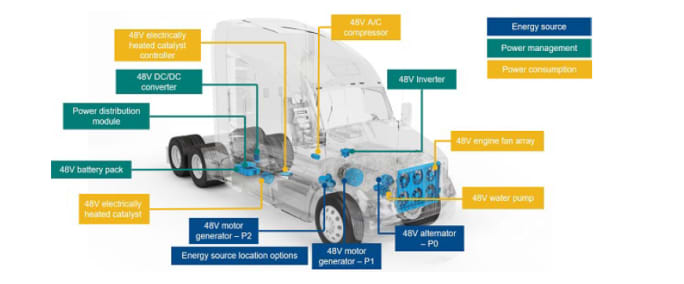
One possible near-future ICE enhancement could be the return of mild hybrid powertrains for Class 8 trucks.
According to the report, engine manufacturers including Cummins, Paccar and Daimler Truck specify approved lubricants for their engines, warning that substituting incorrect oil formulations may compromise durability and, in some applications, affect warranty coverage.
Oil drain intervals have evolved as well.
Instead of adhering to fixed schedules, many fleets now rely on laboratory oil analysis programs that monitor viscosity, oxidation, soot loading and wear metals before extending drain intervals. Systems such as Cummins Oil Guard allow qualified fleets to extend oil changes significantly beyond traditional service intervals when laboratory data confirms the lubricant remains in acceptable condition.
The result is maintenance based on actual engine condition rather than mileage alone.
Connected Trucks Enable Smarter Maintenance
Perhaps the biggest shift in modern diesel maintenance is the rise of connected diagnostics.
Telematics platforms from manufacturers including Volvo Trucks, Kenworth, Peterbilt and Cummins now allow fleets to monitor engine health remotely, verify software updates, identify fault codes and confirm calibration integrity before a truck even enters the service bay.
Instead of reacting after a breakdown occurs, technicians can increasingly identify developing issues while the truck remains in operation.
NACFE says this connected approach forms the foundation for condition-based maintenance, predictive maintenance and eventually prescriptive maintenance strategies that recommend repairs before failures occur.
The report emphasizes that these digital tools don’t replace technicians. Instead, they allow technicians to spend more time solving problems and less time searching for them.
Even Coolant Requires a High-Tech Approach
Coolant chemistry has become increasingly important as engine manufacturers continue incorporating aluminum and other lightweight materials into engine designs.
Using the correct coolant mixture, supplemental additives and deionized water helps prevent electrolysis — an electrical condition that can quietly damage radiators, heater cores and cylinder liners long before visible corrosion appears.
The report notes that many cooling-system failures commonly attributed to corrosion are actually caused by electrical activity within the cooling system.
As a result, technicians are increasingly expected to perform electrical testing alongside traditional coolant analysis, checking voltage levels as well as chemical balance to identify problems before expensive engine damage occurs.
It’s another example of how today’s maintenance procedures increasingly blend mechanical knowledge with electronic diagnostics.
The Diesel Engine Still Has Room to Evolve
Although today’s advanced diesel engines are vastly different from those of two decades ago, NACFE says innovation in internal combustion technology is far from over.
One example is Reactively Controlled Compression Ignition (RCCI), an experimental combustion architecture that could one day further reduce emissions while improving engine efficiency. Rather than relying on a single fuel, RCCI combines two fuels with different combustion characteristics. A low-reactivity fuel, such as natural gas, gasoline or ethanol, is premixed with air, while a small amount of diesel fuel is injected to precisely control ignition timing.
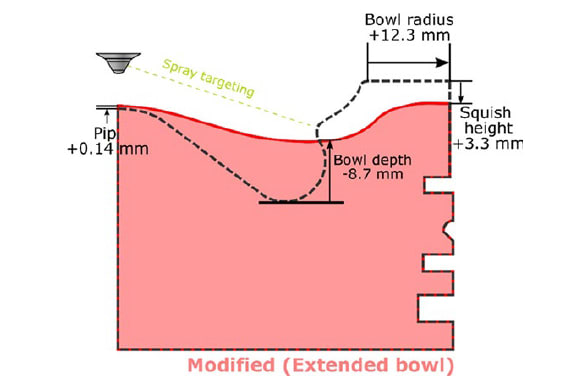
Squish zone piston crown geometry.
The approach allows engineers to better manage combustion inside the cylinder, reducing both soot and nitrogen oxide (NOx) emissions while maintaining the efficiency that has long made diesel engines the preferred choice for heavy-duty applications.
RCCI engines also incorporate changes to piston design. Deere, for example, has patented a specially contoured piston crown that reshapes the engine’s “squish zone” — the space where the piston approaches the cylinder head at top dead center. The revised geometry improves fuel-air mixing, helping create a cleaner, more efficient combustion event.
While technologies such as RCCI remain in the research and development stage, they illustrate an important point made throughout NACFE’s report: the internal combustion engine continues to evolve alongside battery-electric, hydrogen fuel cell and other emerging propulsion technologies. In the Messy Middle, diesel technology is not standing still.
Preparing Technicians for the Next Generation
NACFE argues that perhaps the industry’s greatest challenge isn’t the technology itself but preparing technicians to maintain it.
Tomorrow’s diesel technicians must understand lubrication science, emissions systems, electronic communications, software calibration, connected diagnostics and data analysis in addition to traditional mechanical repair skills.
That need for continuous training will only grow as fleets add battery-electric trucks, hydrogen-powered vehicles and other advanced propulsion technologies alongside conventional diesel equipment.
For now, however, modern internal combustion engines remain the backbone of freight transportation.
Keeping them operating efficiently no longer depends solely on turning wrenches. It requires technicians capable of managing sophisticated digital systems every bit as effectively as they rebuild engines — a reality that defines truck maintenance in NACFE’s Messy Middle.
You can download the NACFE’s full Maintenance in the Messy Middle Report here.
Credit: Source link