A Russian cargo ship was ordered out of British territorial waters this week after anchoring near critical undersea telecommunications infrastructure, heightening maritime security concerns across Europe.
The Sinegorsk sailed into the Bristol Channel late Tuesday evening, January 27, before dropping anchor roughly two miles off Minehead on the Somerset coast. The vessel remained stationary for approximately 14 hours until Wednesday afternoon, positioning itself less than a mile from major undersea cables connecting the United Kingdom to the United States, Canada, Spain and Portugal.
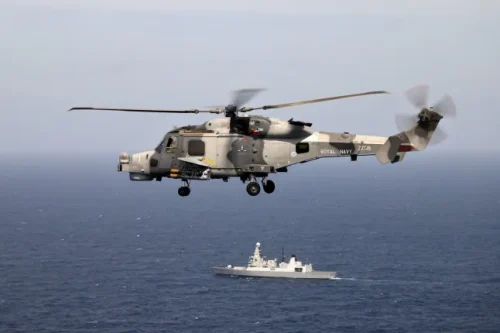
British authorities responded by deploying an HM Coastguard surveillance aircraft and a Royal Navy Wildcat helicopter to monitor the situation. The Department for Transport issued a warning directing the vessel to leave UK waters, which the ship complied with Wednesday afternoon at 2 PM, according to maritime tracking data.
The Russian crew claimed they had entered British waters to carry out essential safety repairs. However, Shadow Minister for National Security and Safeguarding Alicia Kearns described the movements as deeply suspicious, calling the incident another reminder of persistent threats facing the country from the Kremlin and its allies.
Vessel tracking records show the Sinegorsk’s most recent port visit was three weeks earlier at Arkhangelsk, a major trading hub that also serves as headquarters for Russia’s Northern Fleet. The ship altered course multiple times near seabed data cables and passed within miles of Hinkley Point nuclear power station during its journey through the channel.
British defence officials confirmed awareness of Russian attempts to map undersea infrastructure. A Ministry of Defence (MoD) spokesman stated the government recognises threats posed by Russia, including efforts to chart undersea cables, networks and pipelines belonging to the UK and its allies, and is tackling these challenges directly.
The incident reflects broader European concerns about Russian maritime activity near vital infrastructure. The vessel anchored within three quarters of a mile of five major cables that include direct links to New York, a key Canadian telecommunications hub in Nova Scotia, and critical connections to Spain and Portugal.
While the Sinegorsk itself is not under UK sanctions and is not believed to be part of Russia’s shadow fleet, Western governments have increasingly linked Russian vessels to suspicious activity near critical underwater infrastructure. Shadow fleet refers to Russia’s practice of using aging ships, often tankers flying under false flags, to transport sanctioned goods such as oil.
First Sea Lord Admiral Sir Gwyn Jenkins warned in December that Russian incursions in UK waters had increased 30 percent over the past two years. He expressed particular concern about underwater activities, noting that while Russian spy ships like the Yantar operating near British waters are visible, what happens beneath the waves poses the greatest threat.
Recent months have seen multiple incidents involving Russian linked vessels in European waters. Earlier in January, a sanctioned Russian tanker reportedly sailed through the English Channel under a false name and flag after departing a Turkish port. The vessel, known under multiple identities, was suspected of heading toward Russia.
Security experts have repeatedly cautioned that Europe faces growing exposure to state linked maritime threats. These include disinformation campaigns, drone operations and incursions near sensitive infrastructure sites.
The broader challenge of Russia’s shadow fleet continues to expand across global shipping lanes. Estimates suggest between 1,100 and 1,400 vessels operated in the shadow fleet by December 2023, up from over 600 ships at the end of 2022. Many of these vessels are aging tankers purchased to circumvent international sanctions following Russia’s invasion of Ukraine.
Western authorities have struggled to contain the growth of the illicit fleet despite imposing sanctions on hundreds of individual vessels. The European Union (EU) has designated 342 ships, the United Kingdom 133, and the United States several hundred, according to recent enforcement data. However, limited overlap between these sanctions lists has created jurisdictional gaps that Russian operators exploit through reflagging and registry manipulation.
Shadow fleet vessels have transported around 1.4 million barrels of crude oil daily since Russia’s invasion of Ukraine, representing a 111 percent increase compared to pre invasion levels. The fleet generates an estimated $87 to $100 billion annually, revenue that has matched or exceeded the total economic and military assistance provided to Ukraine since the war began.
These vessels pose environmental risks beyond their strategic implications. Roughly 72 percent of shadow fleet ships are over 15 years old, requiring constant maintenance, and 60 percent lack proper insurance coverage. Without adequate insurance, cleanup costs from potential spills, estimated between $859 million and $1.6 billion, would fall to European taxpayers or coastal states.
Several European nations have taken steps to intercept suspicious vessels in recent months. France boarded the sanctioned tanker Grinch in the Mediterranean, while Finland captured the freighter Fitburg after it was suspected of damaging undersea cables connecting Estonia and Finland. The United States Navy seized the Russian flagged tanker Marinera in the North Atlantic in early January.
Fourteen European nations issued a joint warning this week to shadow fleet tankers in the Baltic and North Seas, declaring that ships failing to maintain valid documentation on safety and insurance would be treated as stateless vessels.
Baltic and Nordic states possess exceptional maritime domain awareness and capable coast guards, positioning them to act decisively against vessels violating international maritime conventions. However, analysts note that fragmented designation regimes across the US, UK and EU have hindered coordinated enforcement efforts.
Russia has shown willingness to defend its shadow fleet operations through military means. The Kremlin sent fighter jets into Estonian airspace earlier this year to protect a shadow fleet tanker, while Russian naval vessels escorted ships through the English Channel.
British officials emphasised that deterring, disrupting and degrading the Russian shadow fleet remains a government priority. The Ministry of Defence stated it has imposed sanctions on over 500 Russia related shadow fleet oil tankers and 16 liquefied natural gas (LNG) tankers to date, forcing approximately 200 ships off the seas.
Maritime security analysts stress that addressing the shadow fleet challenge requires coordinated action using legal instruments already available under international law. The United Nations Convention on the Law of the Sea (UNCLOS) grants coastal and port states authority to inspect, detain or deny port access to vessels suspected of violating safety and environmental regulations.
Enhanced port state control inspections focusing on insurance irregularities, false registries and mechanical deficiencies could significantly disrupt shadow fleet operations. Member states could establish designated holding areas for detained vessels, ensuring inspections and evidence collection proceed safely without disrupting commercial ports.
The Sinegorsk incident underscores the persistent challenge facing European nations as Russia continues to probe maritime boundaries and test responses to activities near critical infrastructure. As tensions remain elevated, security officials expect Russian vessels will continue testing Western resolve through calculated incursions in strategic waterways.
Credit: Source link