Only last month, a portrait by the Italian Baroque painter Giuseppe Ghislandi, looted in Amsterdam in 1940 and bought by Friedrich Kadgien (aide to Hermann Goering), reappeared on an Argentinian estate agent’s website, hanging above a sofa.
Since the house for sale belonged to Kadgien’s family, the trail to the lost Ghislandi suddenly went hot. The painting immediately disappeared again, though it has since reappeared in the hands of the family lawyer. The Kadgiens insist they are the rightful owners.
Much of the Nazis’ plundering was opportunistic − a brutal and universal fact of war − but in the case of high-value items, they operated an industrial-scale theft machine. They expropriated entire collections from Jewish collectors, such as the Rothschilds and the Lederers, with the connivance of non-Jewish dealers and experts.
Racial laws debarred Jews from owning property, so those art-world figures were − or so they persuaded themselves − handling legally confiscated goods.
There was a method to this sweeping up of European masterworks. Hitler planned to turn the Austrian city of Linz into the Reich’s cultural capital, with a mega-museum containing 36km of gallery space. Today, the world’s largest museum, the Louvre, has only 13.5km.
The Fuhrermuseum’s megalomaniac acquisitions policy can be summarised in one word: loot.
He was enabled in his cherrypicking of loot by an organisation known as the ERR (Einsatzstab Reichsleiter Rosenberg), based at the Jeu de Paume in Paris, which acted as a clearing house for Jewish-owned art.
When the American ‘Monuments Men’ arrived and entered the caverns, they discovered 9,000 paintings and sculptures
Artworks destined for the Fuhrermuseum, meanwhile, were stored in a salt mine at Altaussee in the Austrian Alps. As the Allies advanced in 1944, Hitler ordered their destruction, but the dynamite was never detonated.
When the American “Monuments Men” − members of the Monuments, Fine Arts and Archives corps tasked with recovering looted art − arrived and entered the caverns, they discovered about 9,000 paintings and sculptures, including Jan van Eyck’s Ghent Altarpiece (1432) and Michelangelo’s Madonna of Bruges (1504), along with thousands of other treasures.
This was just the start. Across Nazi-occupied nations, people had kept covert records of thefts. And there were the seized files of the ERR and the work of the US Art Looting Investigation Unit, which led to the recruitment of the Monuments Men.
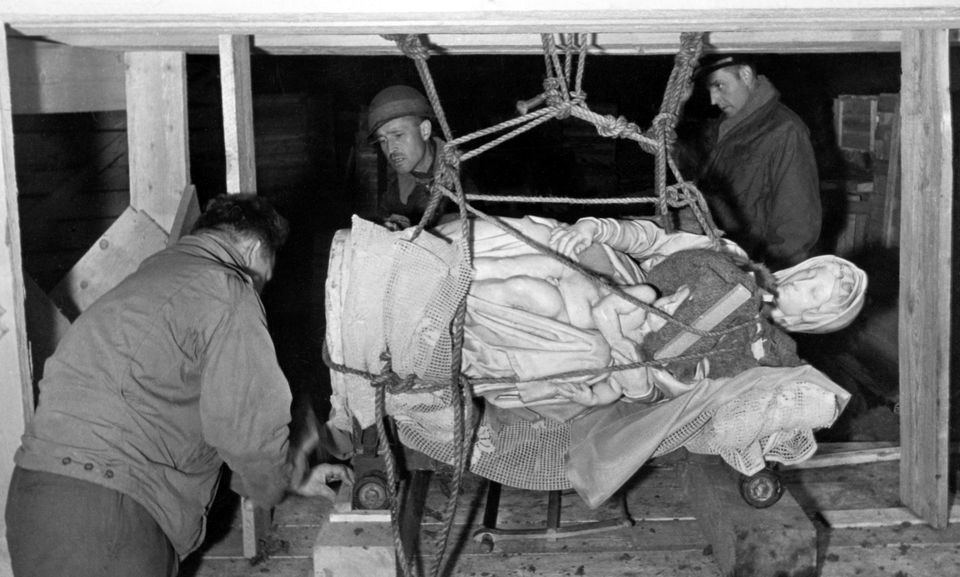
Michelangelo’s ‘The Madonna of Bruges’ is recovered from the Altaussee salt mine, Austria, in 1945. Photo: Getty
In recent years, with the creation of online databases and real-time information sharing, the sleuthing has gathered pace. The German Lost Art Foundation’s database contains detailed records of about 200,000 artworks, while Interpol’s Stolen Works of Art database lists 57,000.
Here are 10 masterpieces from those lists, all but one of which are still missing.
1. Raphael, Portrait of a Young Man (1513-14)
This is the most important Nazi-looted painting still unaccounted for.
Alongside Leonardo da Vinci’s Lady with an Ermine (1491) and Rembrandt’s Landscape with the Good Samaritan (1638), it was one of the “Great Three” in the collection of the Polish aristocratic Czartoryski family, which Hitler and Goering coveted.
Shipped to Berlin in 1939, the paintings were later returned to Poland − probably to keep Goering at bay − where Nazi governor Hans Frank wanted them for himself. The Leonardo and Rembrandt were later retrieved, but not Portrait of a Young Man, which was too big for Frank to take with him when he fled. Its whereabouts are unknown.
2. Gustav Klimt, Portrait of Trude Steiner (1900)
The daughter of Jewish Viennese factory owners Wilhelm and Jenny Steiner, Trude died from meningitis in 1900. Her parents commissioned this posthumous portrait from Klimt, a close friend of Jenny’s sister, Serena Lederer.
Following the Nazi annexation of Austria in 1938, the family escaped to Paris, eventually settling in America, but their business and art collection were seized. Portrait of Trude Steiner was auctioned in Vienna in April 1941 and has not been seen again.
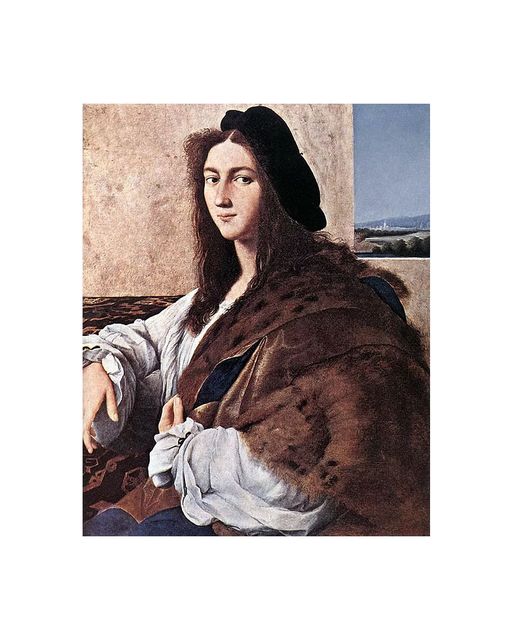
Raphael’s Portrait of a Young Man
3. Hans Memling, Portrait of a Young Man (1480−90)
During the Allied bombing campaigns of 1942, paintings from the Uffizi in Florence were moved to a castle in the Tuscan village of Poppi. In August 1944, German troops broke in on the pretext of hunting spies. They drove off with truckloads of artworks.
When the Monuments Men reached Poppi, they found 198 paintings had gone, noting the looters’ preference for northern European artists such as Memling. They had left behind The Birth of Venus (1480s) by his contemporary, Botticelli.
4. Albrecht Durer, Saint Christopher Carrying the Infant Christ (1471−1493)
The organised nature of Nazi looting and the high-profile campaigns for restitution can overshadow the incalculable losses that happened in the chaos and lawlessness of war.
During 1942 and 1943, the contents of Anhalt Picture Gallery in Dessau were dispersed to rural hiding places, with Durer’s Saint Christopher kept in a forester’s lodge. Dessau was flattened by Allied bombing in March 1945. In the surrounding countryside, no one was in charge. This little painting, carefully prised from its frame, disappeared.
5. Pierre-Auguste Renoir, Head of a Young Girl (Gabrielle) (1895)
In October 1938, Jewish businessman Manfred Nachmann and his family, who had managed to obtain American visas, left Berlin for New York. They discovered on arrival that one crate of their possessions was missing. It contained this portrait by Renoir of Gabrielle Renard (his model and his children’s nanny), along with other paintings. After the war, the German shipping agents claimed their records had been destroyed.
Although it has appeared on Interpol’s “12 Most Wanted” list, Head of a Young Girl remains untraced.
6. Paolo Veronese, Maria with Child (Madonna with Child) (1560)
Seized from a warehouse in Paris in 1942 by the ERR, this painting was in the collection of German-Dutch banker ‘Fritz’ Gutmann, who in 1939 had moved artworks from his house, near Amsterdam, to Paris. Gutmann was murdered in Theresienstadt concentration camp in 1944.
The search for the looted treasures of his collection is recounted by his grandson, Simon Goodman, in the 2015 book The Orpheus Clock.
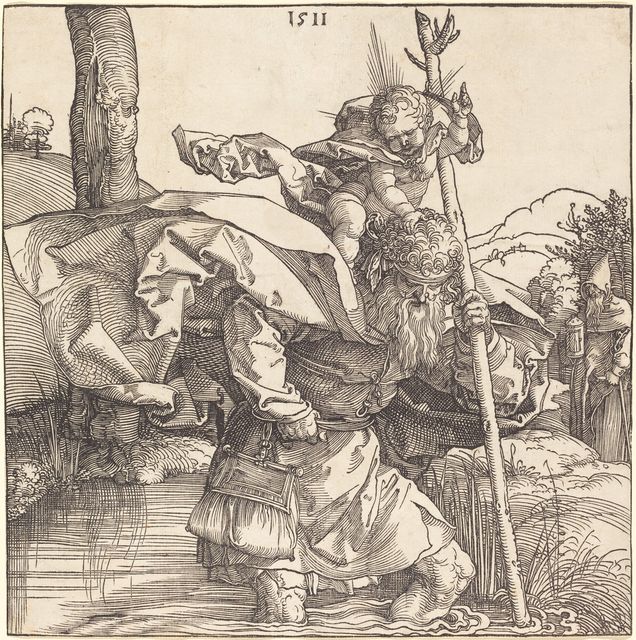
Albrecht Durer’s ‘Saint Christopher Carrying the Infant Christ’. Photo: Getty
7. Edgar Degas, Portrait of Mlle Gabrielle Diot (1890)
The art dealer Paul Rosenberg hung this pastel by Edgar Degas over his desk in Paris. With the Fall of France in 1940, he became the focus of Nazi attention. He escaped, via Portugal, to America, but had to leave his collection behind.
By December 1940, Portrait of Mlle Gabriele Diot was with the ERR, who sold it in 1942 to a Swiss buyer. We know that, in 1974, a Hamburg dealer arranged its sale – again to a Swiss collector – but Rosenberg’s heirs have been unable to trace it further.
8. Dosso Dossi, Christ the Redeemer (early 16th century)
From September 1943 until the Allied spring offensive of 1945, Prince Felix of Luxembourg’s home at Villa Borbone della Pianore, near Vicenza, was commandeered by the German military. Troops stripped out almost everything, from masterpieces to bathroom taps. Dozens of paintings were looted, including Christ the Redeemer by the Renaissance artist Dossi.
As recently as 2014, some missing works from the villa have come to light, hanging in Italian homes, but not Dossi’s Christ.
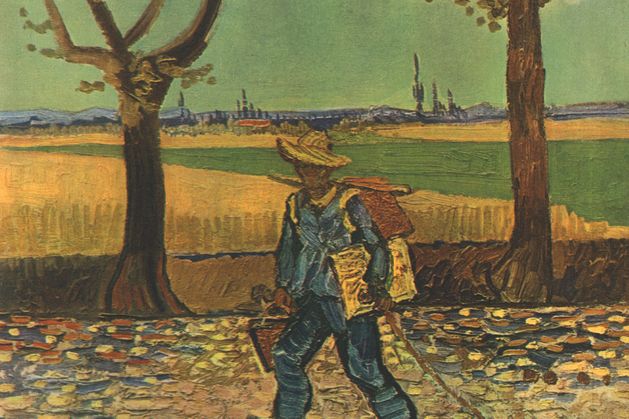
9. Vincent van Gogh, The Painter on the Road to Tarascon (1888)
Officially, Van Gogh was classified by the Nazis as a “degenerate” artist, yet this work was left in place in the Kulturhistorisches Museum in Magdeburg. They had even, highly unusually, had it photographed in colour.
The Painter on the Road to Tarascon ended the war half-a-kilometre underground in the Neu-Stassfurt salt mine. When American forces reached the mine in April 1945, the shafts had been ablaze, but art stored at Neu-Stassfurt has since been found intact, so van Gogh’s painting may still be out there.
10. Salomon van Ruysdael, River Landscape with Ferry (1649)
The Jewish-Dutch art dealer Jacques Goudstikker was a towering figure on the 1930s Amsterdam art scene. He died in an accident at sea while fleeing from the Nazis in 1940.
This landscape was one of 1,200 paintings in his collection − which included the recently recovered Ghislandi − appropriated by Goering. It later found its way into the Rijksmuseum, to be reclaimed, after much research and litigation, by Goudstikker’s heirs.
A happy ending? Not entirely. High costs meant that the painting had to be sold to pay for its own recovery. It is now in the National Gallery in Washington DC.
Credit: Source link