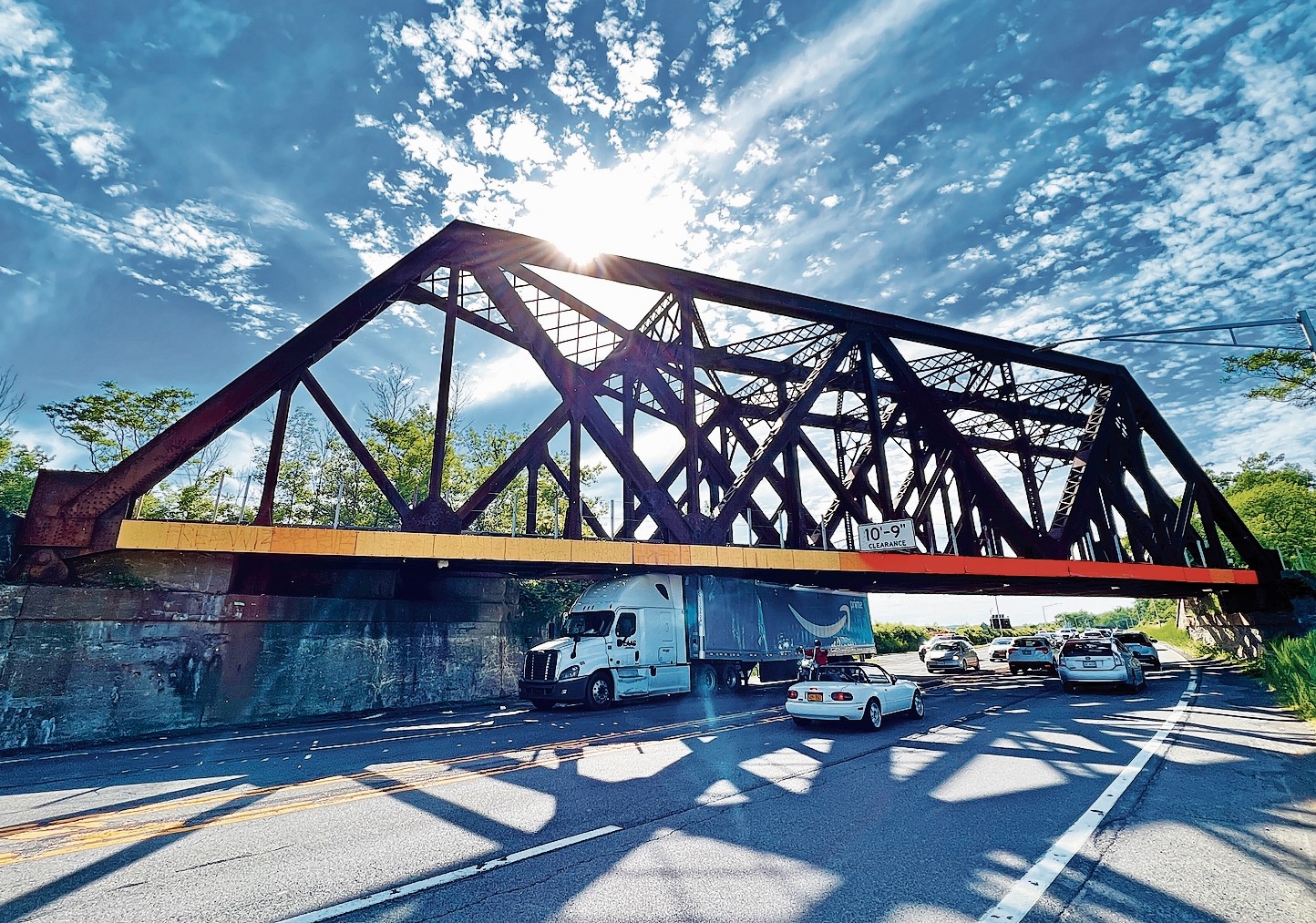
Salina, N.Y. – A reduction in lanes and other changes to traffic patterns on Onondaga Lake Parkway are sure to slow the daily commutes of thousands of drivers and likely worsen rush-hour backups in the village of Liverpool.
The changes announced Friday are part of New York state’s plans to end what has become a routine nuisance: About once a month, a truck driver ignores dozens of warnings and crashes into the low 152-year-old railroad bridge over the parkway.
That handful of drivers, who officials say are likely following a smart phone map rather than watching the dozens of warnings on the road, are reshaping how tens of thousands of Central New Yorkers get to work, school and Onondaga County’s most popular park.
Some of the changes will be implemented immediately, while others will take effect over the next four months. All of them are designed to get truck drivers to obey a ban on commercial vehicles on the parkway and slow down those who continue to flout the ban.
For the first time, the state is doing more than adding signs and sensors, though those are part of the plan.
The number of lanes on the parkway will be reduced from two to one in each direction. A ramp connecting Interstate 81 to the parkway will remain closed for the foreseeable future.
The Department of Transportation is putting traffic lights on the parkway on both sides of the bridge. They will turn red when sensors detect over-height vehicles approaching.
“The trucks would essentially have to run a red light to strike the bridge,” New York Department of Transportation Commissioner Marie Therese Dominguez said in Syracuse on Friday.
The changes will make the parkway safer, Dominguez said. The reduction in lanes will “calm traffic” and give trucks that illegally enter the parkway more time to heed warnings about the low bridge, she said.
Fewer lanes should also limit the chances of head-on collisions on a 55-mph road with no median.
At the same time, state officials don’t know exactly how effective the changes, which will cost an estimated $1.2 million, will be. That’s why some, like closing off access to the parkway from I-81, are temporary.
It’s unclear how long “temporary” will last.
Dominguez said her department will evaluate the impact of the changes, including potential traffic backups in Liverpool, before deciding whether to make them permanent.
“We’re going to have to monitor what the traffic patterns are and how it actually goes,” she said. “We’ve got 22,000 cars a day on Onondaga Lake Parkway, and we’ve got to manage the traffic well, and we also have to keep people safe.”
For now, the state plans to close the parkway entrance from Interstate 81 North, forcing traffic coming from the northbound lanes of the highway to use Park Street to get to the parkway. (Traffic will still be able to use the ramp from I-81 to access Old Liverpool Road.)
And the state is upgrading its sensor system, which uses a combination of infrared beams and cameras to detect tall vehicles headed toward the bridge.
The transportation commissioner said one of the biggest reasons for the frequent bridge strikes is that many truck drivers are relying on consumer GPS apps rather than commercial versions that warn of low-clearance bridges.
In addition, the nation has seen an increase in distracted drivers, with a resulting increase in accidents, since the start of the Covid-19 pandemic, she said.
DOT officials said they are also considering other changes, including reducing the speed limit on the parkway to 45 mph year-round. Currently, the limit is 45 mph during the winter and 55 mph the rest of the year.
Ultimately, though, Dominguez said truck drivers need to pay attention to the dozens of signs, beacons and road markings that warn of the low bridge and the ban on commercial vehicles.
“We can’t do this alone,” she said. “We need drivers, especially drivers of over-height vehicles, to do their part. They need to remain alert.”
Traffic frequently backs up in the village of Liverpool at rush hour already, so the reduction in lanes is expected to add to those jams, at least initially.
So far, two local leaders are open to seeing how the changes work.
Stacy Finney, who was elected mayor of the village on Tuesday and will take office July 3, said commuters can avoid the backups by seeking alternative routes into Syracuse, including Old Liverpool Road, the Thruway and Interstate 690.
“It’s going to be an adjustment,” she said.
Salina Town Supervisor Nick Paro said he supported the changes planned by the DOT and called for the state to waive tolls on the Thruway between the three Salina exits as a way to encourage more motorists to use the highway as an alternative to the parkway. The Thruway Authority has resisted such calls for many years, saying it would only waive the tolls if the state reimbursed it for the lost revenue.
“People should be able to have the option to use the Thruway and it should be free,” said Paro. Finney echoed that sentiment.
DOT Chief Engineer Nick Choubah said the reduction in lanes will take effect immediately. But no signs or road markings alerting motorists to the change were seen on the parkway as of late Friday afternoon.
State officials have considered reducing the number of lanes on the parkway for years. But until Friday, they appeared reluctant to implement the change because of public opposition in Liverpool. A hundred people attended a public hearing on the issue in 2019. No one spoke in favor of the change.
But Dominguez said the surge in trucks hitting the bridge this year forced her department to act. Six trucks have hit the bridge so far this year, she said.
She said the state will continue to study other possible changes to enhance safety, including installation of a median to prevent vehicles from crossing the center line and colliding with oncoming traffic.
Dominguez said the state has been in contact with CSX, the owner of the bridge, about raising the bridge. However, she said it would be an extremely expensive and difficult thing to do, especially given how close the bridge and the tracks leading up to it are to Onondaga Lake.
“It’s a very difficult, structurally, proposition,” she said.
Got a tip, comment or story idea? Contact Rick Moriarty anytime: Email | Twitter | Facebook | 315-470-3148
Credit: Source link