On Nov. 19, 2021, a service truck, driving the wrong way on Interstate 20 near Big Spring, struck an Andrews ISD motorcoach nearly head-on.
Three people died and 50 others sustained minor-to-serious injuries as a result of the crash, which happened as Andrews High School students and officials were traveling to a postseason football game.
In May, the National Transportation Safety Board released its final report on the crash. The investigative details included, “A 2016 Ford F-350 service truck traveling in the wrong direction in the eastbound lanes struck a 2005 MCI motorcoach nearly head-on. The service truck (then) sideswiped a 2018 Freightliner bus. The motorcoach sustained frontal damage, the (2018 Freightliner bus) sustained minor damage to its left side, and a post-crash fire consumed the service truck.”
Nathan Paul Haile, 59, of Midland was driving the service truck, according to the Department of Public Safety.
There are no known reasons why the service truck driver was traveling the wrong way on Interstate 20, according to the NTSB.
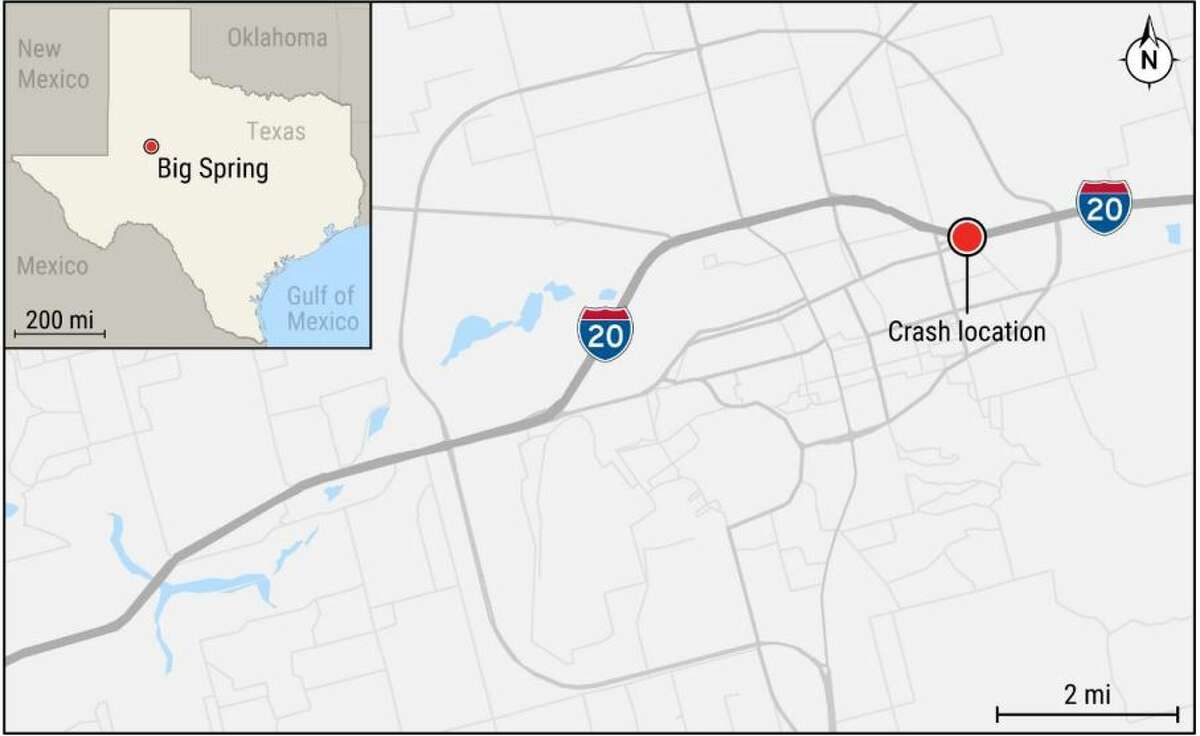
Map showing crash location on I-20. (Source: Google Maps)
NTSB/Google Maps“The factors that were most often cited as a causal in the wrong-way crashes – such as alcohol use, issues associated with older drivers and possible drug involvements – were not factors in this crash,” the NTSB reported.
The following were other highlights of the report.
– The service truck traveled about 1 mile west from the location of the exit 179 ramp when the crash occurred. Surveillance videos from local businesses in Big Spring showed the service truck driver traveling the wrong way on East 3rd Street and past “Do Not Enter” and “Wrong Way” signs before entering Interstate 20 (traveling west in the eastbound lanes). The service truck driver encountered at least four vehicles heading toward him before the crash occurred.
“A witness – who was affiliated with the Andrews Independent School District, was driving a car in front of the caravan and spoke to police at the crash – stated that he was ‘in the right lane and had to swerve into the left as he [the service truck driver] was coming head-on in the right lane.’ The car’s passenger tried to call the band director, who was in the motorcoach to warn the motorcoach occupants about the wrong-way driver, but she heard the crash as she was making the phone call.”
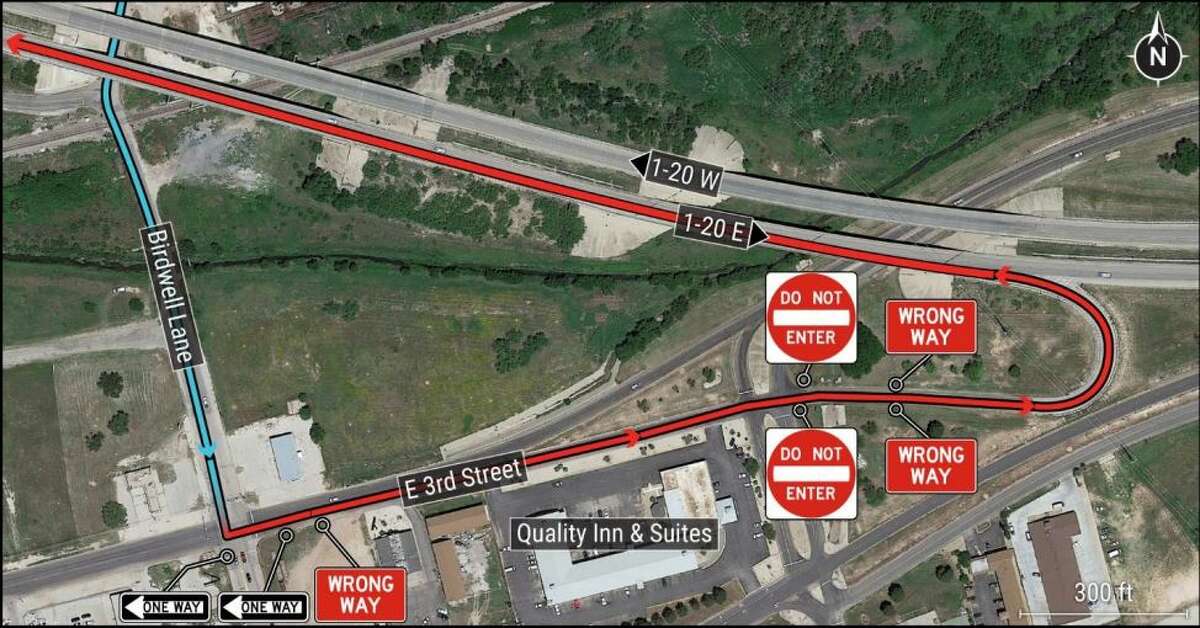
Traffic signs encountered by service truck driver indicating wrong-way travel
from Birdwell Lane until he entered the exit ramp onto I-20. (Source: Google Maps;
annotated by NTSB).
– After the collision with the service truck, the motorcoach traveled into the median and struck the cable barrier before coming to a rest. The service truck came to rest in the right lane of eastbound I-20 and was consumed by a post-crash fire.
– The travel speeds of the truck, motorcoach and bus involved in the crash were unknown.
– As a result of the Nov. 19 crash, the Texas Department of Transportation reviewed crashes in the vicinity of 3rd and 4th streets in Big Spring since 2012 and found that 10 were attributable to wrong-way drivers.
– “The 10 wrong-way driving crashes and this fatal crash led the Texas Department of Transportation Abilene District to undertake an initiative to evaluate and improve traffic operations and signage at all ramp connections and at-grade crossovers on five-lane divided highways. All ramps and crossover are being inspected by the three area engineers to ensure that proper signage is in place conforming to Manual on Uniform Traffic Control Devices for Streets and Highways standards. In addition to the required signage, all ramps will have a wrong-way arrow installed that includes raised retroreflective pavement markers displaying a reflected red light to wrong-way drivers. The projects to inspect and add signage and new pavement markings are expected to be completed by the end of calendar year 2023.”
– Other improvements completed include “Do Not Enter” and “Wrong Way” signs installed at all signalized intersections on 3rd and 4th streets, “Wrong Way” signs installed on every other block with wrong-way pavement marking arrows placed on the roadway pavement at intermediate intervals between the signs and one-way signs have been placed on all traffic signals and stop signs.
Credit: Source link