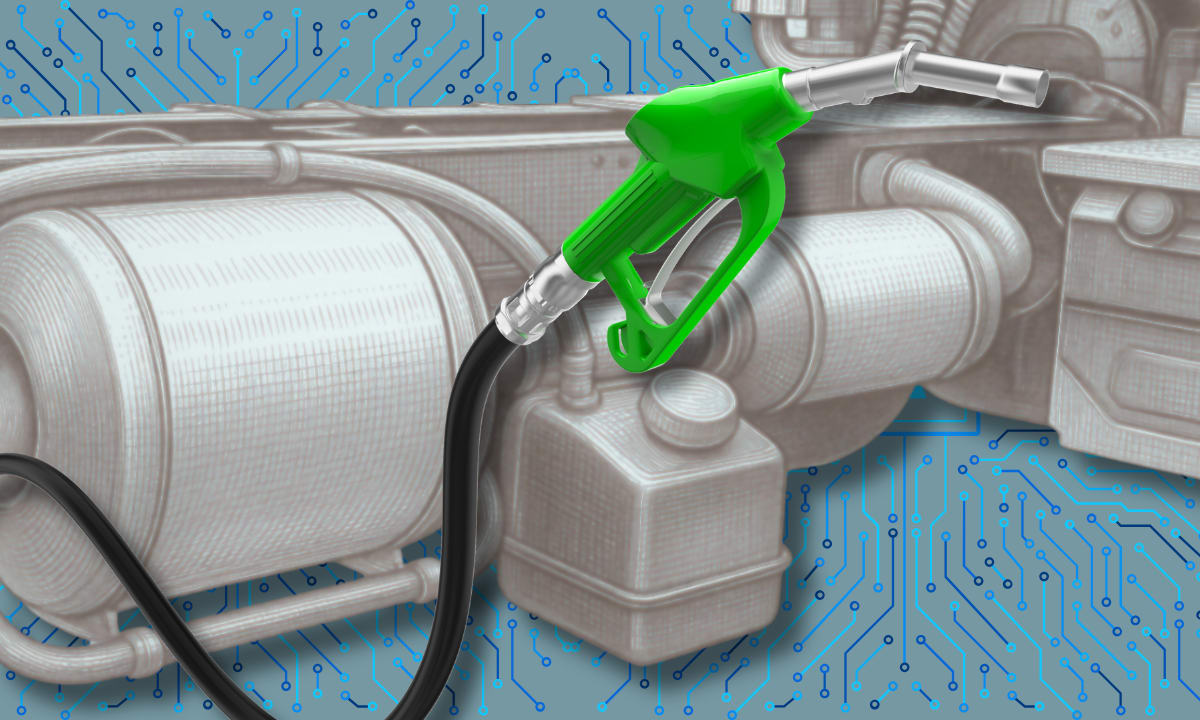
Degraded aftertreatment systems aren’t just a maintenance headache. They also could be wasting fuel.
While it’s no secret that a truck’s mechanical condition can affect fuel economy, that’s not as easily quantifiable as some other fuel-saving strategies. But artificial intelligence can change that, according to predictive maintenance provider Questar.
Questar analyzed a large mixed-class fleet and discovered it was wasting as much as $30 in fuel per vehicle, per day, because of mechanically degraded aftertreatment systems.
A clogged diesel particulate filter creates exhaust backpressure, forcing engines to work harder (and burn more fuel) to expel combustion gases. Degraded SCR systems trigger frequent, fuel-wasting active regeneration cycles to burn off soot.
In a new white paper, The Hidden Fuel Cost of Mechanical Degradation, Questar describes its findings. Excess fuel burned in vehicles operating with degraded diesel particulate filters and selective catalytic reduction systems was running $25 to $30 per day, an average of $27 per vehicle, per day.
In one example, a fleet vehicle showed an average of 0.13 – over 10% – gallons per hour wasted while idling.
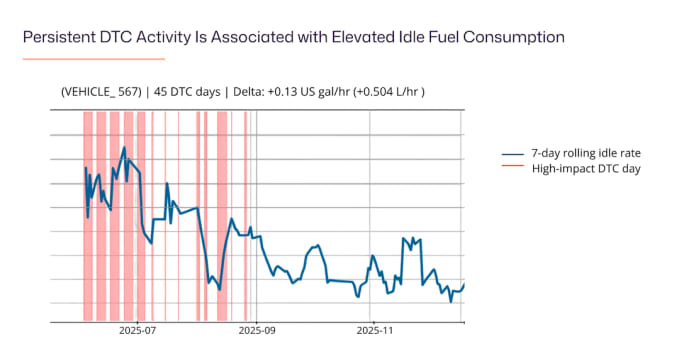
When the aftertreatment system is throwing persistent trouble codes, Questar found, it correlates to more fuel consumption
How AI Can Help
Questar’s AI-driven predictive maintenance platform gives companies real-time visibility into their fleet’s health and the ability to ask questions in plain language.
The white paper explains how Questar’s platform continuously collects and structures rich vehicle data, from raw telematics signals to diagnostic trouble codes, and runs machine learning models that produce accurate, explainable health scores for every major vehicle system.
The question, “Show me the quantifiable impact of aftertreatment system health on fuel consumption across my fleet’s historical data,” initiated an autonomous research agent‘s exploration of the heavy-duty commercial fleet explored in the white paper.
Questar’s Deep Research Agent looked at thousands of vehicle-days, ingesting hundreds of sensor parameters and building predictive models of fuel consumption based on operating conditions, vehicle manufacturer, and type.
The agent built predictive models, trained them on fleet data, then used them to estimate how much fuel each vehicle should use given how it’s being driven on any given day. There were separate models for idle fuel consumption and for driving fuel efficiency.
Then it measured the gap between predicted and actual consumption.
Putting Numbers to the Problem
“Fleets have long understood that mechanical degradation can increase operating costs, but until now had no way to accurately identify and quantify the cause,” said Yuval Shalev, Questar VP for Data Science and AI, the paper’s author.
“Any experienced fleet engineer knows that a clogged DPF or a failing SCR system forces the engine to work harder. What has been missing is the ability to quantify how much fuel is actually being wasted — vehicle by vehicle, day by day, separated from every other factor that affects consumption.
“Aftertreatment system health — the condition of the DPF and SCR system — emerged as the dominant mechanical driver of excess fuel consumption, and now we can put numbers on it.”
Credit: Source link