As battery-electric and hydrogen trucks have been at the center of discussions around decarbonizing heavy-duty transportation, B.C.-based Edison Motors’ co-founder and CEO Chace Barber said the industry has overlooked what he believes to be the ‘common sense transition technology’ — hybrid diesel-electric trucks.
Speaking during a B.C. Trucking Association webinar on July 8, Barber described the company’s drivetrain as “a freight train on wheels,” arguing that pairing electric drive motors with an onboard diesel generator delivers the efficiency and torque of an electric truck but without the associated range limits or charging infrastructure required.
“We had decided several years back, ‘Why don’t we make it like a freight train’, and we can solve the range issue by just putting the generator on board, run the batteries, run those electric drive motors, get the super high torque, high power, and efficiencies of those electric motors, but then as a battery gets low, we just fire up the diesel generator,” he said.
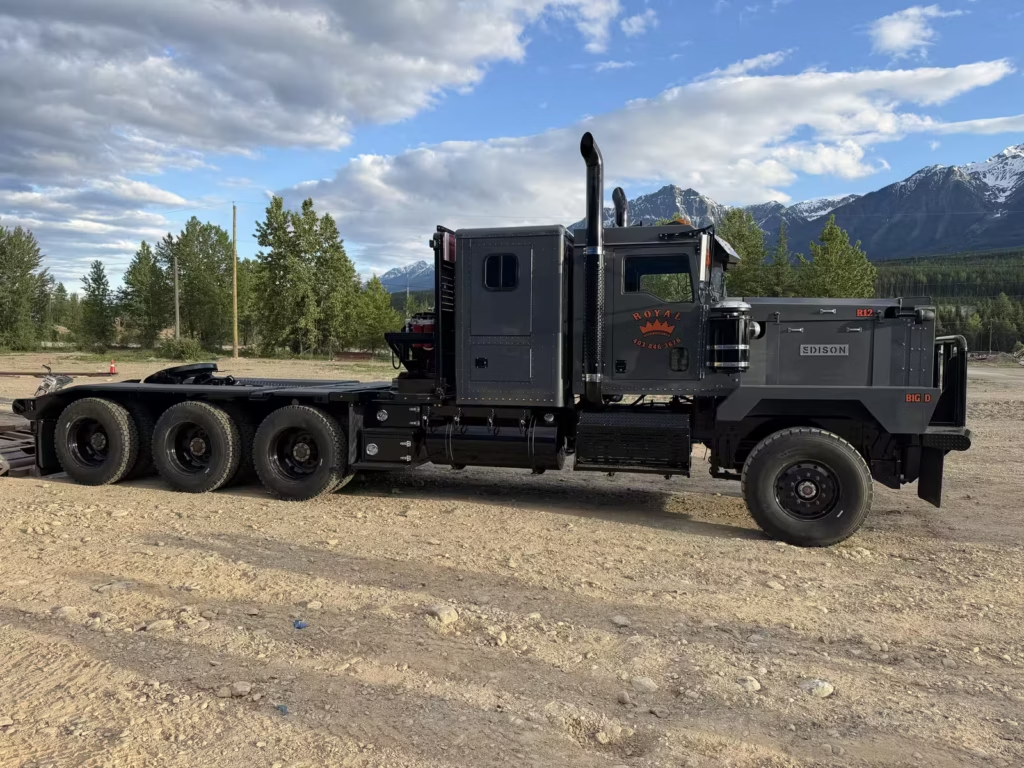
Edison Motors received approval from Environment and Climate Change Canada to manufacture its Class 8 hybrid in Canada in early May, clearing a regulatory hurdle that had delayed production while the company worked with Environment Canada to certify a powertrain.
The company originally planned to use a 9-liter Scania engine as an onboard generator. However, Barber said Environment Canada classified it under a separate set of emissions standards than on-highway truck engines, making it ineligible for highway certification.
“They didn’t allow the generator in the truck, because generators are classified under generator emission standards. On-highway had to be classified as on-highway,” Barber explained.
To move the project forward, Edison replaced it with a Cummins X15. “What they did was they called it an ‘emission control device’. So, the hybrid drivetrain is an emission reduction device added to the on-highway X15.”
How the truck works
Edison’s hybrid uses electric motors to propel the vehicle. The Cummins X15 does not drive the wheels but serves a generator, making electricity to recharge a battery whenever additional energy is required.
Using a smaller battery also avoids many of the weight and charging challenges associated with electric trucks.
Barber said that rather than maximizing battery capacity, Edison designed its battery pack to accept extremely high charge and discharge rates allowing it to deliver more than one megawatt of power when combined with electricity generated by the X15.
Built for heavy-duty applications
Barber also said the hybrid system is not intended to replace conventional diesel trucks in every application.
For steady-speed highway freight, he estimated fuel savings over a conventional diesel truck of between 0-5%.
Urban and regional applications, however, can achieve fuel savings of 30% to 40% because frequent braking allows the truck to recover energy through regenerative braking.
The greatest benefits, Barber said, come in logging, heavy-haul and other resource-sector applications lie rig-hauling where trucks repeatedly climb and descend steep grades or reach the heaviest legal weights. He said it is easier to spec’ trucks for the heaviest jobs while operating well below maximum capacity during everyday work.
“We’ve seen a lot of these trial runs where they’re showing that, ‘Hey, look, we can pull 80,000 pounds on the highway at the port. Well, cool. As a logger, as a low-bedder, I need to be able to move 150,000 pounds for a 15-hour day,” he explained. “Our electric in a tri-drive configuration [with six electric drive motors] is putting out about 2,500 hp and about 200,000 lb.-ft. of torque, and it can pick up that weight, and it can move it. It can climb a grade like you have never seen.”
Barber further described one operation hauling Super-B trailers to a mill over seven- to eight-hour shifts on a short runs, claiming that regenerative braking on downhill runs generated enough electricity that the onboard generator barely needed to operate.
So far, he said, Edison has delivered five or six hybrid trucks to its customers, including one to the military.
Credit: Source link