


Canada’s spot market growth slowed in June, but remained ahead of year-ago volumes, Loadlink recently reported.
Meanwhile, Class 8 truck demand is increasing as freight fundamentals improve and data center construction has become a tailwind. Shippers are also feeling the shift in the freight market, and are seeing among their worst conditions of the past quarter century.
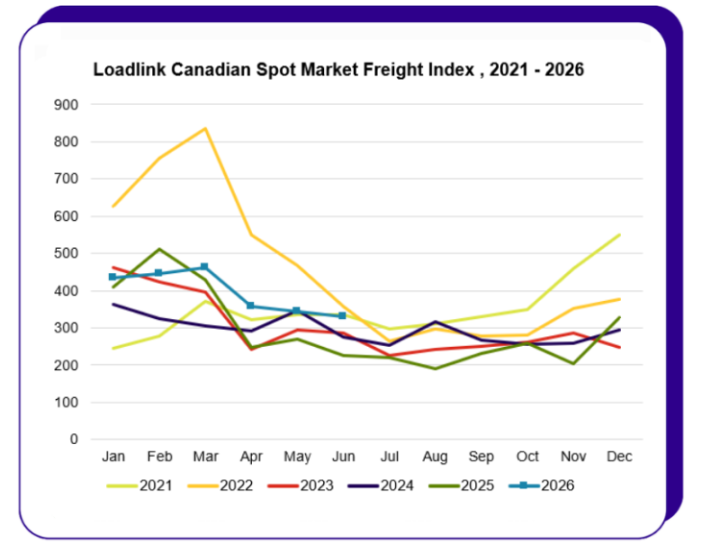
Canadian spot freight volumes remain well ahead of last year despite June slowdown
Canada’s spot freight market lost a little momentum in June but remained significantly stronger than a year earlier, according to the latest data from Loadlink.
Overall freight volumes slipped 4% from May but were up 46% year over year, while truck availability increased, pushing the truck-to-load ratio to 2.34 from 1.96 in May. Despite that monthly increase, the ratio remained 30% lower than June 2025’s 3.35, indicating carriers still faced less competition for available freight than they did a year ago.
Cross-border freight accounted for 62% of all postings from Canadian-based customers. Outbound loads to the U.S. fell 7% from May but surged 86% compared to June 2025. Inbound freight from the U.S. rose 2% month over month and 29% year over year.
Domestic freight represented 37% of postings. Intra-Canada loads declined 9% from May but remained 48% higher than a year earlier. Equipment postings increased 15% month over month and 12% year over year.
“June brought a healthier balance to the market,” said James Reyes, general manager at Loadlink. “Freight activity remained well ahead of last year, while the increase in available trucks gave brokers more flexibility when securing coverage. Carriers still had strong opportunities across key lanes, creating a solid start to the summer.”
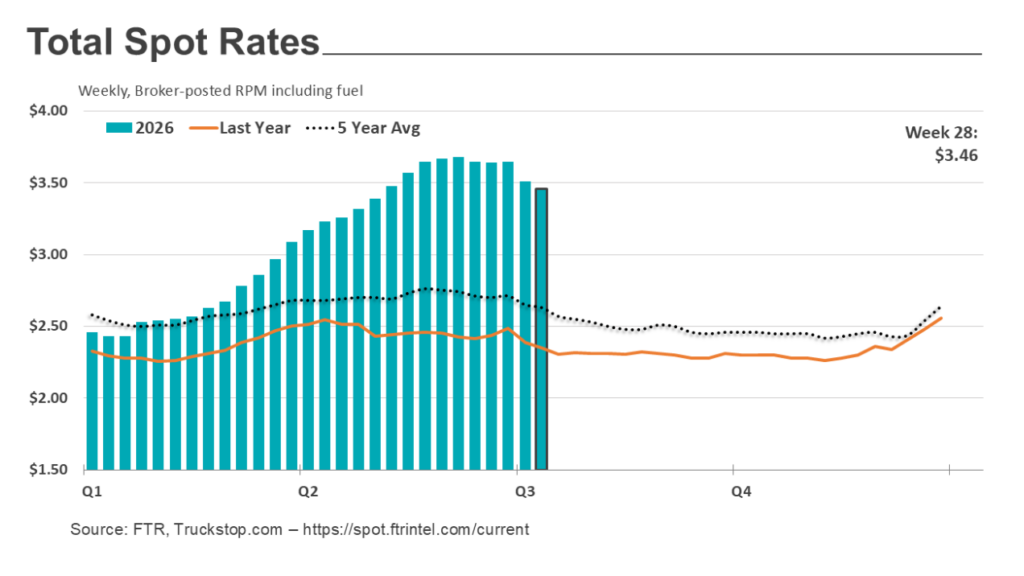
Spot rates decline seasonally in most recent week
Spot truckload rates continued their seasonal decline during the week ending July 17, even as market conditions remained significantly stronger than a year ago, according to Truckstop.com.
The overall Market Demand Index (MDI), which measures the balance between available loads and trucks, fell 18.7 points to 151.0. Load availability declined 5.8% from the previous week while truck availability increased 5.9%.
Despite the weekly pullback, the MDI remained 77.2% higher than the same week last year.
The national average broker-posted spot rate slipped 1.3% to $3.46 per mile but was still 45% above year-ago levels. Meanwhile, the average national diesel price increased 20 cents to $4.86 per gallon.
Truckstop said the market is behaving largely in line with seasonal expectations after the traditional early-July peak, although rising fuel prices could temper the normal pace of spot-rate declines in the weeks ahead.
Dry van rates fell 2.8% to $2.88 per mile as load postings declined and truck availability increased. Refrigerated rates dropped 2.4% to $3.37 per mile, while flatbed rates slipped 0.9% to $3.64 per mile, marking the fifth consecutive weekly decline. Specialized freight posted the largest weekly rate decrease, falling 3.3% to $3.45 per mile.
All four equipment categories continued to post substantially higher demand and stronger rates than a year ago despite the seasonal softening.
Strong freight market continues to fuel Class 8 truck demand
Demand for new Class 8 trucks remained strong in June as improving freight fundamentals continued to support fleet investment, according to ACT Research.
Preliminary North American Class 8 orders totaled 31,400 units in June, up 231% year over year and well above typical seasonal expectations, ACT reported in its latest North American Commercial Vehicle Outlook.
ACT President and Senior Analyst Ken Vieth said the strong order intake, combined with already-full manufacturer backlogs, could result in higher-than-expected production through the end of the year or push some deliveries into the first half of 2027.
“The ongoing supply-led and demand-supported recovery in the trucking industry” has driven the rebound in Class 8 orders since December, Vieth said. “As we often say: Truckers only buy trucks when they’re making money.”
Vieth attributed tightening capacity to a combination of regulatory and demographic factors, including the FMCSA’s crackdown on nondomiciled commercial drivers, new carrier registration requirements, efforts to close ELD loopholes and fraudulent CDL schools, the U.S. Supreme Court’s Montgomery decision, an aging driver population, and broader immigration enforcement.
At the same time, rising industrial activity has boosted freight demand. ACT noted aggregate DAT spot rates exceeded 50% year over year in early July, helping strengthen contract rates as well.
The vocational truck market also remains strong, driven by investment in artificial intelligence and utility infrastructure projects.
Vieth estimated U.S. investment in those sectors is running at US$12.5 billion to US$15 billion per week, supporting record flatbed spot and contract rates. While those infrastructure projects are expected to continue driving demand into 2027, he cautioned that political and local opposition could modestly slow project growth next year.
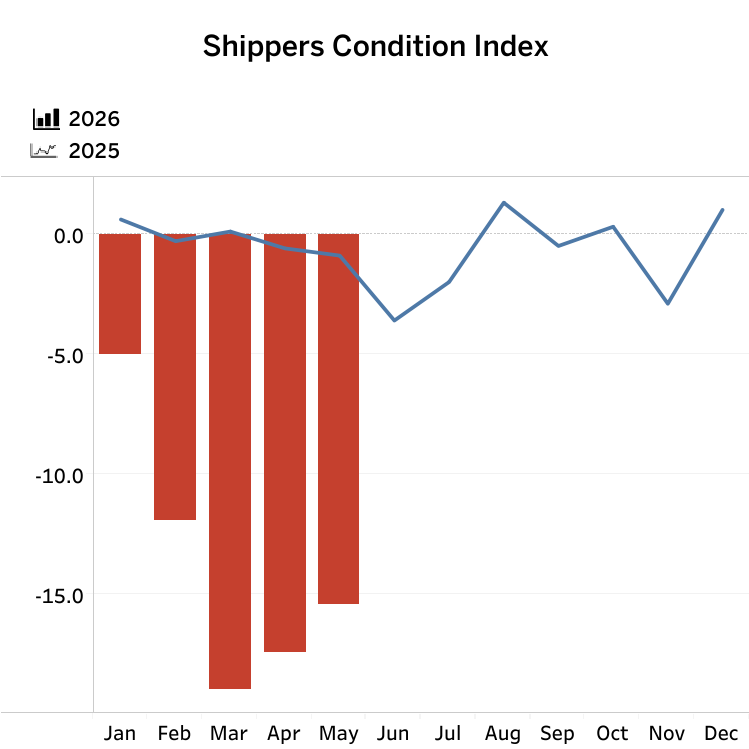
FTR: Shipper conditions remain among worst in 25 years
Market conditions for shippers improved only marginally in May and remained among the least favorable seen in more than two decades, according to FTR.
The firm’s Shippers Conditions Index (SCI) improved to -15.4 in May from -17.4 in April, but the reading still ranked among the six worst since FTR began tracking the index in 2000.
FTR said freight rates continued to be the primary factor weighing on shippers, offsetting the modest improvement from the previous month.
“There is little in the way of good news for shippers,” said Avery Vise, FTR’s vice president of trucking.
While June’s preliminary SCI points to some relief from lower fuel prices, Vise warned that trend appears to have stalled and could reverse. He added that the only factor providing near-neutral conditions has been relatively soft freight demand, although that varies by equipment type.
FTR expects conditions to gradually become less challenging over the coming months but forecasts the SCI will remain negative throughout its two-year outlook.
“Most risks to that forecast probably are to the downside for shippers,” Vise said.
Credit: Source link


