

Every owner-operator intimately knows that today’s trucking business environment is challenging, at best. There’s a lot about it that individual owner-operators have no control over: for instance, the macro-economic forces of global demand for goods and the demand for crude oil to make diesel fuel, and more micro-economic measures of supply (overall trucking capacity) versus the demand for freight transportation. We do have 100% control over how we manage our businesses in today’s market, though.
Today, with relatively low freight rates coupled with high fuel costs, are you still running your business the same way as you did in the good, booming years? If the answer is yes, it’s high time for a change.
In order to compete with large fleets that have a business-operation advantage based on sheer size, owner-operators must leverage inherent operational efficiency to be competitive. By definition, owner-operators lack this advantage. Those without a durable competitive efficiency advantage will inevitably find themselves with neither advantage.
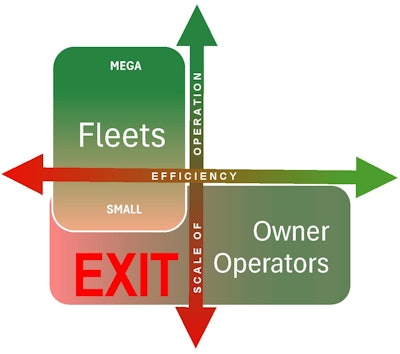
 These operators will find themselves in the lower-left quadrant on the chart and at the mercy of the market or heading to the exit — whether by choice or as a victim of getting culled from the herd.
In the booming good times mid-late 2020 through the entirety of the next year, high freight rates and relatively low fuel cost underscored the perfect strategic sense for owner-operators to focus on high productivity. The strategy was to run fast to maximize higher revenue. Back then, it was OK to run harder, even if less efficiently, as high rates more than offset the higher fuel costs of greater speed.
 Efficiency is always important for a business owner, and remained so during the boom time. Yet it was a secondary consideration, as illustrated in this figure.
The aim is to work smarter, not harder!
There are two ways to do this:
- Increase the quality of the revenue, not the quantity of revenue miles.
- Increase your business’s efficiencies — both fuel efficiency and operational efficiency.
This way you attack the current bust market on two fronts by moving from high fuel costs to lower fuel cost per mile, and increase the freight rate per mile by improving the quality of the rate. (Ways toward the latter: Expanding your niche market capabilities; transitioning from live load/unload loads to power-only drop and hook loads; moving from solo driver to team operations; addressing customer challenges with driver assist, after-hours driver unload, cross border, etc.; or another operational shift.) If you want to transition from the bottom-of-the-barrel freight rates offered in “commoditized” markets that are the bread-and-butter of the larger fleets, you’ve got to move out of their lane and leverage your own capabilities.
Equipment can help, but that’s not the end of the story
Optimized vehicle specifications can help deliver maximum fuel economy. Spec’d as aerodynamically as possible, including the trailer in that calculation, our “Purple Haze” 2023 Volvo VNL 760 can pull 80,000 lbs. GCVW at 800 rpm at 55 mph. An efficient truck/trailer combo will turn high fuel prices into profit.
 The fast rear axle ratio (RAR) allows the Volvo I-Torque spec to comfortably run long distances at a reduced piston speed, better matching power generated to power required, to achieve superlative fuel economy.
At 6 mpg (a common fuel-surcharge basis mileage), fuel economy simply offsets fuel expense. At today’s pump prices, 8.9 mpg and above enable fuel surcharges to be a real profit center; assuming a fuel discount program is in place, 7.9 mpg fuel economy will do the same. [WE MIGHT NEED A LITTLE MORE ABOUT YOUR REASONING FOR THIS — ARE WE SPEAKING SPECIFICALLY ABOUT WHAT YOU SEE IN YOUR OWN OPERATION/CONTRACTS/HOW YOU NEGOTIATE RATES? TO MY THINKING IF A FUEL SURCHARGE WITH A CARRIER FOR A LEASED OWNER IS ON A 6 MPG BASIS, ANY FUEL MILEAGE ABOVE 6 MPG FOR THE OPERATORS TURNS THE SURCHARGE INTO A PROFIT CENTER, THAT IS IT WOULDN’T BE LIMITED TO GETTING UP TO 8.9 NECESSARILY. GENERALLY, THE SENTIMENT MAKES SENSE, BUT THE DETAILS FEEL MURKY TO ME HERE.]
Yet getting equipment specs in line isn’t the only answer to the question of how to improve efficiency. Goals there also require a mind-set for proper load selection and realistic dispatching that accounts for lower average speeds, speed management to reduce changes of inertia, and proper driver behavior during non-driving periods. (Use those APUs, eAPUs, bunk heaters, solar panels to charge the batteries, etc.)
Based on years of experience, we consistently achieve hyper-fuel efficiency because we strategized and designed and implemented plans to attain that goal. Moreover, we routinely offer these keys to success to help others become more profitable in their business operations:
- Proper truck specs prevent piss-poor fuel economy. Don’t drive beyond your truck’s specs. Today’s goal is to run efficiently, not fast! We spec’d for our on-highway specific duty cycle all of the following: engine, transmission (Volvo I-Shift automated manual), fast rear axle ratio [WHAT’S THE RATIO IN PURPLE HAZE’S CASE?], aerodynamics, 6-by-2 configuration with liftable axle, driveline, tire selection (tread design for low rolling resistance, purpose), non-torque reactive suspension, fifth wheel placement, lubricants, fuel additives … This list goes on. The Volvo I-Torque specs provide drivetrain versatility that allows the truck the ability to perform multiple roles without needing to swap trucks. Thus: No compromise between productivity and efficiency!
- Use preventive maintenance to maintain “optimal” specs, not simply factory specs. Have an annual maintenance program that proactively maintains your livelihood’s equipment in top-performing condition.
- Drive as slowly as possible, and only as fast as necessary. Why drive faster only to waste fuel, and to wait longer at the destination? Optimize the situation! Ask whether running faster is justifiable in today’s freight markets, whether you have appointments and/or have not already secured the next load. Evaluate the cost of increased productivity against the cost saved with increased fuel efficiency.
- Match average dispatch speed to the time and distance alloted for any move. The average dispatch speed is the number of miles from shipper to receiver divided by the dispatched available hours to complete the run between scheduled/appointment times. This includes all stops, breaks, rest periods, etc. It’s important to distinguish between cruise speed and dispatch speed. if the average dispatch speed is much more than 50 mph (requiring a cruise set speed of at least 60 mph), then this becomes a costly load to run. A load with cruise-set speed of 70 mph will only yield an average dispatch speed of 55 mph. Higher cruise speeds to meet a time crunch will degrade the profitability of the load.
- Pulling power-only loads can minimize live loading and unloading and thus detention times to maximize miles, especially with team operations.
- Pull aerodynamic trailer equipment to maximize fuel efficiency. If not aero-efficient, why bother? An aerodynamic trailer reduces the power required so you can operate more efficiently by only generating the power needed, which may allow for staying in top gear longer.
- Optimize fuel purchases by utilizing group fuel purchasing power by buying fuel in-network and then, within that network, at the cheapest ex-tax price along route. Remember that fuel expense is the product of two factors: purchased fuel quantity and net fuel price. See National Association of Small Trucking Companies members’ savings, like other large group programs. Our high fuel economy routinely saves us about $2,400 per month versus a typical truck getting 7 mpg, while our fuel discount program saves an additional $600 and more. Who cannot benefit from saving $3,000 or more monthly per truck?
- Develop a deep understanding of operational data through telematics.
- Capitalize on your strengths, whether the time efficiency a team operation can bring, a specialized market niche, value-added services only a small business can offer, and/or close agent/broker relationships.
In essence, owner-operators absolutely must make or truly solidify the strategic shift from “steering wheel holding truck driver” to savvy business owner to succeed in down markets like that of the present. Otherwise, you’re better off remaining as or reverting back to being a company driver. For former owners, it could mean leveraging professional and financial experience as a trainer for developing new drivers.
Here are a few key elements of our 2023 Volvo’s success achieving the mpg we have, from aftermarket suppliers worth investigating:
Credit: Source link


