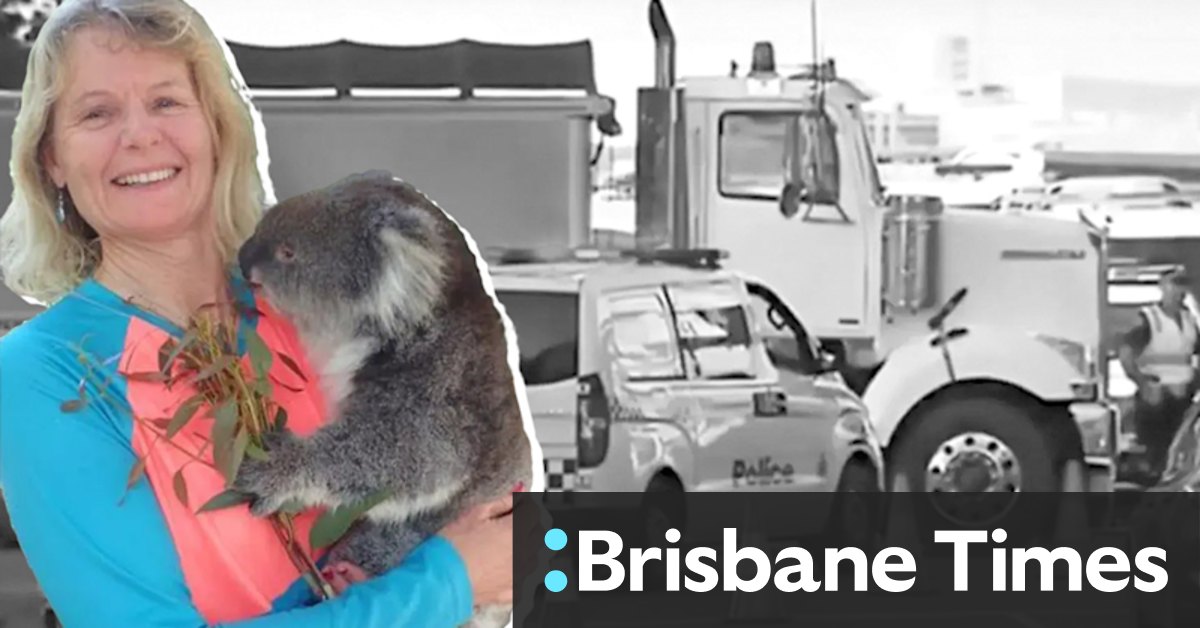
Forensic Crash Unit police found the truck had a large blind spot, and an object 1.7 metres tall would need to be at least 2.8 metres in front of the tip truck before the driver could see it.
The Boral-contracted truck was not required to, and did not have, blind spot mirrors, cameras or sensors.

The scene on Bowen Bridge Road after Carolyn Lister’s death.Credit: Seven Network
That was despite the recommendations of a coronial inquest into the death of Danish student Rebekka Meyer, who was hit by a truck while riding on Annerley Road in South Brisbane in 2014.
Five years before Lister’s death, that inquest had called for “conventional shaped heavy vehicles [to be] prohibited unless they are fitted with appropriate technologies to warn the driver of any obstacles or other road users within the forward blind spot of the truck”.
Thacker’s report says this was not implemented “due to the cost of retrofitting, lack of similar interstate legislation and high frequency of heavy vehicles crossing state boundaries”.
Loading
Transport and Main Roads (TMR) sought support for the introduction of blind spot technology in all new heavy vehicles after the Meyer inquest, through the National Strategic Vehicle Safety and Environmental Group, but it was decided Australia had limited capacity to influence international manufacturers as it was a small market.
Space 4 Cycling advocate Belinda Ward said she was disappointed an inquest was not held. She believes blind spot technology, like mirrors, “could have prevented this tragedy”.
“It’s not like she put herself in that situation doing anything illegal – she rode down the road on a bicycle,” she said. “A small mistake shouldn’t cost people their lives.”
Bicycle Queensland chief executive Lisa Davies Jones described Lister’s death as tragic and unnecessary.
“She died because there is no appropriate cycling corridor around the Royal Brisbane Hospital, a major workplace,” she said.

A memorial for cyclist Carolyn Lister near the hospital.Credit: space4cyclingbne
Brisbane City Council told the coroner it had done a planning study to improve safety at the intersection.
On October 1, 2023 – three years after Lister’s death – new federal standards came into effect for new trucks, including mandatory safety features such as devices to reduce blind spots and side guards to stop pedestrians and cyclists from being caught under the rear wheels.
Following an internal review, Boral required its trucks to avoid the intersection from February 2021.
A Boral spokesman said the company had acted to ensure its fleet had appropriate blind spot mirrors or cameras, including for contractors.
“We express our condolences to the family and friends of Carolyn Lister for their loss,” he said.
Credit: Source link