As part of its commitment to hiring local workers and providing opportunities for women to enter traditionally male-dominated fields, Bechtel Energy is partnering with Lamar State College Port Arthur to establish a women-only commercial driver’s license program.
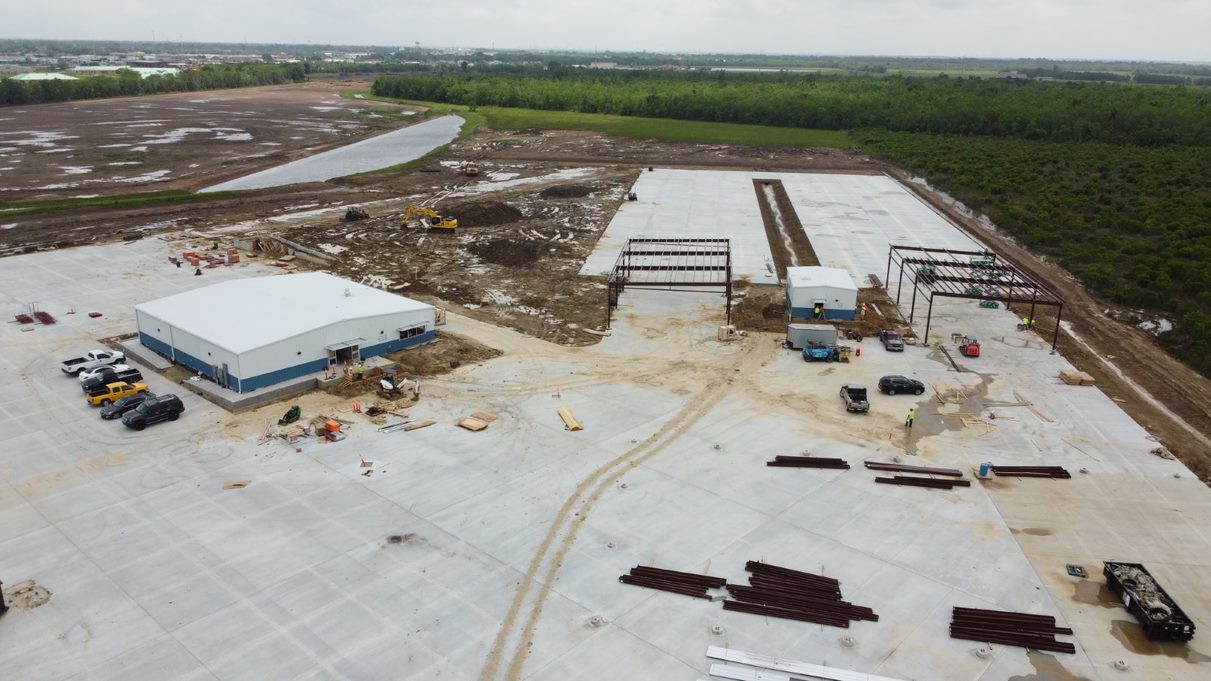
After Bechtel earlier this year was awarded a development contract to construct the Sempra Port Arthur LNG liquefaction project in Sabine Pass, the company saw a perfect opportunity to train and hire more female drivers, construction workers and engineers to fulfill its needs.
“With this initiative, we can both increase opportunities for women and address the shortage of qualified CDL drivers,” Bechtel Port Arthur LNG Project Manager Kane McIntosh told The Enterprise via email.
The initiative also comes at an ideal time for Lamar State College Port Arthur, as it gearing up this summer to officially unveil its CDL training and testing center, set to be the largest in Texas.
“From this side of Houston all the way up around Livingston, we (train) on an average year, 100-plus new drivers,” college Vice President of Workforce Development and Continuing Education Ben Stafford told The Enterprise. “We are also an examination center — we can conduct the knowledge and the skills exam that leads to the commercial driver’s license. We’re the only third-party examination center in this region as well.”
RELATED: Lamar Port Arthur receives $1.75M from local foundation
Bechtel has partnered with Lamar Port Arthur for more than a decade, focused on helping community members develop the skills necessary to pursue careers on its construction sites, McIntosh said.
“They need several hundred drivers (for the Port Arthur LNG project),” Stafford said. “They’ve asked us to run training classes just for women for the driving positions, and in the future, the craft positions.”
In his decade at Lamar Port Arthur, Stafford said the college has never deliberately run an all-female cohort for its programs, adding that this occasion is also the first in which an industry partner has requested such an initiative.
“We immediately said, ‘We can help you with that,'” he said. “We have a lot of women students request to train for our positions. If you look at the applicants to the truck driving academy, just under 30% of applicants are women. Yet, if you look at those who actually commit and go through the class, it falls to about 10% women.”
Stafford said a lot of female students are interested in the CDL and craft programs, but many don’t feel like they can fit in there, leading them to not follow through with the program.
RELATED: School history made at Lamar Port Arthur with 3 state recognitions
“I think this will give a good incentive to see those people follow through and really get a career,” he said. “Not a job, but a career — some really good income with benefits.”
In the transportation field in general, Stafford said he’s seen more women interested in the profession.
“We’ve seen a lot of women coming in as solo drivers and a lot of women coming in team driving with their husbands,” he said. “That’s the reason truck stops are much nicer places over the last five years…women have dictated that.”
At the same time, the country is experiencing an “extreme shortage” of about 78,000 drivers, according to the American Trucking Association’s 2022 shortage update. In that same update, the association said one of the factors contributing to the shortage is the low representation of women.
Women make up just under half of the U.S. workforce, whereas in truck driving, they account for just 8% of all drivers.
The impact of such a partnership can be seen in Tolitha Jackson, who graduated from the Lamar Port Arthur’s CDL program in 2021. Jackson, 40, started her own training and operations management company, Lemonade Logistics, in 2022, utilizing many of the skills she learned through the Lamar Port Arthur CDL program.
RELATED: Local schools receive $3.7 million in state grants for career, technical education
Jackson is currently working to offer training courses at Lamar Port Arthur and Lamar Institute of Technology centered on hot shot trucking in the owner-operator market as well as dispatcher training.
“I basically learned how to run a company doing these things, and so now I’m teaching people how to (do the same) on the other end,” she said.
Jackson was laid off from her job as a contracted dispatcher for Chevron Industrial Lubricants in Port Arthur when the COVID-19 pandemic hit. At that time, she saw an opportunity to earn a living in trucking, which she said was “booming.” Jackson’s CDL training was covered by the Port Arthur Economic Development Corporation and Texas Workforce Commission, and it took her about at least four months to complete.
“I tested out, went to work, hated it,” she said. “I drove briefly for a highway construction company, and I was still under-employed, not making enough money. With my background, knowing how much the freight costs, knowing how much it costs to book the freight and then you’re only paying me how much? The more you know, the more you want to grow.”
While the driving aspect of the trucking industry wasn’t for her, Jackson said the Lamar Port Arthur CDL program taught her about all of the aspects of the industry, leading her to start her own business doing what she feels fits her lifestyle better.
RELATED: Worker shortage puts truckers in the driver’s seat
“When I think about my business, I think about all of these different aspects that I could use to (grow) my business,” she said. “If I’m an outside person thinking about getting a CDL, all I’m thinking about is the driving, but there’s so many other aspects of the business that you can get into and I just want to let women know about that because it’s all profitable.”
The field is competitive, for both men and women, Jackson said.
“The guys are feeling the pressure because females are in all equipment, not just trucks,” she said. “I’m seeing more female track hoe operators, I’m seeing more women doing more work with heavy operating equipment and the reason for that is they’re more delicate with the equipment. Owners of businesses are noticing that when they have women, there’s less maintenance on that truck, because they’re not Tonka toy-playing in the trucks and tearing up the vehicles. So, why not hire women?”
On the dispatching side, women have always been in the industry, Jackson said.
“Women aren’t just in the office, they’re outside and they’re not just working for trucking companies, they’re owning trucking companies,” she said. “Women are not just the help anymore, they’re actually the operation.”
As soon as the college begins receiving applications, Stafford said they will launch the first all-female driving cohort. The college hopes to launch its first all-female carpentry cohort in the fall.
“Bechtel has committed that any of the students who come through and graduate and meet their onboarding criteria will be hired by Bechtel and will go immediately to work on this project,” Stafford said. “It’s a big deal for us (to help alleviate the shortage). It’s what we’re all about. We are a state college, we’re the educational arm of Texas…it is our mandate to meet the needs, so this is what we’re here to do.”
Credit: Source link