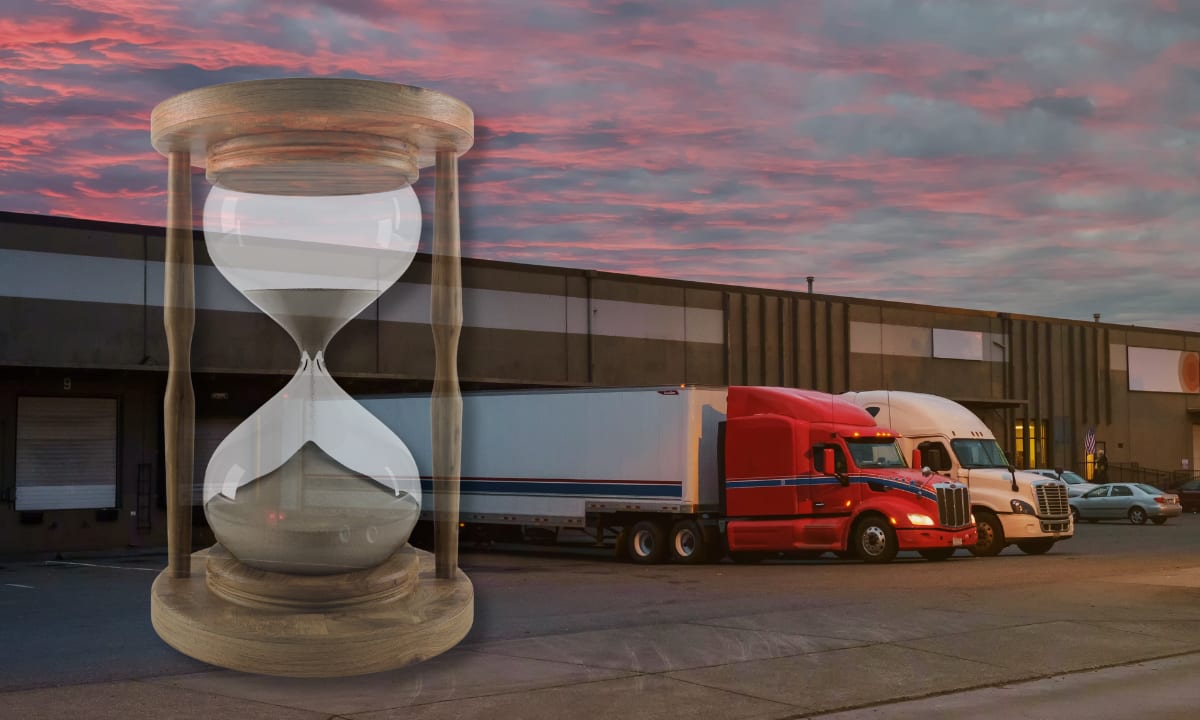
A 2024 ATRI study found detention affects nearly 40% of truckload stops and costs the industry more than $15 billion annually. Despite the toll on drivers, fleets, and supply chains, the problem remains stubbornly persistent.
Picture a cramped classroom. Students doodling in their notebooks, the clock slowly ticking to 4 p.m. and dismissal. Detention. The dreaded after-school punishment every kid sought to avoid.
Now picture something far worse: truck detention.
Instead of students sitting in a classroom, it’s truck drivers sitting at facilities, helpless to do anything as they watch the chaos and inefficiency of the yard. Soon, they run out of hours of service. They won’t be able to pick up their next load and may even arrive home late, missing out on precious family time.
Truck detention was voted as the fifth-highest issue for drivers and causes the industry over $15 billion in annual losses, according to a 2024 study by the American Transportation Research Institute. Yet most people in the industry accept detention as a cost of doing business.
“Detention is so common that many industry professionals have accepted it as inevitable without realizing the true extent of its cost,” said Chad England, CEO of C.R. England, in a news release about the ATRI results.
When digging further into the data, it’s clear that detention and its impact are worse than many realize. Even when detention is paid out, the cost is far greater than the fees fleets collect.
The Financial and Human Cost of Detention
ATRI’s 2024 study on detention updated an analysis first released in 2019. The data shows that detention occurs on nearly 40% of all stops — 56% for refrigerated loads.
That adds up to 135 million hours of detention a year in the for-hire trucking industry. For perspective, that’s enough time to complete almost 1 million round-trip lanes from Chicago to Los Angeles.
With all that lost time comes lost dollars. In terms of top-line revenue (mainly the revenue lost from the truck not being able to move freight) the impact is $11.5 billion.
Detention fees are paid out by the shipper in less than half of all incidents, and even when they are paid out, they do not cover the full expense, according to ATRI. Direct expenses incurred while waiting in detention, such as fuel, salary, insurance, and truck payments, total $3.6 billion annually.
Common Causes of Truck Detention
What’s causing this detention? Every instance is unique, but there are several common themes:
- Scheduling issues at customer facilities
- Insufficient dock or parking capacity
- Staffing shortages at customer locations
- Upstream production delays
- Driver late arrivals
That last issue, drivers’ late arrivals, is one of the more pesky parts of the crisis. If a driver shows up 30 minutes late and then waits 8 hours because they are now a work-in, can they still charge detention? By the letter of the contract, likely not.
But was an 8-hour delay really necessary for showing up 30 minutes late?
And what if the driver was late because they were detained at their previous stop? Who should be responsible?
Why Driver Safety Suffers When Delays Grow
The monetary costs are just a sliver of the actual impact of truck detention. Recouping detention dollars is great, but in the long run, what matters most is the driver, their safety, and their quality of life.
In trucking, nothing should be more important than getting drivers home on time and safely. Detention often disrupts this.
Drivers often attempt to make up for lost time caused by detention. ATRI found drivers who were detained drive 15% faster; refrigerated drivers drive 27% faster. An extra 15 minutes of dwell time raises the crash rate by over 6%.
A Better Approach to Solving Truck Detention
There is no cure-all for detention. It is a pervasive problem rooted deep in the industry. Although a free market can fix many inefficiencies, this is one that has not yet been solved.
The imbalance of information between carriers and shippers remains a significant obstacle to eliminating detention.
Many transportation management systems have detention modules that track the trucks and may alert dispatchers when detention is starting. However, they typically require a manual touch from the dispatcher.
The owner of a 150-truck fleet in Arkansas told me, “We pay for our TMS’s detention module, but our dispatchers are still doing 99% of the work.”
Stop Seeing Detention as the Status Quo
So, how do we start to solve the detention problem?
First, it will take an attitude adjustment on both sides.
Carriers should not simply accept detention as a cost of doing business.
Shippers should stop treating trailers as though they’re temporary storage and should instead view detention as the inefficiency it is.
That’s not to say there aren’t good shippers. In fact, the transportation manager at a Fortune 500 company recently told me they want to pay detention but need to confirm it’s valid. This information also can provide insights into the shipper’s problem facilities and allow them to better allocate resources.
Of course, a mental shift isn’t going to solve the problem on its own. Carriers need access to the same information as shippers.
Can Better Data Help Reduce Truck Detention?
Historically, carriers have had limited visibility into shipper performance. That imbalance makes it difficult to account for detention when pricing freight or planning operations.
If a shipper can vet a carrier, why can’t a carrier vet a shipper for how it handles things like driver detention? What is the average wait time at the shipper’s facilities? When detention does happen, how often does the shipper pay it out?
The answers to questions like these can help carriers make better decisions about loads, including how to properly price them to account for expected detention.
Once shippers start feeling the burden of detention, whether through detention fees or higher rates, they will be financially incentivized to improve their operations. Investment in warehouse and yard management systems will increase, and in turn, driver detention will decrease.
It is a long way off and will require collaboration across the industry, but I believe eliminating truck detention is possible. For now, the first step is understanding the ground truth.
How much time are your trucks spending in detention? The answer is probably higher than you think.

Tim Roberts
About the author: Tim Roberts is co-founder of Docktime, a platform aiming to eliminate truck detention through tools and technology for drivers, carriers, brokers, and shippers. He has a long family history in the trucking industry, dating back nearly 100 years. Tim graduated from MIT in 2019 with a degree in Civil and Environmental Engineering.
This article was authored and edited according to Heavy Duty Trucking’s editorial standards and style to provide useful information to our readers. Opinions expressed may not reflect those of HDT.
Credit: Source link