One of the saving graces of the freight recession has been the unusually stable diesel prices over the past couple of years. After the last spike to $5.75 in June 2022, the average U.S. retail price of a gallon of ultra-low-sulfur diesel has hovered at or below $4 per gallon since the end of 2023.
Until the attack on Iran caused crude oil prices, and thus diesel prices, to skyrocket.
History shows us that prices eventually come back down. But for trucking fleets, it’s not just about high fuel prices. It’s also about the uncertainty, the volatility, and how fast the assumptions behind your fuel budget and business strategies can change.
Advocates of alternative fuels and fleet electrification point out that there are alternatives to diesel that aren’t as vulnerable to these kinds of price shocks.
Fuel Choices Are About More than Regulations
With the change in the regulatory environment under the Trump administration, fleets aren’t feeling the same pressure to move away from diesel into alternative fuels or electric vehicles.
But trucking fleets that have been ahead of the curve on adopting alternative fuels and electric vehicles have had other reasons to make the investment beyond regulations.
For some, it’s a sincere belief and corporate value in the need to do better by the environment.
Often, that’s the case with private fleets of major corporations, particularly for those based in Europe or even Asia. These global companies have not forgotten about their sustainability programs. They may not be promoting them as much in the current environment, but they’re still there.
We can see the same thing in for-hire fleets, whether it’s their own corporate values or customer demands. Some of HDT’s Top Green Fleets are using data-driven approaches to provide lower-carbon alternatives to customers, as well as carbon emissions calculations that customers can use to estimate their own carbon footprint.

There is increased interest in renewable natural gas as a truck fuel. Here a demo truck participates in the ride-and-drive at ACT Expo.
But now, in addition to regulations and sustainability goals, fleets have another reason to look seriously at alternative fuels: Preparing for the next oil shock.
What used to be sustainability or compliance decisions are increasingly just good risk management decisions.
Whether it’s electric trucks or renewable natural gas or renewable diesel, all may be options for some portion of your fleet, depending on location, duty cycle, and other factors.
Of course, alternatives bring their own challenges regarding infrastructure, policy, vehicle investment, and supply. But it’s worth investigating where they may have a place in your operations.
The New Pillar of Alternative Fuel Strategy: Resilience
Diesel fuel prices are closely tied to crude oil. Oil, as a global commodity, has prices driven by geopolitics, including wars, OPEC actions, and refining capacity. On top of that, events such as hurricanes in the Gulf of Mexico will cause price spikes because so much U.S. refining capacity is located near the Gulf Coast.
That’s not to say that alternative fuels don’t have their own volatility risks. But their price swings are triggered by other factors.
Energy diversification is the new fuel strategy. Or, if you prefer, “Don’t put all your eggs in one basket.” Fleets that rely on a single fuel will be more vulnerable to price spikes and potential shortages than fleets with multiple fuel sources.
That’s one way trucking fleets can be more resilient in the face of unpredictable fuel prices, availability, government regulations, and customer demands.
According to McKinsey & Company, resilience is the ability not only to recover quickly from a crisis, but also to bounce back better.
“Truly resilient organizations don’t just bounce back better; they actually thrive in hostile environments,” the company says.
Applied to the question of how we power freight transportation, resilience ties right in to other fleet priorities, such as cost control, customer service reliability, driver retention, and ESG/customer pressure.
The fleets that are coming out ahead aren’t the ones picking a winner. They’re the ones building enough flexibility to adjust when things change.
So let’s take a look at some of the alternatives.
What Drives Natural Gas Fuel Prices
Unlike diesel, compressed natural gas and renewable natural gas are largely produced in the U.S., which helps insulate them from global price swings.
Sudden changes in natural gas prices are driven more by weather and storage than geopolitics. For instance, The Henry Hub natural gas spot price spiked to all-time highs in late January 2026, driven by Winter Storm Fern. But that spike only lasted about a week.
Domestic natural gas prices remain comparatively low, hovering near $3 per MMBtu, and are projected to stay stable due to our country’s abundant supply and pipeline infrastructure.
In fact, high oil prices can encourage more oil drilling, and natural gas is a byproduct of that process.
While the U.S. exports crude oil and diesel fuel, natural gas is a lot more local. It has to be liquified in order to ship abroad. Most of the natural gas in the U.S. gets used here, and there’s plenty of storage.
Average retail fuel price figures from the Alternative Fuels Data Center showed that last October, compressed natural gas was $2.96/GGE (gasoline gallon equivalent) while diesel was $3.74/gallon.
One natural-gas fuel provider told me they can work with fleet customers to lock in a rate for up to 7 years. Not only does that make managing fuel expenses more stable for the fleet, but it also gives trucking companies a selling point to customers. Fleets can approach shippers and sell the idea of locking in a long-term contract – one without fuel surcharges.
What About Renewable Fuels?
Renewable fuels bring a different kind of pricing dynamic.
Renewable diesel has garnered a great deal of interest, as it’s a “drop-in” fuel that doesn’t require investments in new equipment or maintenance facilities.
Over the past five years, there has been significant growth in renewable diesel production in the U.S. In 2020, there was about 1 billion gallons (3.8 billion liters) of capacity. Last year, we surpassed 5 billion (almost 19 billion liters), according to Donnell Rehagen, CEO of Clean Fuels Alliance America.
But it’s not a complete hedge against price swings.
Renewable diesel prices are driven by the feedstocks used to produce it, such as soybean oil or animal fats. Policy incentives are also an important factor, whether RIN credits through the Environmental Protection Agency’s Renewable Fuel Standard (RFS) program, state low-carbon fuel standard programs, or blender tax credits.

Before he added battery-electric trucks to his regional LTL fleet, Keith Wilson adopted renewable diesel at Titan Freight Systems
Titan Freight Systems
EPA’s Renewable Fuel Standards for 2026 are establishing the highest blending volumes in history. This is expected to boost biodiesel and renewable diesel production by more than 60% compared to 2025.
Prices also are influenced by overall diesel demand.
Volatile prices for renewable diesel could happen if, for instance, there’s a big swing in soybean oil prices, if there are policy changes, or if there are bottlenecks in supply.
Biodiesel is getting some attention as technology improves to allow it to be used in higher percentage blends, even 100% using certain add-on equipment. Its prices are tied to similar factors as renewable diesel.
Compared to renewable diesel, biodiesel has been around longer and is more widely available, especially in blends such as B5, B10, or B20. On the other hand, it has more variability in areas such as cold weather performance and blending limits.
Renewable natural gasprices and volatility are driven by policy incentives, carbon markets, and feedstock availability.
RNG prices don’t behave like diesel prices, or even like conventional natural gas. RNG pricing is tied not just to the fuel itself, but to environmental credit markets and policy incentives.
That means its volatility is less about geopolitics and more about regulatory changes and credit pricing. In some cases, fleets can insulate themselves from that volatility through long-term fuel contracts tied to specific projects.
Electricity Pricing for EVs
Unlike diesel, which is tied to global oil markets and often at the whim of commodities markets and geopolitical upheavals, electricity prices are largely driven by regional supply, infrastructure, and regulation.
Power is generated and consumed locally. Depending on your location, the mix of how the power is generated will vary. But it is usually a mix, not a single source, coming from natural gas, coal, nuclear power, or renewables.
And that’s increasingly the case with the growth of renewables such as wind and solar. Those resources aren’t exposed to the same geopolitical forces that drive oil markets. And while wind, solar, and nuclear power have high upfront costs, once they’re built, there’s no reason for the prices of the electricity they generate to spike like there is with crude oil and diesel.
Another factor in price stability for electricity is that pricing is built around long-term investments in power plants and grid infrastructure. That tends to smooth out short-term swings.
For fleets, electricity can often be contracted at fixed rates, and charging can be managed to take advantage of lower-cost periods.
In fact, both natural gas and electricity can be contracted for longer terms than diesel fuel to help keep prices predictable.
Diversifying fuels doesn’t eliminate volatility, but it does change what you’re exposed to.
New Technology, New Equipment Make EVs, Alternative Fuels Better Option
All this is happening at a time when technological advances appear to be reducing some of the problems with alternatives to diesel.
On the electric side, battery technology appears to be finally accelerating to the point where it will soon become less expensive, lighter weight, and able to store more power.
More than 1,710 solid-state battery patent applications were published globally in the first quarter, according to IP analysis firm KnowMade.
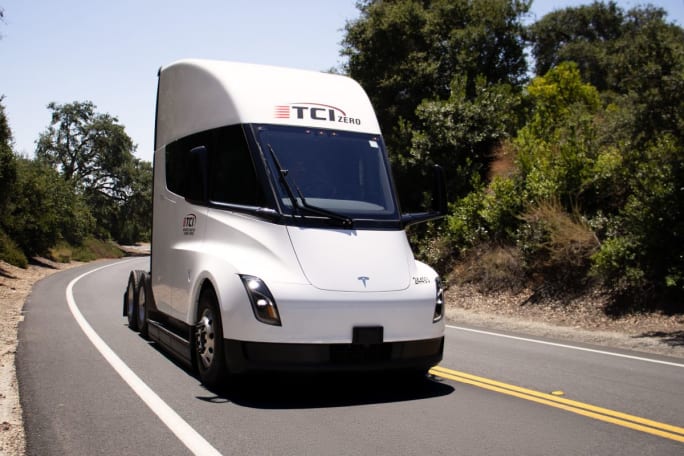
HDT Top Green Fleet TCI Transportation, Commerce, California, recently deployed multiple Tesla Semi electric tractors, on top of 100 CNG trucks and other EVs in its fleet.
The long-awaited Tesla Semi is reportedly being offered for significantly less than the legacy OEM EVs, and with longer range.
In fact, the International Council on Clean Transportation reported that in just over a year, Tesla’s Semi racked up more tractor voucher applications under California’s Clean Truck & Bus Voucher (HVIP) incentive program than every manufacturer combined over the previous four years.
For natural gas, the new Cummins X15N is being called a game-changer, as the engine offers the kind of power and fuel efficiency comparable to the kind of diesel engines over-the-road truckers are used to.
Natural gas fueling infrastructure has much improved since the days of the CNG vs LNG debate.
According to The Transport Project (which admittedly exists to promote natural gas fuel), the number of existing stations in the United States has risen to 1,385 stations dispensing CNG and 81 stations dispensing liquified natural gas (LNG). Its report indicated a 2% increase in CNG stations coming online year-over-year.
- 53% of CNG stations are publicly accessible.
- 46% offer heavy-duty Class 8 truck access.
- 51% of CNG stations nationwide directly dispense renewable natural gas.
Fuel Strategy is Now Risk Strategy
Of course, there are other factors than fuel prices and volatility when making strategic decisions on how to power your fleet.
Your particular location and operations can dictate what’s even feasible. Charging and fueling infrastructure, while improving, is not nearly as ubiquitous as diesel. For EVs, contingency plans must be made in case of power outages. Customer demands make a big difference.
Alternative fuel vehicles (other than biodiesel or renewable diesel that are drop-in replacements) have a higher purchase price than their diesel counterparts. But while the Trump administration may have been pulling back incentives, many states have their own programs to help fleets transition to lower-emission vehicles. And it’s not just blue states like California and New York. Red states such as Texas and Florida have such programs, too.
So if you’ve pushed any fuel diversification plans to the back burner, whether because of the freight recession or the change in the regulatory environment, what happened in the Middle East is a good incentive to explore which alternatives might be right for your fleet.
Credit: Source link