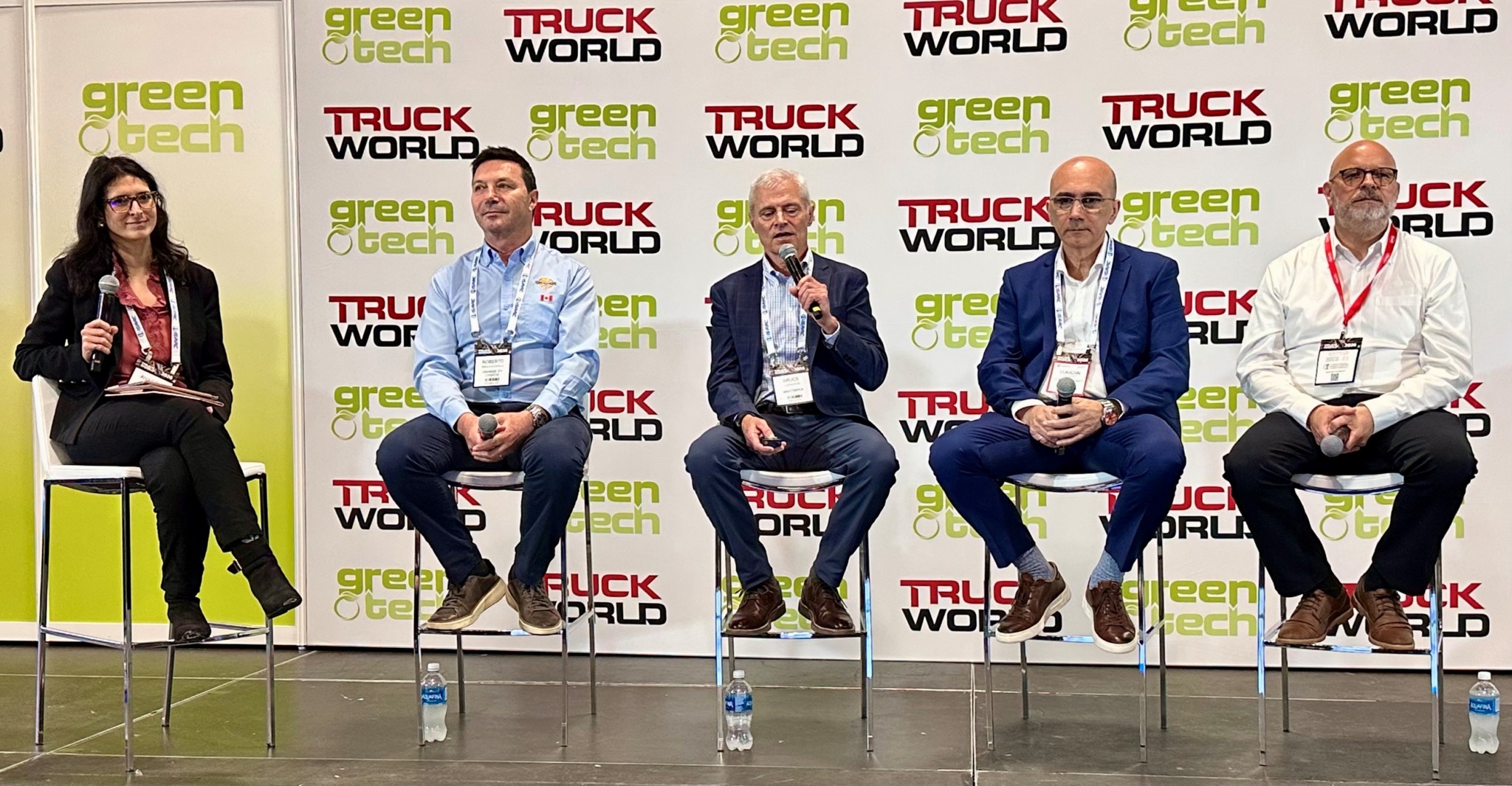
Planning, partnerships and a clear understanding of duty cycles are emerging as critical factors in the adoption of electric trucks, panelists said during a discussion at Truck World 2026 in Mississauga, Ont.
Speakers representing OEMs, suppliers and fleet operators pointed to lessons learned from early deployments, emphasizing that success depends less on technology alone and more on how fleets prepare for and integrate it into operations.
Roberto Bragagnolo, country director, Canada, Orange EV said fleet acceptance and understanding of electrification’s benefits have improved in recent years, driven largely by performance and uptime.
Higher uptime translates into more moves and improved operational efficiency, he noted, adding that utilization ultimately accelerates payback timelines.
Bruce Johnson, executive vice president of Martinrea/Effenco said partnerships have played a central role in advancing electric truck technology from development to commercialization. He pointed to collaboration between manufacturers, municipalities and funding partners as essential to scaling production and demonstrating real-world value.
Early engagement and pilot testing
Getting equipment into the field allows fleets and other stakeholders to see benefits firsthand, he said, adding that Canada’s strength lies in combining technical, operational and administrative expertise through coordinated efforts.
From a municipal perspective, Vudakin Lalovic, director of fleet and asset management at the City of Toronto, said early engagement, pilot testing and data collection are key to selecting the right zero-emission vehicles for specific applications.
He said fleets must evaluate duty cycles carefully, particularly in medium- and heavy-duty segments where applications vary widely. Toronto has taken a phased approach, focusing on risk management, stakeholder engagement and continuous data gathering to guide decisions.
The city currently operates about 500 zero-emission vehicles, with data showing significant fuel and maintenance savings compared to internal combustion equivalents.
Early challenges and failures
Martin Blanchet, national sales manager of alternative powertrain at Peterbilt Canada, said inadequate planning has been a common factor in unsuccessful deployments. Projects that moved too quickly, often driven by available incentives, sometimes failed to account for charging requirements, operational impacts and driver readiness.
In some cases, fleets purchased chargers without properly sizing them or introduced vehicles without preparing drivers or adjusting workflows, leading to operational challenges and loss of confidence in the technology.
By contrast, projects that involved detailed planning, including route analysis and charging strategies, were more successful. Blanchet said engaging internal stakeholders and aligning expectations across the organization improves adoption outcomes.
“All the time that you spend planning is time well spent,” he said.
Total cost of ownership
Total cost of ownership (TCO) remains a central consideration. Bragagnolo said fuel costs are the largest contributor, noting that electric vehicles offer insulation from fossil fuel price volatility. Maintenance is another key factor, with fewer moving parts reducing service requirements.
Johnson added that fleets are also seeing broader benefits beyond traditional TCO metrics, including reduced greenhouse gas emissions and lower noise levels, particularly in urban environments. These social impacts should also be considered.
Lalovic said Toronto’s experience shows about 75% fuel savings and roughly 50% maintenance savings for light-duty electric vehicles, with payback estimated at around four years. However, he noted that comparable data for medium- and heavy-duty trucks is still developing.
Higher upfront costs
Upfront costs remain higher, particularly for heavier vehicles, reinforcing the importance of accurate data and informed decision-making when scaling deployments.
Blanchet said the expiration of federal incentives for heavy-duty electric trucks at the end of March adds pressure to TCO calculations. He described grants as a key factor in earlier adoption decisions and said their absence makes planning and financial analysis even more important.
At the same time, he noted that electrification can create new business opportunities. Some fleets operating zero-emission vehicles are attracting customers seeking lower-emission transportation options, even if those benefits are not always captured in traditional TCO models.
Panelists also emphasized the importance of starting early, even at a small scale. Blanchet encouraged fleets to begin with limited deployments to gain operational experience, including charging, winter performance and workflow impacts.
No one-size-fits-all solution
Johnson echoed that approach, saying there is no one-size-fits-all solution and that fleets should match technology to specific applications.
“Do it now. Benefit immediately,” he said, adding that early adopters gain valuable experience that can improve competitiveness over time.
Bragagnolo said waiting for perfect technology is not necessary, noting that advancements are ongoing and that operational and financial benefits are already available.
The speakers agreed that electrification is moving beyond pilot stages, but its success depends on disciplined execution.
Credit: Source link