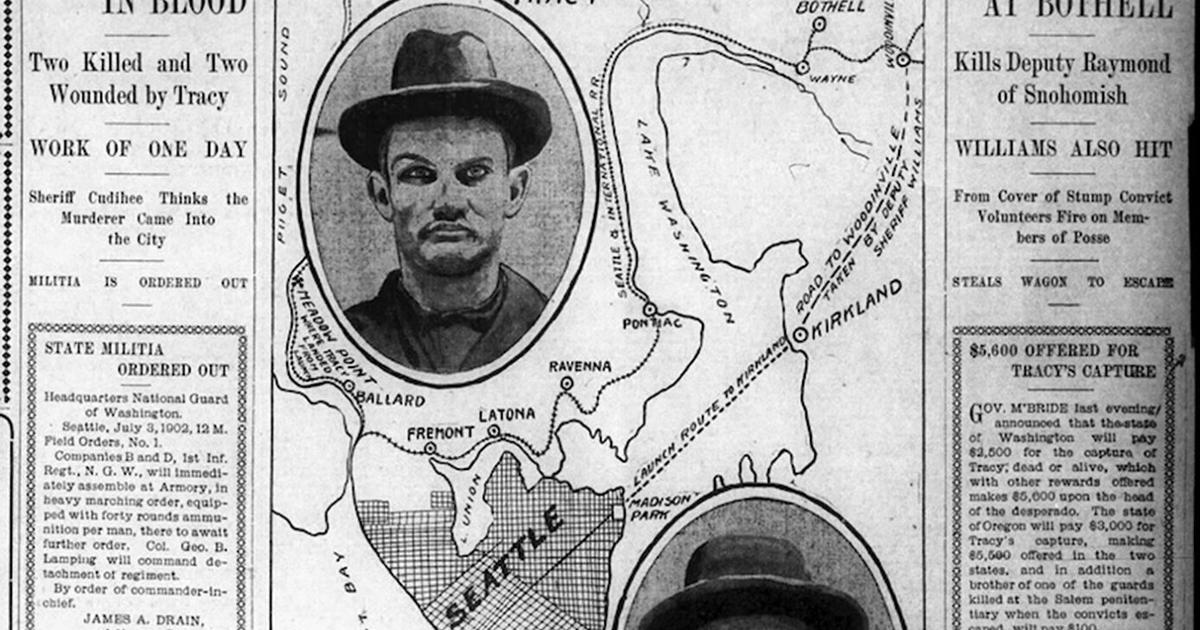
Frustration was evident in the Seattle Post Intelligencer headline on Saturday, July 5, 1902:
“Outlaw Tracy Eludes Pursuers,” it read, followed by a smaller headline, “Though Every Avenue Escape Seems Guarded and Hundreds Are Scouring the Country, the Desperado May Have Again Escaped.”
The desperado was Harry Tracy, real name Harry Severns, who just two days earlier had killed four men attempting to recapture him. A month earlier, Tracy and a partner had escaped from the Oregon state penitentiary in Salem, and they had been leading pursuers on mind-boggling chase through the Pacific Northwest ever since.
By July 5, Tracy was the most wanted outlaw in the United States, with more than 200 men on his trail, including local posse members, the Washington state militia, and even naval vessels as Tracy forced boatmen to take him repeatedly back and forth on Puget Sound.
Tracy’s criminal record over the previous four years was even more astounding. He had escaped from two state prisons — one in Oregon and one in Utah — and two county jails in western Colorado. And he was alleged to have killed nine or 10 men by July 5, 1902.
Questions about how many men he actually killed continue to swirl around the life and death of Harry Tracy, who was said to be charming and helpful to people who weren’t trying to capture him.
Equally baffling was why he stayed in the Seattle area so long, when he could have high-tailed it to less-populated areas. He seemed to want to be caught. He reveled in the publicity he garnered, and he nearly always introduced himself to people he accosted during his flight by saying, “I’m Tracy.”
Tracy was never a mastermind at the business of banditry. The crimes that landed him in prison were poorly planned break-ins or armed robberies for little more than petty cash. But once behind bars, he became an imaginative escaper artist.
Tracy was born Harry Severns in Pittsville, central Wisconsin, in 1874 or 1875. His grandfather was a Civil War veteran and a pillar of the small community. His father seems to have been a ne’re do well who abandoned his family before Harry was a teenager.
By the time he was in his late teens, Harry had joined his brother working in a logging camp in northern Wisconsin. He worked for a time as the camp cook, and he would list “cook” as his occupation when he was taken into the Oregon prison.

LEFT: This article in the New York Evening World on July 5, 1902 shows that Harry Tracy garnered major headlines across the country.
www.newspapers.com
About 1892, he moved to North Dakota and worked for a freight company. But at some point he either stole or was wrongly accused of taking a wagon horse to go into Fargo for an evening of carousing. In any event, he fled. He may have gone to Nebraska and married a woman named Gallagher whom he knew from Wisconsin. Or he may have gone to Wyoming or Montana.
It appears he worked for a time on the railroad, traveling between Seattle, Spokane and Great Falls, Montana.
In July of 1897, he turned up in Provo, Utah, where he broke into a house in broad daylight. The crime occurred on July 7, he was arrested July 8 and pleaded guilty on July 10. On July 11, he was incarcerated in the Utah state prison in Salt Lake City.
Another man, David Lant, was arrested for robbing a store in Utah two months later and arrived at the penitentiary on Sept. 27, 1897. Lant, Tracy and two other inmates escaped 11 days later.
That prison break wasn’t as bloody as the Oregon escape. Tracy used a carved wooden gun wrapped in tinfoil to fool a guard, then stole the guard’s clothes.
While the other two escapees went their own way, Lant and Tracy stayed together and made their way toward Brown’s Park, Colorado, where they ended up in the middle of one of the most notorious incidents in the Park’s history.
They camped just north of Brown’s Park, in Wyoming at a place called Powder Springs, with cattle rustlers John Bennett and Patrick Johnson. But one day, Johnson killed his young friend, 14-year-old Willie Strang, in a dispute over spilled water.
The men headed south toward the safety of Robber’s Roost in Utah. But they were trapped in Brown’s Park. On March 2, 1898, while hiding among large rocks, Tracy, Lant and Johnson got in a shoot-out with a posse. Brown’s Park rancher Valentine Hoy was shot and killed, presumably by Tracy.
Bennett had gone his own way, promising to meet his comrades later. But he was tricked into being imprisoned at the Herb Bassett ranch. And on March 2 or March 3, a group of eight masked men removed him from the room where he was being held and lynched him from the entrance gate to the Bassett ranch. The masked men were never formally identified.
Without horses, food or water, the other three surrendered on March 5. Because Willie Strang was murdered in Wyoming, Johnson was taken to a jail in Rock Springs. But Tracy and Lant were held for the Hoy murder in Colorado. The two were taken first to Craig, where the photo of Tracy on this page was taken, then to the Routt County Jail at the Hahn’s Peak mining town.

RIGHT: Harry Tracy in custody in Craig in 1898, shortly after being arrested for the killing of Valentine Hoy, before he and David Lant escaped from the Hahn’s Peak jail. Note the leg irons.
Photo courtesy of the Museum of Northwest Colorado, Downtown Craig
When Routt County Sheriff Charles Neiman entered the jail on March 24, Tracy and Lant retired to their cell as protocol required, and the cell door was closed. But Lant had somehow managed to sneak into another cell, where the door was open. He tackled the unsuspecting Neiman, beat him severely, took his jail keys and released Tracy. They locked Neiman in a cell, bound and gagged, although he had urged Lant to kill him. Then they escaped into the night.
Escapes were one thing, but hiding while on the lam was another thing Tracy didn’t excel at. After Neiman was released with the aid of local citizens, he and another man took a stagecoach south toward Wolcott, Colorado, where he believed the two outlaws were headed.
Six miles south of Steamboat Springs, two men stopped the stage asking for a ride. It was Tracy and Lant, and they were surprised to find Neiman inside, with his gun pointed at them once they were seated.
They were taken back north to Hahn’s Peak, but not for long. Neiman soon got permission to send them to the Pitkin County Jail in Aspen, believed to be the most secure jail on the Western Slope at the time.
They arrived in Aspen on April 9, and stayed there until June 22, when they made their second Colorado escape. As at Hahn’s Peak, they were able to fool a jailer into believing they were securely locked in their cells when he came to retrieve their dinner dishes. But they had blocked the mechanism that locked the doors, which they pushed open to attack jailer Bob Jones, beat him, then hogtie him and place him in one of the cells. They took his keys, waited until dark, then disappeared into the Aspen night.
David Lant was never officially heard from again, and rumors about what happened to him have circulated for more than a century.
Bob Silbernagel’s email is [email protected].
Credit: Source link