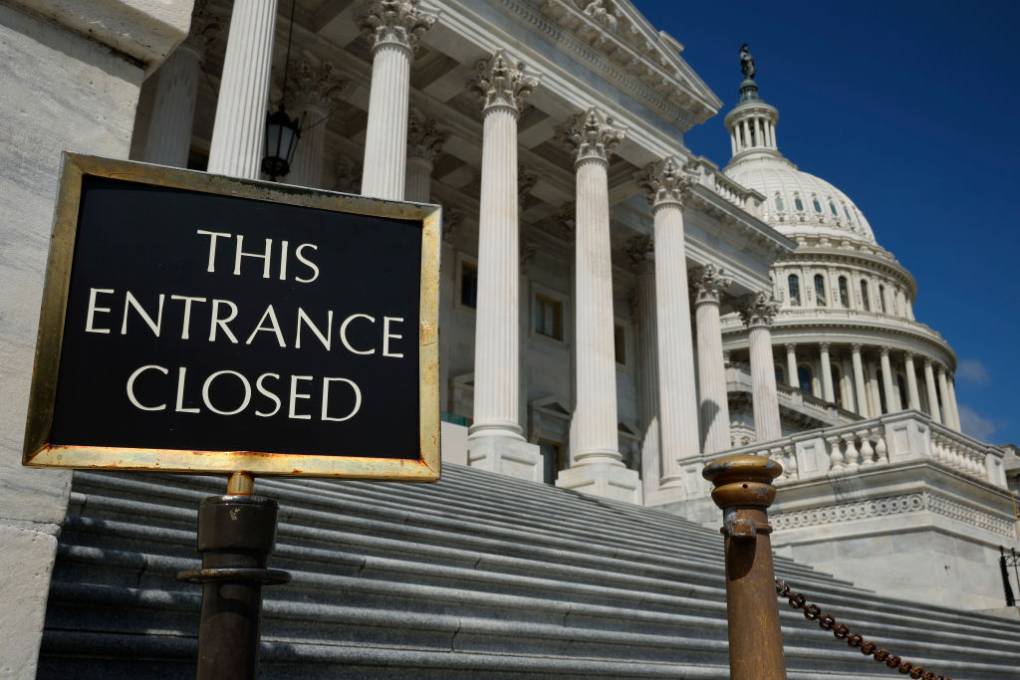
“We did a survey of all our state departments and agencies,” said H.D. Palmer with the State Department of Finance (DOF), “and the upshot is that if a federal shutdown is relatively short in duration, our assessment is that there will not be any significant impact on state operations since most affected state programs have available balances that can cover their expenses for several weeks at a minimum.”
“However,” he added, “there are still some short-term impacts that may occur to some programs as a result of this impasse.”
The following is an assessment of commonly-used programs, services and functions of the federal government and how they would respond if Congress fails to act.
General impact
- California has roughly 175,000 federal workers who live in the state. Many of them and their families will be financially affected if their paychecks are stopped.
- If federal employees learn on Monday morning that they are being furloughed, most will be given half a day to wrap things up and go home, according to agency contingency plans.
- “Non-essential” functions will be suspended. In the last government shutdown that started a week before Christmas in 2018, 420,000 federal employees worked without pay. Another 350,000 were furloughed without pay. Working without pay will of course affect at least tens of thousands of families with government employees in California.
- A 2019 U.S. Senate investigation (PDF) into the true cost of government shutdowns found that the three shutdowns from 2013–2018 (totaling 54 days) cost the government roughly $4 billion in lost revenue, administrative costs and (mostly) back pay to furloughed workers.
- The report notes that once the shutdown ends, Congress routinely provides full back pay both to federal employees required to show up for work and those required to stay home. But taxpayers bear the cost of lost productivity as a result of the furloughs.
- FYI: Here is the Office of Management and Budget’s index of executive branch agency contingency plans.
Social safety net programs
- Social Security and Medicare will not be affected as they have separate funding.
- Supplemental Nutrition Assistance Program (SNAP): October payments are funded but November payments could be interrupted.
- Special Supplemental Nutrition Program for Women, Infants, and Children (WIC) also has funding through October, but could be impacted if the shutdown continues into November. California has about 972,418 WIC recipients.
- Head Start is administered solely by the federal government and could be affected by a disruption in funding.
- School lunches: Not affected by a shutdown.
- This could be the most immediate impact of the shutdown felt by average Californians.
- According to the DOF’S H.D. Palmer, “We would expect a federal shutdown (of parks) this weekend. And not only does that affect people who are going into those parks, it would certainly have an economic impact to the communities that are around those parks for lodging or food or groceries or things of that sort.”
- A senior official in the Department of the Interior said “the majority of national parks will be closed completely to public access” and that “thousands of park rangers will be furloughed.”
- That means Yosemite, Point Reyes and Alcatraz will likely be closed, along with Joshua Tree and other national parks in California and across the country. Interior Department officials are discouraging people from visiting those places.
- The Presidio of San Francisco will continue to essentially operate normally, said spokesperson Lisa Petrie. Visitors and tenants shouldn’t feel many impacts because the trust that manages the park earns its own revenue. However, Petrie said “there may not be Park Ranger talks at the Campfire at Presidio Tunnel Tops. Or the shutdown may affect janitorial service at Crissy East and West Beaches and Baker Beach.”
- Restroom, trash and visitor services in national parks will stop, according to the office of Rep. Jared Huffman (D-San Rafael). Access to some parks may be shut off entirely. During a partial government shutdown in 2019, parks like Yellowstone and Joshua Tree saw trash and vandalism with limited staff to supervise them.
FEMA/disaster response
- Direct government response to things like wildfires or earthquakes will not be affected.
- “If a wildfire occurs either on state or federal lands, certainly Cal Fire would get planes of the air crews on the ground to fight those fires immediately,” said H.D. Palmer.
- However second-level impacts could be felt, for example, reimbursements for previous disasters could be delayed for local governments.
Security and defense
- According to the Biden administration, the Coast Guard will continue doing vital duties like search-and-rescue operations.
- California has some 163,000 active duty service members here. They will be at risk of not being paid.
- Hundreds of thousands of civilian employees assisting national security operations may not be paid until the government is funded.
- Veterans will continue getting benefits and access to VA health care.
California National Guard
- A spokesperson for the California Military Department told KQED that a shutdown could impact some of the National Guard’s non-critical duties.
- “Critical daily operations in support of State and Federal missions will continue,” said Major Robert Woodson, the department’s deputy director of communications. “Resources are available for our service members, employees, and their families to help avoid financial hardship during a shutdown.”
Airports
- Air traffic controllers will have to work without pay at airports, including those in San Francisco, San José and Oakland.
- SFO spokesperson Doug Yakel said security screening staff will continue to be paid because their contract with the TSA is already fully funded. TSA employees are part of DHS, which says they are generally exempt from furloughs — and will work through a shutdown — because they’re “Necessary for Safety of Human Life or Protection of Property.”
- However, staffing could be lighter and some air traffic controllers and TSA agents could call in sick if they’re not getting paid, causing potential delays.
Amtrak
- “We are closely monitoring and plan to continue normal operations of the Amtrak passenger rail network,” Amtrak spokesperson Kelly told KQED in an email. “Passengers planning to travel on Amtrak trains in the Northeast Corridor and across the country in the coming days and weeks can be assured that Amtrak will remain open for business.”
Border, immigration, passports
- Border and immigration enforcement will continue. The vast majority of Homeland Security staff will keep working (without a paycheck) during a shutdown. That includes U.S. Immigration and Customs Enforcement agents and U.S. Customs and Border Protection agents (including Border Patrol), as their law enforcement work is considered exempt from furloughs.
- Another branch of DHS is U.S. Citizenship and Immigration Services, which processes applications for green cards, citizenship, humanitarian parole, DACA renewals and work permits for everyone from refugees to foreign students. Most USCIS officers are also exempt and will work through a shutdown.
- Passports and visas are issued by the U.S. Department of State, which says that as long as there are “sufficient fees to support operations,” passport offices will keep operating. But they could shut down if they run out of funds.
Federal courts, including immigration courts
- Spokespeople for the U.S. District Court and the Ninth Circuit in San Francisco would not comment, but Reuters reports that the federal courts expect to have enough funds from court fees to keep operating for two weeks, however they could be forced to close by Oct. 13.
- U.S. immigration courts are part of the Department of Justice and hear asylum claims and deportation cases. A spokeswoman for the court system said hearings will take place for cases of immigrants held in detention or those under electronic monitoring. But judges and court staff handling non-detained cases will be furloughed and those cases will be rescheduled.
- Immigration judge Mimi Tsankov, speaking in her capacity as president of the National Association of Immigration Judges, said, considering that the courts already have an unprecedented backlog of 2.6 million immigration cases nationally, rescheduling canceled cases will lead to further backlogs and imperil immigrants’ ability to mount a successful defense against deportation.
- “For the parties that are scheduled to appear for a hearing on Monday, if they don’t go forward, in some of those instances the parties have been waiting for years to have their case heard, and now their cases may get pushed to the end of the docket, which in some cases may be a couple of years away,” she said. Speaking as president of NAIJ, Tsankov added: “It’s definitely inefficient and even worse than inefficient. I think it undermines the integrity of the system. … when a hearing can be scrapped, even though there’s been enormous preparation for it. So we worry about the impact.”
National labs
- A spokesperson for the Lawrence Livermore National Laboratory said they don’t anticipate any impacts and will continue to operate as usual because of their position as a federal contractor (meaning they aren’t officially part of the U.S. government).
The Department of Education (DOE)
- This “non-essential” agency will mostly cease operation.
- Student loans will continue to be due as scheduled and can be processed without the DOE.
- People seeking loan forgiveness may see delays in processing applications.
- Federal Pell Grants for undergraduate students with financial hardships will continue without interruption.
Fleet Week
- San Francisco’s Fleet Week, scheduled to start Monday, could be disrupted if the organizers’ military partners are derailed by a shutdown. Brian Ferguson of the California Office of Emergency Services said that during previous government shutdowns, shows by the Blue Angels were canceled.
KQED will continue monitoring the impact of a shutdown if it occurs.
Credit: Source link