gorodenkoff/iStock via Getty Images
Investment Thesis
TuSimple Holdings Inc.’s (NASDAQ:TSP) self-driving trucks have the potential to significantly disrupt the global truck freight market, which is valued at $4 trillion. The emerging autonomous trucking industry is expected to attract new players from the autonomous passenger vehicle sector, leading to increased competition for talent and partnerships. TSP has faced negative publicity recently due to a crash, the removal of their former CEO over improper ties, and the termination of a partnership with Navistar. The management has acknowledged the need to rebuild credibility by making changes in the management team and board and adjusting the production ramp-up. It is crucial for TSP to provide comprehensive updates along the way in order to regain stakeholder confidence. I remain cautious for now and would like to see continued execution on targets and rebuilding of credibility to become more optimistic.
Tinkering in Roll-out Strategy
TuSimple has acknowledged the need to revise its initial ambitious commercialization plan and instead plans to roll out its self-driving trucks in multiple phases. The first phase will involve launching approximately 500 trucks on a fully automated route from Phoenix to Tucson. This initial route commercialization aims to gather valuable insights on operational efficiencies, establish safety credibility, and instill confidence in consumers. It is expected that this approach will also contribute to reducing unit costs in the future. The management has confirmed that they can achieve breakeven on a lower revenue base by minimizing operating expenses. As the company progresses, it plans to expand its routes to include Texas and other areas in the Southwest, presenting additional opportunities for returns. To strengthen its governance, TuSimple has made significant changes to its board, appointing five independent outsiders out of the total seven members. These new board members, such as Tyler McGaughey, who has extensive experience with regulators including CFIUS, and Michael Mosier, who has worked for the U.S. Treasury, bring unique perspectives to the company. Alongside the shift in operating strategy, TuSimple has adjusted its financial expectations to safeguard its balance sheet, maintaining approximately $1 billion in cash and short-term investments.
Company Presentation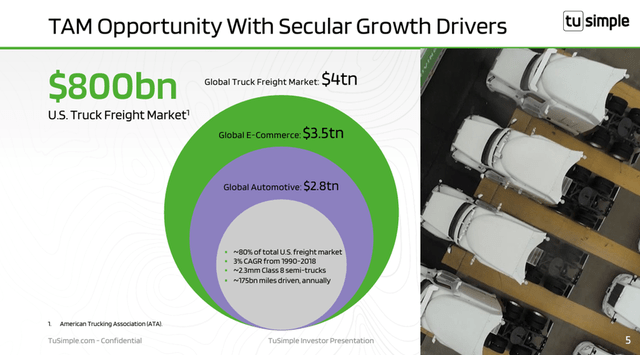
Investigations Add Another Layer of Downside Risk
TuSimple has faced negative publicity in recent times, including a crash in April 2022, the removal of former CEO Xiaodi Hou due to alleged improper ties with Chinese firm Hydron, and the termination of their partnership with Navistar for developing Level 4 autonomous trucks. TuSimple’s Board of Directors last year terminated the employment of Xiaodi Hou, the CEO/CTO, and Co-Founder, following an internal investigation that is still ongoing. The investigation revealed that employees had allegedly dedicated paid time in 2021 to work for Hydron Inc., a company founded by one of TuSimple’s Co-Founders and major shareholders. The Board also discovered that TuSimple had allegedly shared confidential information with Hydron and its partners in 2022 without proper disclosure and adequate nondisclosure agreements. This situation has attracted the attention of investigative bodies such as the FBI, SEC, and CFIUS, who are looking into the relationship between TuSimple, Xiaodi Hou, and Hydron, including potential technology sharing. It is expected that it will take a considerable amount of time for this issue to be resolved. In an effort to rebuild credibility, the management has made significant changes by reshuffling the management team and board, as well as adjusting the ramp-up of commercial production. However, it is crucial for TuSimple to provide comprehensive updates along the way to regain stakeholder confidence.
Valuation
Determining the true value of TSP’s stock involves considering the execution risks, competition, and market sentiment in the short term, while also acknowledging its long-term disruptive potential in a large global market. The Society of Automotive Engineers ranks autonomous driving capabilities from Level 0 to Level 5, with L0 being a typical vehicle and driver, and full automation at L5 with the autonomous driving system handling all functions under all conditions. TuSimple’s go-to-market strategy has focused on bringing Level 4 semi-trucks to the market at scale and with the reliability and support that match traditional offerings.
The company’s scheduled launch of a commercial route on Interstate 10 in late 2024 has been delayed to 2026, and now even that remains uncertain due to the recent announcement in which the management stated the exploration of “strategic initiatives” for their U.S. business, which may include a potential sale.
If TSP can show technical progress, meet production timelines, and achieve its targets, it may trade at a higher valuation than it currently is at a forward EV to EBITDA of 1.8x. However, concerns surrounding safety, the departure of the former CEO and Co-Founder, and the high turnover in the C-suite will continue to weigh on the company’s valuation which is why I assign a hold rating to the stock and currently do not have a price target.
Ycharts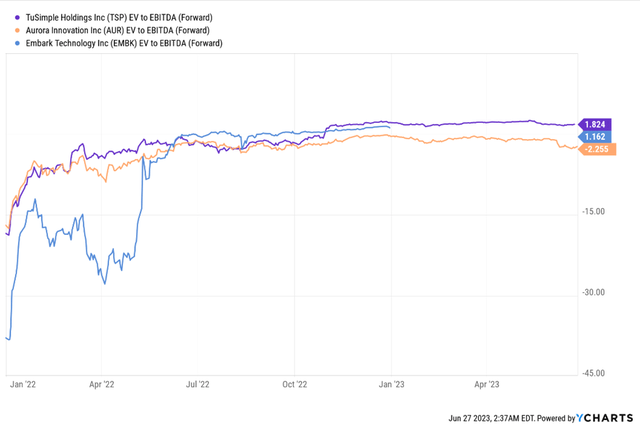
Risks to Rating
The self-driving technology of the company still requires thorough testing and validation without a human driver. However, improvements in original equipment manufacturer (OEM) production, internal capabilities, and successful testing have the potential to accelerate the deployment of their technology and establish an advantage as an early market entrant. TuSimple has experienced two CEO changes within a year while transitioning to commercialization. A smooth transition to a new senior management team could minimize further delays and help the company achieve its milestones sooner than expected.
Conclusion
TSP operates in a vast TAM of approx. $4 trillion, however, the company’s production timeline has experienced delays. Moreover, over the past year, TSP has faced negative publicity due to an April 2022 crash, the removal of former CEO Xiaodi Hou for improper connections with Chinese firm Hydron, and the termination of their partnership with Navistar for Level 4 truck development. To regain credibility, management has taken steps such as restructuring the management team and board and adjusting the timeline for commercial production. However, it is crucial for TSP to consistently provide detailed updates throughout the process to establish trust and confidence among stakeholders. I currently assign a hold rating to the stock and would like to see continued execution on targets and rebuilding of credibility to become more optimistic.
Credit: Source link