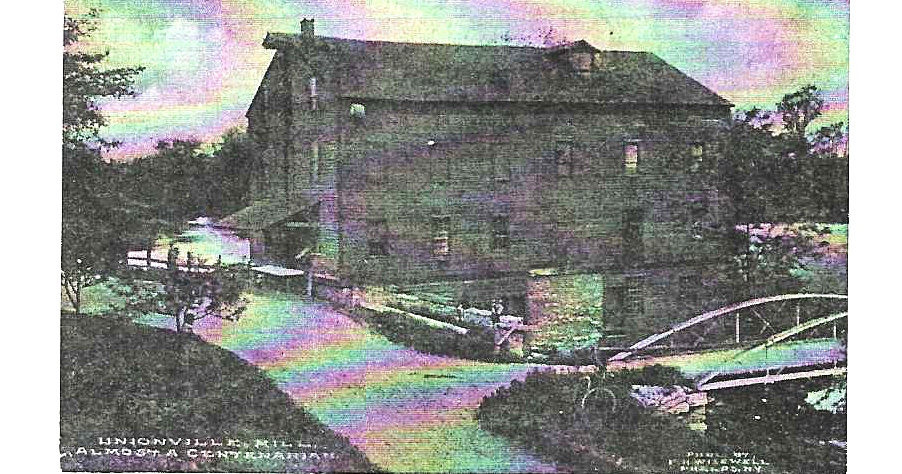
Unionville, near present-day Phelps, was established by several businessmen around the late 1790s to the early 1800s.
John Decker Robison was the first white settler in Phelpsburg in 1789. This was around the same time that Oaks Corners was being established by Jonathan Oaks. Unionville was named by the Swifts.
The businessmen who formed Unionville were Moses Swift, Issac Pinckney, Benoni Beardsley, William Whiting, Eben D. Langdon, and Mr. Scribner. Mr. Scribner kept and ran the brick inn, which was later believed to be the Yorkshire Inn. Unionville included the following structures: mills, inns, stores, a blacksmith shop, wagon repair shop, a shoe store and tailor shop and school district No. 4. The school was later the site of Mr. and Mrs. Laverne Peak’s residence. (Laverne Peak was a carpenter/builder who built a home for his daughter and son-in-law Gloria and Gary Fischer on the west side at the beginning of Fort Hill Road. The home has changed hands several times.)
Moses Swift of Waterloo was one of Unionville’s early promoters and optionors. He purchased land from the Granger’s Land Tract and was responsible for the construction of the two large brick houses east of the future inn. The first brick home was built in 1824 by William Dickinson but was thought to be too small to please Mrs. Swift, so Moses built the second and larger, elaborate brick home. Mrs. Swift, thought to be from Geneva, died soon after moving in.
In 1824, Moses Swift went on to build a brick two-story general merchandise store on the north side of the road overlooking his mill. He had a large sign in front that read “Swift’s — Cash for Wheat.” He also constructed a one-story brick building on the east side of the store. Later, the proprietor was Benoni Beardsley, who ran both store and inn; then, Issac Pinckney took over management. Beardsley and Pinckney were part of the early consortium of businessmen of Unionville.
The paper/carding mill was built in 1839 by Moses Swift on the north side of the road. In 1840, the mill was converted to a grist/flower mill and renamed “The New Mill.” It was at the bottom of a steep hill and fed water from a dam byway hand-dug from the Canandaigua Outlet to power the mill.
My friend, philosopher and expert farm welder Jim Richmond of Melvin Hill Road, related to me how at one time he had driven his team of horses and wagon down to the grist mill to have a load of wheat milled into flower. The mill was operated by Alonzo Rathbun until 1922, when it burned to the ground during a lightning storm.
Yorkshire Inn
The Yorkshire Inn was built about 1829-30 and was the center of activity for the hamlet. One of the new families that settled in the hamlet in 1833 was John Bloomer, a builder. He and his sons constructed the Phelps Town Hall in 1849.
The recollections of Mabel Oaks note that the Yorkshire Inn was an early stagecoach stop and had old lettering on its front. The other inn was a displaced dwelling, the Squire Granger Place. The second owner, Jacob Farr, moved the large farmhouse to west of Unionville and built the unique plaster house and barns. It became the village’s west inn/tavern.
A Mr. and Mrs. James Malone once ran a restaurant in the inn. My wife and I remember stopping there for lunch a few times in the 1970s with friends. The inn has been many things in its long history — from stagecoach stop/rest inn, private home, restaurant, a meeting place, locale of church socials, to its present use as a bed-and-breakfast.
Horse racing was a popular event from 1820-50. A one-mile (or was it a half-mile?) track was laid out from the east end of the Vienna village to Unionville, with the finish line in front of the Yorkshire Inn. An article from the 1934 Geneva Daily Times notes a young Nahum Cobb was one of the local jockeys. A large barn in back of the Bement/Robison house was used to stable the horses.
Along came the New York Central Railroad in 1841. The first design and build had the tracks running through the center of Unionville and the racetrack. The brick store on the north of Route 96 was used by the railroad as a passenger and freight station. The locomotives were very noisy, causing quite a disturbance for the citizens and scaring the horses as they crossed the highway. The citizens of Unionville and the surrounding area complained to the railroad company, and it was said that Commodore Cornelius Vanderbilt came to Unionville to get firsthand knowledge of the situation.
Needless to say, the tracks and beds were moved to their present location south of the inn and the school, ending the problem. There was a spur track added for the mill.
Question: Was Cornelius Vanderbilt a horse racing man? It is said that horse racing brought large crowds from all over: Pennsylvania, Canada, New Jersey, Long Island and Maryland. The two inns and the Vienna Globe Hotel must have been overflowing with race enthusiasts. Later, a third floor with four bedrooms was added to the Yorkshire Inn to accommodate the increased number of visitors/guests.
Were you aware that at one time there was a road cut running north-south creating a four corners intersection near the east side of the inn? The north road connected to White Road but couldn’t be navigated in the spring due to high water and flooding of the Canandaigua Outlet. The east road, called Hicks Road, ran to Lester Road and connected near the Cobb/Hicks farms. The crossroads no longer exist, and the New York State Thruway construction eliminated the north road in 1953-54.
Have you ever given any thought about where all the bricks came from? It took an awful lot of bricks to build these structures. It is said that sometimes the bricks were made on site, but in this case, they were probably manufactured by pioneer families such as Ashel and Lemuel Bannister near the Banister Bridge and now Route 96 and County Road 6, and the Pecks’ tile and brick farm on Fort Hill Road (now the Windy Hill Farm). Nearly all farms had lime kilns. Plaster was burned to make lime, which was used in the brick composition, mortar mix, and fertilizer. Believe me, this was one hard mixture! I have personally come across this while renovating my son’s home in Seneca Castle.
I would like to acknowledge John M. Parmelee’s “Life of the Phelps Pioneers” and “200 Years of the Town of Phelps” and Mable Oaks’ “Phelpstown Footprints” for their contributions. These and more paperback books can be purchased at the Phelps Historical Society, taking you back to the early days of Phelps history.
Credit: Source link