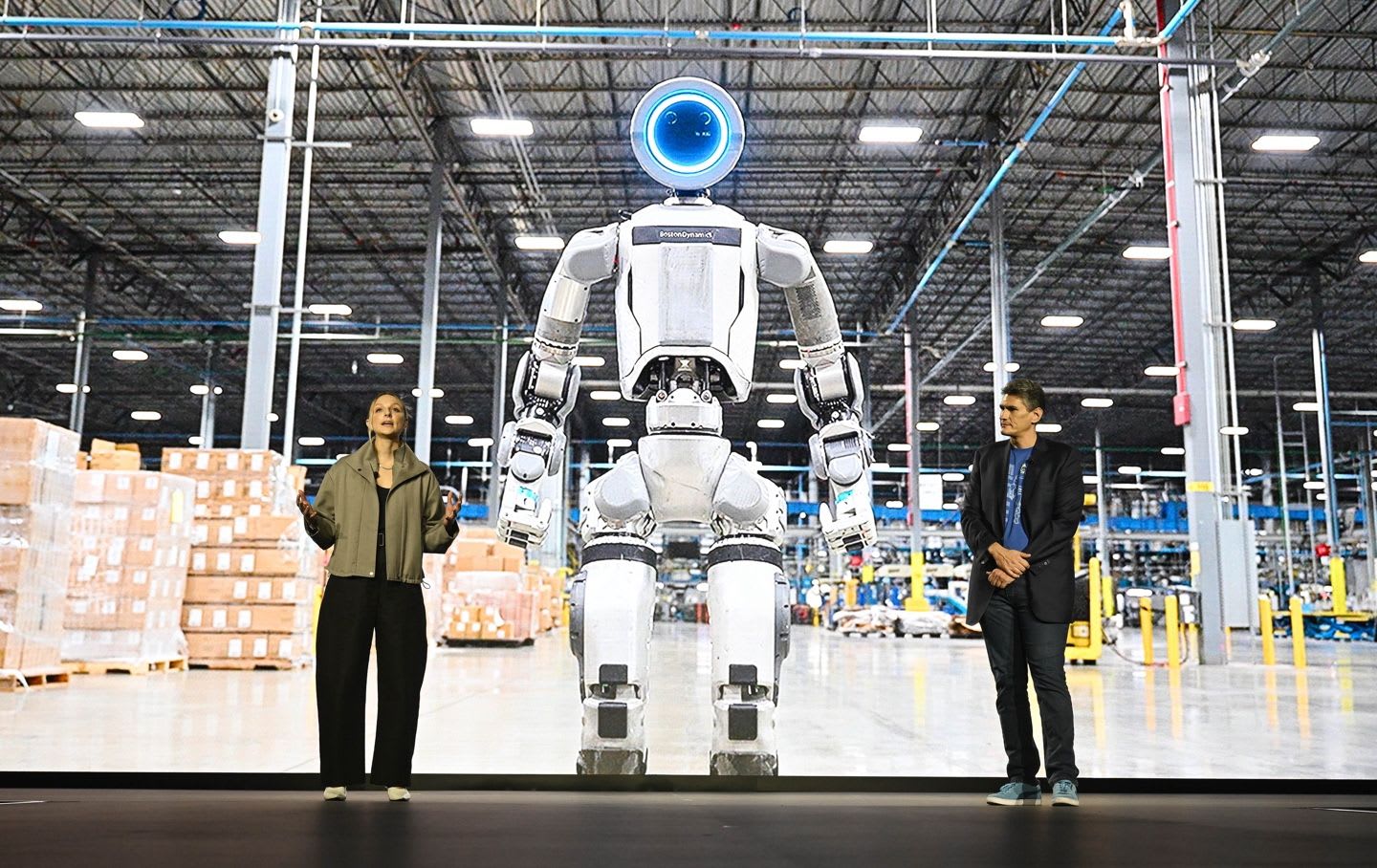
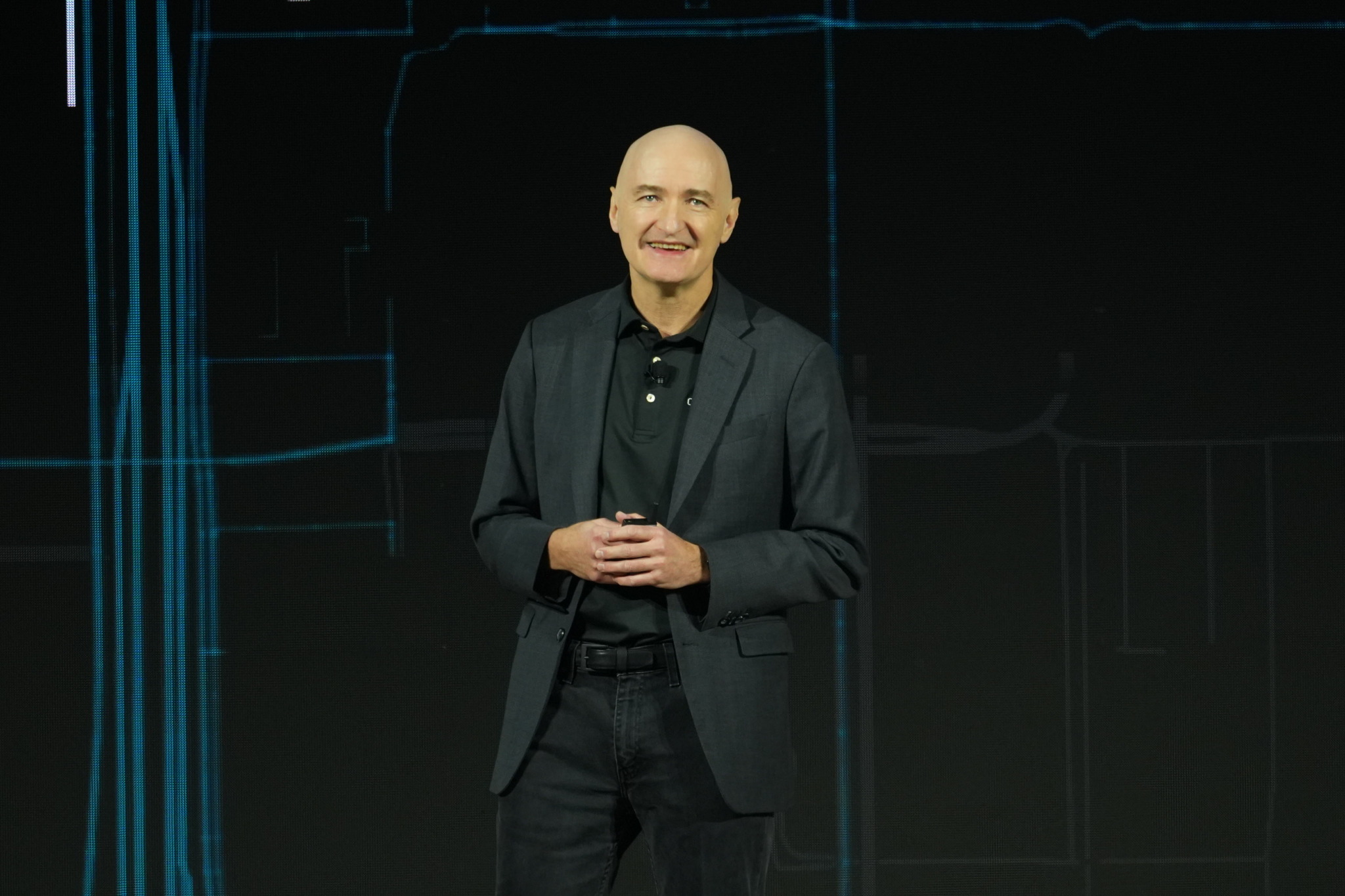
At CES 2026, Hyundai and Boston Dynamics showed how humanoid robots like Atlas could soon take on repetitive and hazardous work in warehouses and industrial facilities.
Hyundai Motor Group is getting into the robotics business, and it’s going big on humanoid robots — some that will eventually work in logistics and warehouse operations.
You may remember seeing videos from six or seven years ago of Boston Dynamics’ Atlas humanoid robot demonstrating its gymnastics and parkour skills. But what walked onto the stage at CES 2026 in Las Vegas was nearly as different as Star Trek’s Data was from the classic B9 robot in Lost in Space.
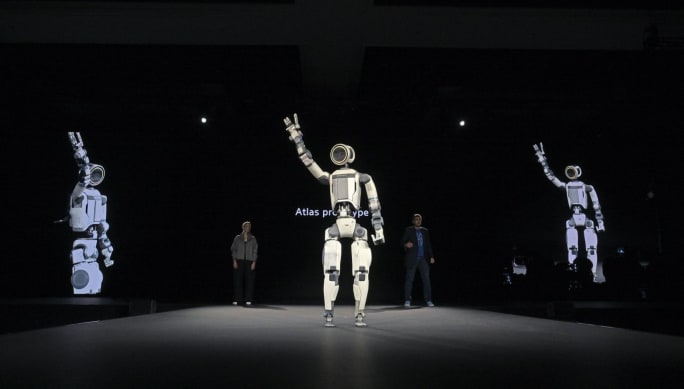
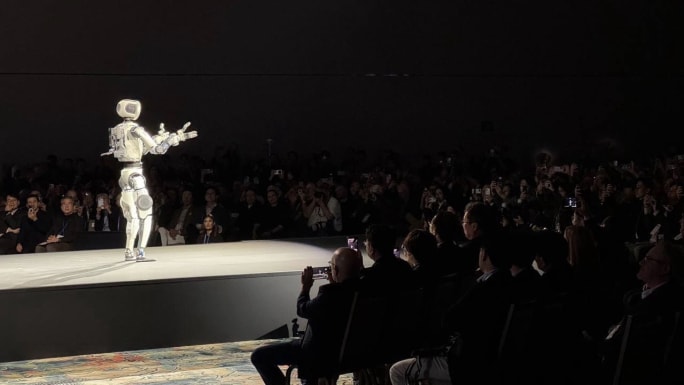
The newest version of Atlas got applause as it walked across the CES stage and waved to the audience.
But what may have been more impressive was how it could move and rotate its joints unlike any human. The demonstration made it easy to envision how Atlas could squat, pick up a box, and put it up on a shelf behind it without having to turn its whole body around.
“We’ve been at this robotics thing for a while, and we’ve learned that there’s more to it than just copying nature,” said Zachary Jackowski, general manager of Boston Dynamics. “We can pick the best parts of what nature has to offer, and do better at others.”
The Atlas prototype has joints that can move 360 degrees. “This lets Atlas move even more efficiently than humans.”
Robotics Isn’t New to Hyundai
Not only is Hyundai putting humanoid robots to work in its own auto factories, but it also plans to be able to manufacture 30,000 robots a year by 2028. And it’s working with Boston Dynamics and other partners to get there.
The two companies envision these robots performing hazardous and dangerous tasks, as well as repetitive tasks.
Hyundai has already deployed Boston Dynamics robots in industrial settings. For instance, Spot, the quadruped robot that looks a bit like a dog, is now operational in more than 40 countries, according to the company, performing tasks such as data collection and safety monitoring in industrial sites.
And Stretch, the warehouse robot, has unloaded more than 20 million boxes globally since its launch in 2023.
Hyundai’s vision is for a collaborative human-robot environment.
What is Boston Dynamics Atlas Robot Designed For?
The next-generation Atlas humanoid robot shown at CES 2026 is a big leap in robotics for industrial applications, according to a news release.
As a general-purpose humanoid, Atlas is built to integrate with existing facilities, enabling it to adapt as business needs evolve.
The Importance of ‘Being Human’ in Trucking Today
The Atlas prototype shown at CES serves as a research model, testing capabilities for future products.
Equipped with advanced rotational joints and sensors, Atlas can navigate complex industrial environments, perform repetitive tasks, and leverage AI-driven learning to quickly adapt to new roles.
Its mechanical design enables dynamic movement, ensuring it can operate in spaces traditionally suited to humans.
With 56 degrees of freedom, most with fully rotational joints, and human-scale hands with tactile sensing, Atlas is engineered to handle demanding tasks autonomously.
Atlas offers capabilities such as:
Ease of task training: Most tasks can be taught in under a day, streamlining deployment timelines.
Autonomy and self-sufficiency: Atlas operates independently from day one, with capabilities such as automatic battery replacement and continuous operation.
Strength and precision: Able to lift up to 110 pounds and perform precision tasks, Atlas excels in environments requiring repetitive and exhausting manual labor.
Durable and weatherproof: Atlas is water-resistant, designed for washdowns, and operates at full capacity – including strength capacity – between -4 and 104 degrees.
Humanoid robots such as Atlas can reduce human physical burden by performing higher-risk tasks as well as repetitive ones.
The Future of Humanoid Robots
Hyundai Motor Group expects humanoids to become the largest segment of the Physical AI market in the future and intends to mass-produce the Atlas product model. By 2028, the Group aims to establish a scalable production system capable of manufacturing 30,000 robot units annually.
Robots will handle labor-intensive or high-risk tasks, allowing human workers to focus on training the robots and providing oversight. Within this framework, Atlas robots will undergo extensive training using the Group’s manufacturing environment.
It plans to use a robotics-as-a-service (RaaS) model, which has already been deployed with global partners such as DHL, Nestlé, and Maersk.
“This end-to-end RaaS strategy positions the Group not only as an AI Robotics manufacturer, but also as a long-term service and operations partner, enabling customers across multiple industries to benefit from sustainable, real-world robotics solutions,” the company said in a news release.
NFI to Deploy Boston Dynamics’ Stretch Robot
That doesn’t mean humanoid robots will be the only ones. Spot and Stretch are already being widely used and will be expanded to external markets, including logistics, energy, construction, and facility management.
Investing in Robotics in the U.S.
Hyundai also plans to invest $26 billion in the United States over four years. This will expand collaboration with leading U.S. companies in robotics, AI, autonomous driving, and other future technologies.
As part of this initiative, a new robotics facility with an annual capacity of 30,000 units will be established.
Boston Dynamics and Google DeepMind
In addition, Boston Dynamics announced a strategic partnership with Google DeepMind to accelerate technological development for next-generation humanoid robots.
Google DeepMind in recent years has been advancing its robot AI foundation models – including Gemini Robotics – built on the large-scale multimodal generative AI model, Gemini.
Its models are designed to allow robots of any shape and size to perceive, reason, use tools, and interact with humans.
Together, the two partners aim to accelerate research on AI models to control complex robots for high-impact tasks, and to scale robot adoptions safely and efficiently.
With onsite reporting from Executive Editor Jack Roberts
More from CES 2026: How Kodiak and Bosch Plan to Scale Autonomous Trucks