


LAKEWOOD – Cummins Inc.’s sprawling engine plant near Jamestown has demonstrated its staying power over the decades.
The plant – Chautauqua County’s largest private employer – just celebrated making the 2.5 millionth engine in its history.
But the Cummins site is focused on the future, and keeping pace with tighter emissions standards in the industry its products serve.
While demand remains robust for Cummins’ diesel-powered engines, the plant is preparing for a $452 million investment that will pave the way for greater production of natural gas-powered engines, and, eventually, manufacturing of hydrogen-powered engines.
People are also reading…
“Really, what it does is, it sets the plant up for the future,” said Anna Dibble, the plant manager. “It builds on what we’re already doing, and sets us up for many years of continued ability to meet the demands of the heavy-duty Cummins market.”
Manufacturing plants are constantly trying to secure new product lines, to maintain their viability – and their workforce – as older product lines are phased out. That approach is especially true for products such as engines, which tie into emissions targets for combating climate change.
Indiana-based Cummins has laid out company-wide decarbonization goals in its “Destination Zero” strategy. Those goals are shaping the massive investment planned for the Jamestown engine plant over the next few years.
“We make diesel engines, but the world is changing,” said Srikanth Padmanabhan, president of Cummins’ engine business. “We’ve said publicly that we will be net zero on carbon by 2050.”
Another key company target: by 2030, lowering emissions from its newly sold products by 25% from 2018 levels.
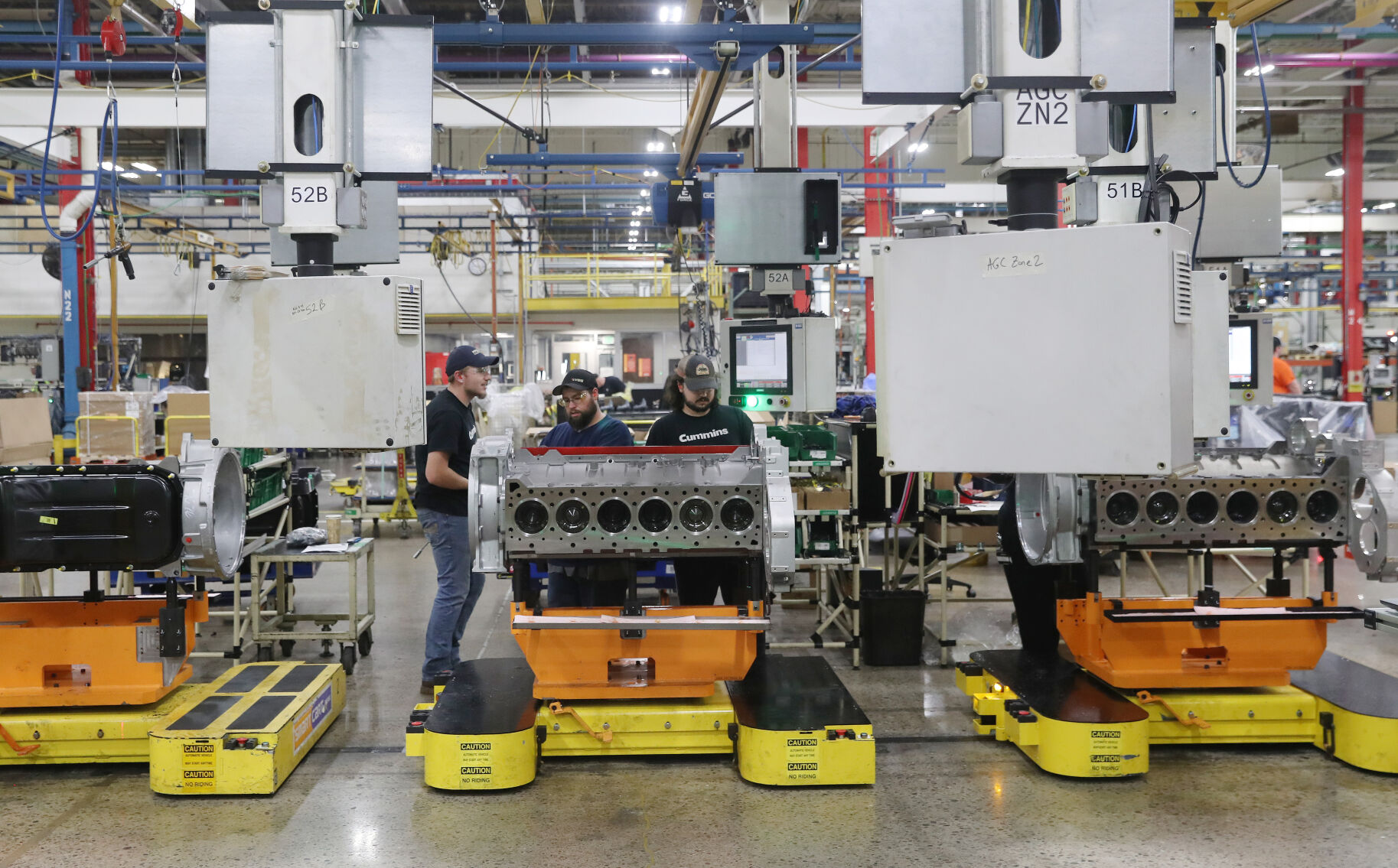
The Cummins engine plant employs 1,480 workers.
The Jamestown plant, which employs 1,480 people, makes engines for transportation and industrial applications, including heavy-duty trucks, buses and fire trucks, as well as a host of components. Its workforce is nonunion.
With some of the new investment, Cummins’ Jamestown plant will produce what are known as “fuel agnostic” 15-liter engines.
“Below the head gasket, everything remains the same,” Padmanabhan said. “Above the head gasket, you can use different kinds of fuels – not just diesel, but natural gas, even hydrogen.”
The Jamestown plant already produces some natural gas-powered engines. The new investments at the site will provide more natural gas engine options for heavy-duty transportation fleets.
Companies such as Amazon, UPS and FedEx are in the midst of their own “sustainability journeys” with their truck fleets as they aim to cut greenhouse gas emissions, Padmanabhan said.
“They are saying, ‘How am I going to get to these reductions goals we have set for ourselves?’ which is why there is a resurgence in natural gas. That didn’t happen, say, 10 years ago,” he said.
“Before, it was just a comparison with diesel,” Padmanabhan added. “Now, they’re comparing it with their sustainability journey, and they’re comparing it with battery electric.”

Srikanth Padmanabhan, president of Cummins’ engine business, speaks about the $452 million investment that will be made at the Jamestown plant.
While automakers are steadily adding more electric vehicles to their lineups for consumers, Padmanabhan said the long-haul trucking industry’s requirements are different.
Electric, so far, has proven more popular for school buses, delivery trucks, and transit buses, where vehicles can return to a depot and recharge overnight.
“Those are the places where it is often easy for battery electric to come together,” he said.
Two factors would help natural gas gain greater traction in the long-haul trucking industry, Padmanabhan said: “Infrastructure (such as refueling stations) is one, and the other is the overall cost.”
Longer range, Cummins has its eye on building hydrogen-powered engines at the Jamestown plant. Padmanabhan said hydrogen would be an “extension” of natural gas-powered engines, relying on the same storage tanks and mechanisms.
A Chautauqua County mainstay
The Jamestown plant is an economic powerhouse, located less than two hours from Buffalo.
The site consists of nearly 1 million square feet, where workers produce about 500 engines a day. The plant will celebrate its 50th anniversary as a Cummins operation next summer. Cummins estimates the plant contributes $1 million a year to the community in the form of charitable donations and employee volunteer hours served.
“Cummins engine is Chautauqua County,” said P.J. Wendel, the county executive.
The $452 million investment will also support expansion of Cummins’ current production, and upgrades to the facility itself. Plans call for Cummins to add 90 jobs at the site. Empire State Development will provide $10 million in Excelsior Jobs tax credits in exchange for Cummins achieving its job commitments.
“This investment will have a significant impact on the region’s economy, growth and stability,” said Hope Knight, Empire State Development’s president, CEO and commissioner.
Padmanabhan called the Jamestown site “one of the most flexible and cooperative workforces that we have anywhere.”
Dibble said the investment coming to the Jamestown site ideally will have a long lifespan, capable of meeting engine technology needs for years to come.

Anna Dibble, Jamestown engine plant manager.
“Part of the importance is to add equipment that’s flexible for the future,” Dibble said. She noted that the plant just last year removed an 11-liter block line dating to the late 1970s.
The new investment secures the Jamestown plant’s place within Cummins, while playing a pivotal role in the company’s pursuit of its zero-emission goals.
“We aren’t exactly sure what the roadmap is going to look like to get there,” Dibble said. “We think there’s going to be some messiness in the middle. But certainly understanding that there’s a pathway forward and that we have products that will meet any customers’ challenges when they are ready is really exciting for us.”
Credit: Source link


