


Fleet leaders across North America are hitting pause on expansion in 2026, with half planning to maintain their fleet size amid economic pressures that are prompting them to adopt a ‘stability-first’ mindset.
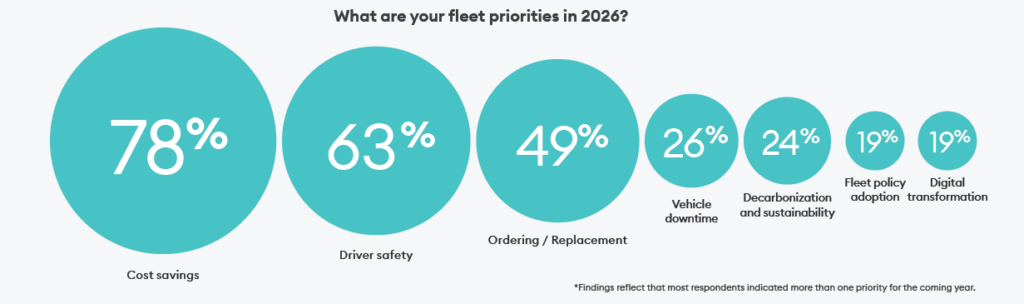
The shift comes as cost control takes precedence across the industry, with 78% of fleet leaders identifying savings as their top priority this year, according to Element Fleet Management’s latest Market Pulse Report.
The report, now in its fifth year, is based on the survey of fleet decision-makers across the United States (55%), Canada (24%), and Mexico (21%). Fifty-eight percent of respondents are directly responsible for operations and fleet, with others in finance and treasury (26%), sourcing and procurement (9%), human resources (4%), and safety and risk (3%).
Tariffs and broader economic uncertainty are forcing carriers to take a more disciplined approach to operations, delaying equipment replacement and extending asset lifecycles to preserve capital and improve utilization.
While driver safety ranked as the second top priority for fleets, following cost savings, ordering and replacement have become less of a priority, dropping 24% from last year and ranking third on the list this year.
More than half of respondents (54%) said tariffs and trade-related factors are having a moderate to significant impact on their operations, with 34% reporting minimal impact, and 12% reporting no impact at all.
Tariffs add to cost pressures, leading half of the surveyed fleets to stall growth for the foreseeable future. Just 6% said they want to grow fleet capacity this year, with another 6% reporting they plan on asset consolidation, while more than a third of fleets said they do plan on adding units, however, slowly.

Tariff impacts are prompting more aggressive adjustments among Canadian fleets than in the U.S. About 30% of Canadian operators report delaying or extending replacement cycles, compared to 22% in the U.S., while 18% are shifting sourcing to local or tariff-exempt suppliers, higher than the 11% reported south of the border.
AI, tech, and sustainability investments
While decarbonization, sustainability and digital transformation are cited as top priorities by less than a quarter of the surveyed fleets, companies still invest in the technology that helps them achieve their primary goals.
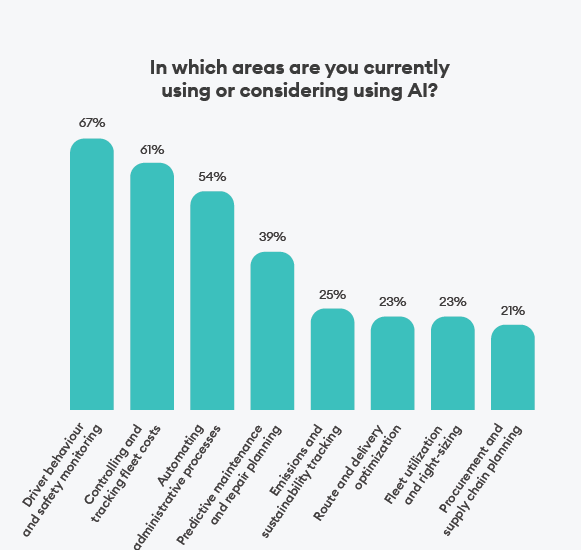
Artificial Intelligence (AI) is part of that process. More than half (53%) report they are exploring AI and digital tools. The most common use cases align closely with top priorities for 2026: improving driver safety (67%) and controlling fleet costs (61%). Others use AI to automate administrative tasks, as well as for predictive maintenance and repairs planning.
However, the report notes that barriers to adoption remain, with a lack of in-house expertise, data security concerns, and implementation costs cited most often.
When it comes to sustainability efforts, 19% of carriers report they are in the early planning stages of EV transition, an 11% increase from last year. Another 19% report they are currently in the electrification process, while the rest did not report it as a strategic priority at the time of the survey.
Of those without electrification plans, 60% said they would be interested in adding hybrid or other alternative-fuel vehicles to their fleet.
You can access the full report for free here.
Credit: Source link


