


Should drivers be charged in the event of a wheel separation incident? I’ve never felt it was appropriate to automatically charge the driver, but in Ontario, a wheel separation charge is considered an “absolute liability offense.”
In other words, there’s no defense. If you’re driving a truck that loses a wheel, or a pair of them, you’re guilty. Period.
My local paper, the St. Catharines Standard, ran a story a few days ago about a driver charged following a wheel separation incident on the Queen Elizabeth Way, near Hamilton, Ont. Luckily, no one was hurt in this incident, nor was there any property damage.
According to the report, the driver was charged with wheel separation and failing to accurately complete a daily inspection report. The truck was also put out of service.
We don’t know if the driver actually did a thorough vehicle inspection, or if he would have even seen anything suspicious if he had. Would he have noticed that the wheels were in danger of parting company with the trailer?
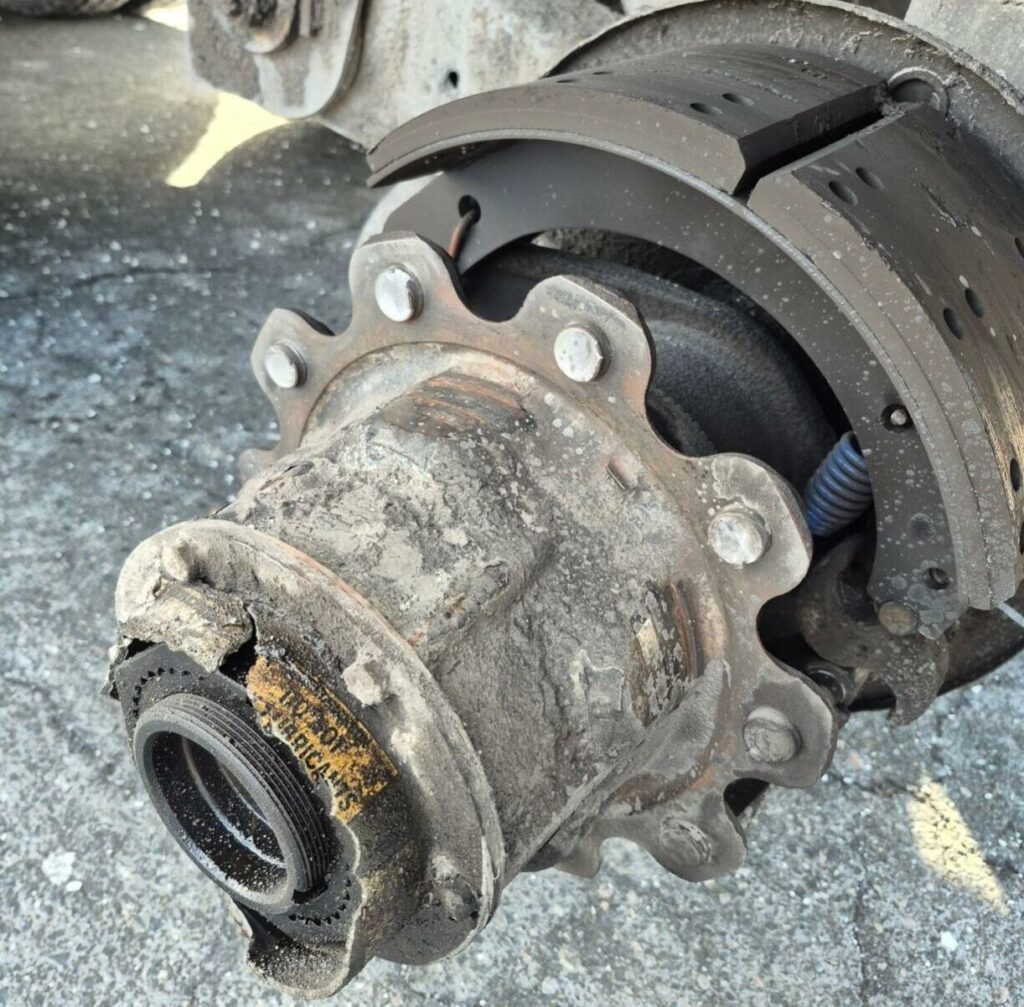
Not always obvious
Funny thing about inspecting wheels for potential separation: even if the nuts are barely tightened down, there’s no way a driver can tell visually, or even by trying to turn them by hand. With just a few foot-pounds of torque behind them, they would still be far too tight to turn by hand.
Short of taking a torque wrench to every nut on every wheel during the pre-trip, there’s no way a driver can be certain how tight the nuts are — unless they are visibly already loose.
In this case, charging the driver probably ended the police investigation. They had their culprit with the smoking gun still in his hand. But as you can see from the photo above, this wheel-end was very recently serviced.
The photo, supplied to the newspaper by the Ontario Provincial Police, clearly shows a nearly new brake lining on axle spindle. It’s not even burnished yet. I’d be shocked to learn that set of brakes had more than a few hundred kilometers on it. That wheel-end had been very recently serviced.
Risks increase after service events
In research I’ve done over the years for various wheel separation stories I’ve written, I’ve learned a thing or two about these incidents. This observation is particularly relevant: Statistics gathered during investigations by Ontario’s Ministry of Transportation’s Carrier Safety Branch, between 2000 and 2003 revealed that in 66 out of 80 reported incidents (83%), wheel separations due to fastener failure occurred shortly after a wheel had been reinstalled following brake work — in less than 500 km (300 miles) in at least two documented occasions.
Of course, to change brake linings, you must take the wheels off. And then you have to put them back on again. Ontario has regulations for wheel installers that include proper procedures to follow when installing wheels. Also, wheel technicians are required to be certified following a training period. So presumably, if the installer had taken the training and was certified, he or she would know what they are doing.
Again, going back to previous research, every stud visible in the photo is sheered off at the point where the first thread begins on the stud. This is the result of high bending stress and stress concentration at the thread root resulting from loss of clamp load. That’s most likely caused by under-torquing the fastener during installation.
Right. Under-torquing of the wheel fasteners. As I said earlier, there’s no way a driver would know if the fasteners were torqued to the recommended 450-500 lb.-ft. of torque. That’s the tightening force required to produce the clamp load necessary to hold the wheels securely in place.
Further investigation needed
By charging the driver, the police appear to have done only half their job. It would be easy enough to determine who installed those wheels following the brake work. That individual should have to account for the job they did installing the wheels that later came off the truck on the QEW.
To be fair, the police may have done that. The newspaper report is silent on that matter. Nor did it mention whether the carrier was charged as well.
This ridiculous absolute liability offense for a wheel separation came about as a knee-jerk reaction to a series of wheel separations incidents in 1995 and 1996 resulting in several fatalities.
Then-transport minister, Al Palladini, introduced the absolute liability offence for wheel separations — along with the wheel installer certification program — in 1997. There were more than 200 reported wheel separation events that year in Ontario alone.
Do tire shops and repair shops that do wheel-end work, like brakes, pay any attention to the wheel installer certification requirements? I’d guess reputable shops still do. Maybe others too. It’s hard to be certain.
But my question really goes back to 1997 and the government’s response to the problem. By virtue of the National Safety Code Standard 13, Trip Inspections, drivers are required to inspect their trucks and report any major or minor defects. Discovery of a defect after the driver has “conducted” an inspection implies the driver wasn’t very thorough or perhaps didn’t do any inspection at all. In either case, NSC 13 leaves the driver open to prosecution.
Only so much a driver can do
In the case of wheel separation, the fines range from $2,000 to $50,000. But as noted earlier, it’s practically impossible for a driver to determine if the fasteners are tight and properly torqued. There are obvious tell-tale signs of loose fasteners if you know what to look for. But unless the fasteners are already half spun off the stud, you’d never know.
So, is it appropriate for drivers to backstop improperly trained (or maybe lazy) technicians? Should drivers be held accountable for the quality of someone else’s work — or disregard for the rules?
In cases where the driver clearly overlooks obvious defects, then yes. The driver can be culpable. But in a case like this, where the fasteners may have “looked” tight upon a visible inspection, I don’t think it’s right that he be held accountable for what happened. There’s only so much a driver can do with this type of inspection.
I’d really like to hear from someone who can explain how drivers are supposed to be able to tell if the wheel fasteners are tight. I chuckle every time I see a photo of a gloved hand checking wheel fasteners for tightness. Any takers?
Credit: Source link


