


Industry professionals say fraud seems to be everywhere in trucking — it is widely seen as systemic, normalized, and insufficiently enforced, according to what you told us in our latest Pulse Reader Survey.
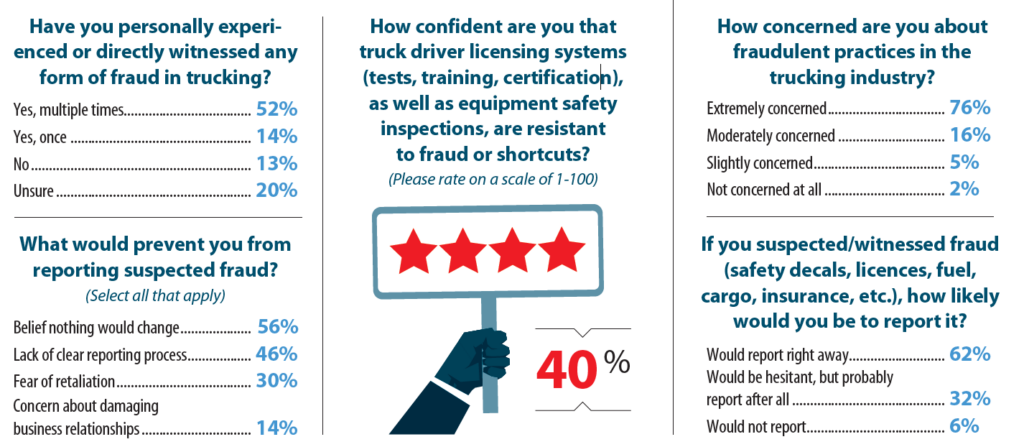
Among the 226 respondents 76% said they are extremely concerned about fraudulent practices in the industry, while another 16% said they are moderately concerned. Just 2% indicated no concerns at all.
When asked whether they have personally experienced or directly witnessed fraud, more than half (52%) said they’ve experienced it multiple times, while another 14% said they had experienced it once.
One reader wrote, “Fraud in the industry today is rampant and the bodies responsible for safety and anti-fraud have been asleep at the wheel for many years. Enforcement, enforcement, enforcement!”
Another one said, “Our whole industry is full of fraud, most of it right under everyone’s nose.”
Licensing, safety-related fraud top list of concerns
Just recently, trucknews.com ran a story about unsafe equipment operating on Ontario roads with unethically obtained safety decals. Though published in late September, it made the list of our top 10 most-read articles of 2025, generating lots of interest from industry stakeholders.

And the Pulse Reader Survey results align with that interest. Eighty-four percent of respondents highlighted fraudulent or improperly obtained licences as the biggest problem facing the industry right now. Fraudulent safety inspections and fake safety decals followed closely at 77%.
Several respondents referenced their personal experiences in their comments. “The shops that follow proper inspection processes are losing business to the scammers that sell stickers instead of making sure the truck is safe for the road,” one respondent wrote.
“Fraudulent safety is something you see every day. Shops that do this type of thing are getting away with it and nothing is being done,” one of the readers agreed. Another one added, “I have seen fake safety stickers, as well as seen drivers share licenses.” Another reader said, “Saw a lot of lick-and-stick yellow stickers.”
Driver Inc. not going anywhere
It is not that surprising that other common issues included employee misclassification, also known as Driver Inc., followed by questionable practices at some of the testing facilities, cargo theft and more.
Employee misclassification was one of the prevailing topics of the readers’ comments. One, for example, shared that it is very difficult for them to hire company drivers in the GTA, “because nine out of 10 applicants ask to be paid as ‘Driver Inc.’”
Another respondent echoed, “More than 50% of the driver applicants that come into our operation request to be paid as incorporated drivers. These drivers aspire to circumvent the income tax system in Canada and therefore cheat the system that depends on everyone’s fair and equitable contribution.”
“Driver Inc. is undercutting rates. Happens daily. Becoming difficult as a carrier to watch the inactivity from the federal government,” one of the respondents complained.

Other than Driver Inc., readers pointed out various fraud and theft having direct financial impacts on their businesses, including cargo theft, equipment theft, and organized scams.
“We get hit with phishing emails and phone calls daily. We have had our fuel cards skimmed. We have been double-brokered. Our systems have been hacked,” one of the readers recalled.
“Multiple brand-new tractors were stolen from our premises,” another respondent shared . “When we recovered the equipment based on our own investigation, there was absolutely no interest in further investigation by police. The response was, ‘You have your equipment back — just be happy.’” Another reader has a similar experience, “Our company has been a victim of fraud and theft. We found police were not very helpful, and it was hard to get updates on the matter.”
Others described large-scale schemes they believe involve organized crime. “Organized crime took us for close to $100,000,” one respondent wrote, adding that the group had targeted multiple shippers while falsely claiming to work on behalf of a major energy company. They called for stronger carrier vetting, licensing and insurance requirements for brokers, and a national registry to flag fraudulent operators.
Safety, competition, and costs
When asked how fraud affects the industry, most of the readers said it’s undermining safety, adding costs, inefficiencies and creating competition.
Several readers pointed to visible safety consequences on the road, from poorly maintained vehicles to the ‘horrendously unprofessional driving.’
“Market prices are artificially low due to competition with carriers that do not follow the safety guidelines,” one respondent said.
Another one added this adds pressure for carriers trying to play by the book.
“I ran a company, ran legal, cargo insurance, commercial inspection, everything. My competitors simply did not and thus could charge less for their service. This put me out of business,” they wrote. “In some areas, you can’t run legal and survive.”
Reporting fraud
And while it is clear that fraudulent practices keep plaguing the industry, some of the readers said is not that easy to report scams and fraud, even when experiencing it first-hand.
And while 62% said they would report fraud immediately if they witnessed or suspected it, and 32% said they would be hesitant to do so at first but would likely report it eventually, readers identified several barriers to reporting.
Some readers shared stories of witnessing and reporting fraud, but not seeing timely results. “Licensing fraud was reported right away after an employee witnessed a suspicious envelope going to an examiner,” one of the shared. “It appeared nothing was done. Three years later, we read about the examiner’s suspension in the public record.”
More than half (56%) of the respondents said they believe nothing would change if they reported fraud. At the same time, 46% cited a lack of a clear reporting process, while 30% said fear of retaliation was a concern. Damaging business relationships is a barrier to reporting for 14% of the surveyed readers.
“I feel fraud often goes unreported because nothing comes of it,” one reader wrote. “The industry is losing respect with the public … and the pride just isn’t there anymore.”
And respondents have also frequently pointed to enforcement — or lack thereof — as one of the main problems. Many said existing rules and regulations are not being consistently enforced and called for greater oversight, increased inspections, and stronger penalties.
“The problem is consequences — there are none,” one reader summed up. “There aren’t enough police, MTO inspectors, or inspectors from the governing bodies. Even when companies get caught, it’s a slap on the wrist and they can continue to operate.”
Another reader warned that lack of enforcement has created a thriving environment for scammers. “The fraudsters are well ahead of the curve, and unfortunately, regulators are so far behind in stopping these unsafe, illegal practices. By the time they have a method to stop these practices, the fraudsters will have added new ways to cheat the systems.
Credit: Source link


