With the tragic accident of Air India Flight 171 at Ahmedabad on June 12, 2025, the focus has fallen on safety and reliability of jet aircraft in general, and the Boeing 787 Dreamliner specifically. Other aspects of that event aside, there is a probably little-known nexus between Air India and Boeing aircraft: In 1962 India’s flag-carrier became not only the world’s first all-jet airline but also the first jet-equipped airline in Asia when it began operating a fleet of Boeing 707-420 aircraft
Today, Boeing and Airbus are the world’s two leading manufacturers of commercial airplanes. But those companies’ histories are diverse in terms of their origins – in Boeing’s case spanning nearly 110 years – and evolution. This article seeks to explore those manufacturers’ stories and products in some detail
Introduction
William E. Boeing was born in Detroit, Michigan, in 1881, to an Austrian mother, Marie Ortmann, and German father, Wilhelm Böing. When his father died in 1890, nine-year-old William moved to Europe with his mother and sister. After the widowed Marie remarried, she returned to the USA with her son (now known as William Boeing) and daughter.
Having enrolled in Yale University’s Sheffield Scientific School in 1898, William Boeing dropped out in 1903 to enter the lumber business in the Pacific Northwest of Washington state, an industry in which his father had made a modest fortune. Not to be outdone, the younger Boeing also prospered on the strength of a construction boom, shipping lumber to the USA’s east coast, via the newly-built Panama Canal.

However, in 1914, William and a friend, Conrad Westervelt, became interested in flying machines. A joy flight with an itinerant barnstormer pilot in 1915 inspired them to build their own airplane. But before constructing an aircraft they had to learn to fly. So the pair took flying lessons at the Glenn L. Martin flying school in Los Angeles, California, and bought their first flying machine, a Martin seaplane.
Back home in Washington, following a flying accident that necessitated repairs to their seaplane, Boeing and Westervelt discovered that Martin, the manufacturer, was unable to supply the spare parts required in a timely manner. Not content to wait, they decided to start building their own parts. Their original company, called B & W, consisted essentially of a boathouse on the edge of Lake Union, near downtown Seattle. But with the advent of World War I, Westervelt was mobilised by the US Navy and moved out. Left to his own devices, Boeing hired a highly-recommended and -qualified Chinese engineer named Wong Tsu (a.k.a. T. Wong).
With Wong’s assistance, the first B & W seaplane, designated Boeing Model 1, was ready to be test-flown by June 1916. There were already 21 workers on the payroll, and in July that year the company was incorporated as the Pacific Aero Products Company, with William ‘Bill’ Boeing as its President.
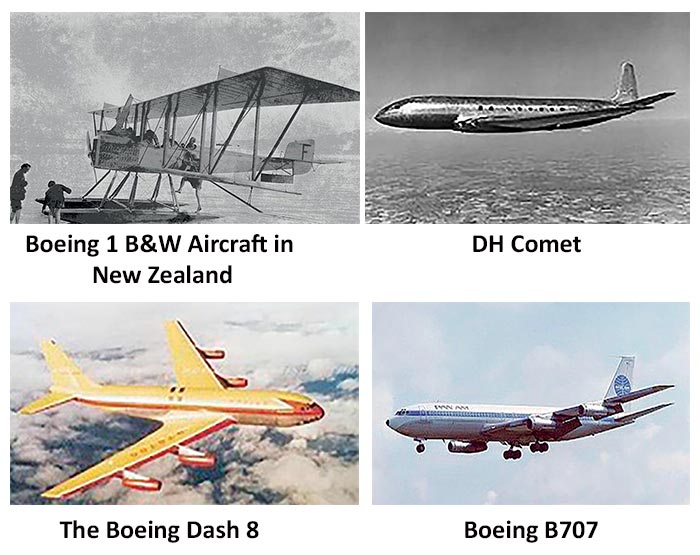
Eventually, the Boeing Aircraft Company, as it was later renamed, procured an order from the US Navy for 50 Model C trainer seaplanes. The company even exported two B & W seaplanes to the New Zealand government, thus recording Boeing’s first overseas order for his products.
More success followed in 1918 with a sub-contract for Boeing to build 25 flying boats for the US Navy. These aircraft were, however, designed by the Curtiss Aeroplane & Motor Company, and designated as HS-2L patrol flying boats. Bill Boeing was so impressed with this design that he improved on it and produced the C 700 aircraft, to carry mail from Vancouver, Canada, to Seattle. This was the first international airmail to the USA, on March 3, 1919.

Meanwhile, in Britain, another aircraft manufacturer, who would achieve worldwide fame, was beginning to make his mark. The company he founded in 1920 would be instrumental in the formation, much later, of the giant European aerospace conglomerate that is known today as ‘Airbus Industrie, or simply ‘Airbus’. That British aviation pioneer was Geoffrey de Havilland, who, after working for the Wolseley and Austin motor car companies, designed and built his first aircraft in 1909 while teaching himself to fly.
Joining the Royal Aircraft Factory at Farnborough as a designer, where much of the emphasis was on kites and balloons, de Havilland succeeded in selling experimental aircraft of his own design to the factory. But a turning point in de Havilland’s fortunes occurred when, a year before WWI, he joined a company called Airco, where he designed many types of aircraft for the Great War, including a bomber named the D.H.4. Although dubbed the ‘flaming coffin’ by pilots, the D.H.4 was de Havilland’s first major success, and by 1917 the company was manufacturing 300 Airco D.H.4s per month. From a total production figure of 6,295 aircraft, nearly 4,900 were built under licence in the USA, many of which were used on airmail services in that country.
For its part, Boeing in the USA suffered setbacks for want of customers after the Great War, but managed to keep producing new models on an average of two types per year, supplying demand from the military and airlines such as Pan Am and TWA.
Remaining with Airco after the war, Geoffrey de Havilland, a prolific and innovative engineer, was responsible for more than 20 new designs, with type numbers from D.H.1 to D.H.21, although some were never built. Among the successful types were a D.H.9 converted to carry four passengers, and the eight-passenger D.H.18 in 1920. That was also then when Geoffrey de Havilland left Airco to establish his own de Havilland Aircraft Company.
The period between the two World Wars came to be known as the ‘Golden Age’ of aviation on both sides of the Atlantic. In what was a ‘technological push’ de Havilland sought to make aviation attractive and affordable to the general public for military and civil transportation within Europe.
Boeing, on the other hand, concentrated most of its energies on building military airplanes. With the advent of World War II, large numbers of Boeing B-17 Flying Fortress and B-29 Superfortress bombers were built. On the other side of the Atlantic, de Havilland, too, was involved in the war effort. The D.H.82 Tiger Moth became the basic trainer of the Royal Air Force, while the twin-engine D.H.98 Mosquito, constructed mostly of wood – thus earning the nickname ‘Wooden Wonder’ – proved formidable in a variety of roles, especially as a fighter-bomber.
After WW II, as in the wake of WW I, both Boeing and de Havilland (DH) suffered a drop in business. Despite Boeing having to discontinue the services of more than 70,000 employees, and in keeping with the agreement dictated by ‘world powers’ on the distribution of limited military orders after the war, the US company, along with other American manufacturers, concentrated on building large bombers and troop carriers. Meanwhile the British focused their attention on small fighters.
But Boeing was also notable for producing the Model 377 Stratocruiser double-decked intercontinental airliner, a civil version of the C-97 Stratofreighter military transport and its airborne refuelling tanker derivative, the KC-97 Stratotanker, all derived from the basic design of the B-29 bomber.
But while nearly all Boeing aircraft manufactured thus far were powered by ‘old-fashioned’ piston-engines, the British had acquired more experience and some success with jet engines. So, in its need to compete with the Americans in commercial aviation, in 1942, the British government instituted the Brabazon Committee, named after former Minister of Aircraft Production, Lord Brabazon, to explore and design new types of transport aircraft, including jet-propelled airliners.
Into the Jet age
With experience gained from its successful D.H.100 Vampire fighter jet, which first flew in 1943, de Havilland proceeded with development of what would become the world’s first jetliner, the D.H.106 Comet.
With its revolutionary new airplane cleared for passenger services in May 1952, de Havilland was nevertheless still treading uncharted technological territory by venturing into high-speed, high-altitude, pressurised flight. Indeed, as the unchallenged, first-to-market, technological leader, the Comet was still not a fully tried and tested product. Unfortunately, that lead didn’t last long, because during the first year of Comet service, with Colombo, Ceylon, as one of its destinations, there were three serious crashes.
After preliminary investigation, the type was cleared to fly again, only for another serious and fatal crash to occur in 1954, following which all Comets were grounded indefinitely.
Earlier, the then President of Boeing, William ‘Bill’ Allen, and a company designer Maynard Pennell, had watched with interest when the Comet prototype was shown off at the 1950 Farnborough Air show in 1950. Having conceded leadership in the ‘jet race’ to de Havilland and the UK, Boeing decided to improve on the de Havilland design in producing its own, first passenger jetliner.
With the grounding of the Comets, Boeing were afforded some breathing space. Benefitting from experience with its B-47 Stratojet, a six-engine bomber, and the eight-engine B-52 Stratofortress, Boeing began design and production of a four-jet military transport, the prototype of which was designated the Model 367-80, or ‘Dash 80’ for short. That successful design led eventually to the Boeing 707 jetliner.
Following design revisions and lessons learned from the disastrous de Havilland Comet 1 crashes of 1953 and 1954, the much-improved, sleeker Comet 4 emerged in 1958, in time to earn the distinction of operating the world’s first trans-Atlantic jetliner service. But the Comet 4 carried a relatively small number of passengers, and was designed to operate mainly to remnants of the already dwindling British Empire with their short runways in ‘hot-high and-humid’ climatic conditions.
On the other hand, the Boeing 707 had a larger passenger payload, and soon overtook the Comet on the Atlantic run, proving much more popular and even economical to operate than its British competitor. The 707’s success was even more remarkable in the face of competition from other new US-built jetliners, such as the Douglas (later McDonnell Douglas) DC-8 and Convair 880 and 990 Coronado. Much later, when Air Lanka was founded in 1979, its first two airplanes were Boeing 707s, procured from Singapore Airlines.
Meanwhile, services to those other African and South Asian destinations with runway and climate limitations, as well as to shorter runways in the USA, had to wait until airports extended their runways and improved facilities to accommodate the new generation of ‘big jets’. To counter some of the challenges at home, Boeing built a shorter version of the 707, the 720, to operate shorter regional flights from shorter runways. As expected, the 720 proved popular with many US ‘majors’, such as United Airlines, American Airlines, Braniff International Airways, Continental Airlines, Western Airlines, etc.
As ‘big-jets’ spread far and wide as the choice of long-distance airliner for major and not-so-major airlines all over the world, a need arose for shorter-range jet airplanes to serve regional and even domestic routes in large countries like the USA and Canada, as well as Europe.
Thus were born airliners such as the Caravelle twin-jet, from the Sud Aviation conglomerate in France, the three-engined de Havilland D.H.121 Trident, later known as the Hawker Siddeley 121 Trident (Air Ceylon operated a single Trident bought brand-new in 1969), and from the drawing boards of Boeing another hugely successful type, the Boeing 727 tri-jet.
In Europe, the British government encouraged the consolidation of its many aircraft builders, resulting in the formation, in 1960, of the British Aircraft Corporation (BAC), with a later incarnation of the ‘old’ de Havilland company as one of its components. This company later merged with Sud Aviation in 1962 to design and produce the supersonic Concorde airliner.
Despite the publicity attached to the Concorde then and even today, it was not the first aircraft built to fly faster than the speed of sound in public service. That distinction goes to the Soviet-built Tupolev Tu-144, an almost lookalike (copy?) of the Concorde that was dubbed ‘Concordski’ in the West. The latter aircraft began operating scheduled passenger and freight services in 1975, followed by Concorde only in 1976. (To be continued)
by Capt. G. A. Fernando ✍️
[email protected]
RCyAF/ SLAF, Air Ceylon, Air Lanka, Singapore Airlines Ltd and SriLankan Airlines.
Types Flown: DH Tiger Moth, DH Dove, HS 748, Boeing B707, B737, B747, Lockheed L1011, Airbus A320, A340 and A330
Credit: Source link