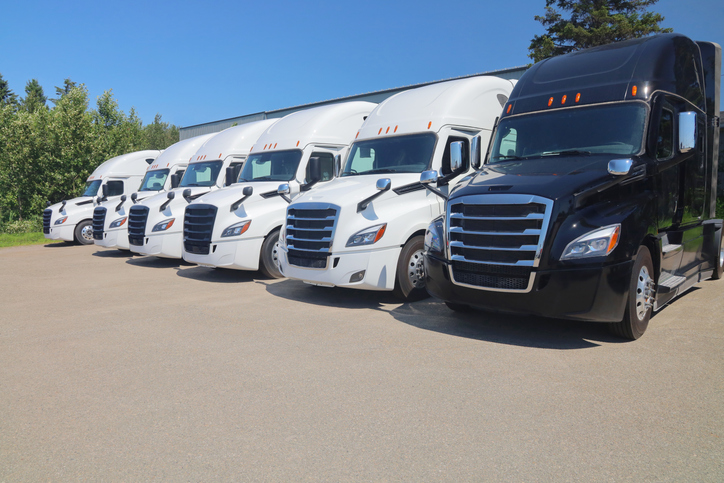
More details about Aurora Innovation’s deployment of driverless trucks are beginning to emerge.
Aurora deployed driverless technology in Texas on April 27. So far, however, the runs have been extremely limited, and the plan is to have a human on board at least some of the trucks for the foreseeable future.
During the company’s business review conference on Thursday, May 8, Aurora CEO Chris Urmson revealed that initial deployment on Interstate 45 between Dallas and Houston had been limited to two driverless trucks. Additionally, the trucks had been restricted to daytime hours and were not running even in light rain.
Urmson said during the conference that its two trucks had combined to log about 4,000 miles. That means each truck was averaging about 250 miles per day.
And while Aurora’s trucks are “driverless,” not all of them are without a human on board. A company spokesperson told Land Line last week that some of the trucks will have an occupant as part of an attempt to comply with a federal regulation that requires the driver of stopped commercial motor vehicles to place warning devices around the truck.
The early limitations highlight that while Aurora fulfilled a notable accomplishment of becoming the first company to operate driverless heavy-duty trucks on public roads, many obstacles remain.
What about that regulation?
Regulation 392.22(b)(1) reads as follows:
Whenever a commercial motor vehicle is stopped upon the traveled portion or the shoulder of a highway for any cause other than necessary traffic stops, the driver shall, as soon as possible, but in any event within 10 minutes, place the warning devices … in the following manner:
(i) One on the traffic side of and four paces (approximately 3 meters or 10 feet) from the stopped commercial motor vehicle in the direction of approaching traffic;
(ii) One at 40 paces (approximately 30 meters or 100 feet) from the stopped commercial motor vehicle in the center of the traffic lane or shoulder occupied by the commercial motor vehicle and in the direction of approaching traffic; and
(iii) One at 40 paces (approximately 30 meters or 100 feet) from the stopped commercial motor vehicle in the center of the traffic lane or shoulder occupied by the commercial motor vehicle and in the direction away from approaching traffic.
Aurora attempted to get ahead of the situation by asking the Federal Motor Carrier Safety Administration for an exemption. Instead of needing a driver to put out the warning devices, a warning beacon would be mounted on the cab of the truck. However, FMCSA denied that exemption request in December 2024.
In order to meet its self-imposed deadline of deploying driverless trucks by the end of April, Aurora pivoted to an approach that requires some of the trucks to have passengers.
The company moved forward with deployment on April 27 before it announced its plan for complying with 392.22(b)(1). Aurora informed Land Line of the plan about a week-and-a-half after its first driverless truck hit I-45.
“Aurora established effective processes for deploying warning devices when driverless trucks need to pull over to the side of the road, like in the case of a blown tire,” a company spokesperson told Land Line on Thursday, May 8. “Because we have a fleet of other self-driving trucks on the road, including some with humans aboard, our trucks are often about 10 minutes away from each other. This means that, should one of our driverless trucks need to pull over, another truck with a human is often close enough to reach it and set out warning triangles if needed. Our process for placing warning triangles for self-driving trucks was thoroughly tested prior to Aurora’s Commercial Launch. This is part of Aurora’s thorough approach to safety, and our ability to safely pull over to the side of the road has been validated with evidence as part of our safety case for driverless operations.”
A day earlier, an FMCSA spokesperson deferred questions of compliance to Aurora.
“FMCSA is aware of reports regarding Aurora’s operations in Texas,” an agency spokesperson told Land Line on Wednesday, May 7. “It is the responsibility of all motor carriers engaged in interstate commerce to comply with all applicable federal motor carrier safety regulations. For specific questions regarding Aurora’s operational practices or compliance strategies, we would refer you to the company directly.”
Despite FMCSA’s lack of clarity, Aurora’s approach to compliance prompts a variety of questions. What happens if both of the trucks are stopped on the shoulder at the same time because of inclement weather or any other reason? Even if a person is able to reach the stopped truck within 10 minutes, does that meet the spirit of the rule? Should this deviation from the original regulation require FMCSA to determine that the approach will meet an equivalent level of safety?
Tray Gober, a trial attorney at Austin, Texas-based law firm Lee, Gober & Reyna, was critical of Aurora’s compliance plan.
“The regulations require the deployment of warning devices,” Gober told Land Line. “I think most people would say that compliance by workaround is not true compliance. Replacing the human deployment of flares or warning triangles with software and roving workers is a reinterpretation that hasn’t been stress-tested in the courts or on the roads. A 10-minute window where a truck is exposed is plenty of time for a major accident to happen.”
What’s next?
Aurora plans to gradually expand its driverless operations throughout 2025 and into 2026.
Using a “crawl, walk, run,” approach, the company plans to operate at night and in inclement weather, such as rain and heavy winds, by the third quarter of 2025. Aurora also hopes to increase its fleet to “tens” of trucks and to deploy a driverless truck route from Fort Worth to El Paso, Texas, and eventually to Phoenix.
The Owner-Operator Independent Drivers Association is watching the situation closely and said that much more needs to be done to ensure that driverless trucks are safe on public roads.
“Road users are understandably very concerned about Aurora unleashing driverless trucks on public roads,” OOIDA President Todd Spencer said. “While the company has shared a voluntary safety report with test results and computer simulations, OOIDA doesn’t believe that’s enough to prove these trucks are ready for real-world driving. One example is ‘phantom braking,’ when a driverless truck suddenly stops for no reason – which can be extremely dangerous for anyone on the road. Until this technology is held to clear, enforceable safety and cybersecurity standards, it’s too soon to tell the public that 80,000-pound vehicles with nobody behind the wheel are safe. Safety reporting should be mandatory, not optional, before these vehicles are allowed on our roads.” LL
Credit: Source link