


chinaface
Introduction
In this article, I want to achieve at least two things.
- Discuss a company I have never covered on Seeking Alpha in the past. That company is Landstar System (NASDAQ:LSTR), one of America’s largest transportation companies. While its regular dividend yield isn’t high, dividend growth is high and consistent. When adding the company’s ability to generate value, we get a cyclical stock with a tremendous long-term risk/reward.
- The company is one of the victims of slower economic growth. While its stock price is still elevated, the company has lowered its guidance. This isn’t fun for existing shareholders, but it could pave the road for attractive entries in the next few months.
In other words, I will explain why I put the LSTR ticker on my watchlist, as I believe it might be a great addition to dividend growth portfolios if the price is right.
So, let’s get to it!
What’s Landstar System?
As this is my first LSTR article, let’s start at the beginning: what does LSTR do?
With a market cap of $6.2 billion, Landstar System is one of the largest companies operating in the Integrated Freight & Logistics industry.
The company isn’t a traditional trucking company. It operates as a technology-enabled, asset-light provider of integrated transportation management solutions. In other words, the company offers safe and specialized transportation services to a diverse range of customers through a network of agents, third-party capacity providers, and employees.
Landstar’s services include various transportation modes, which serve individual shipments of freight and comprehensive third-party logistics solutions.
The company primarily operates in the United States.
Landstar services its customers through a network of over 1,100 independent commission sales agents and more than 108,000 third-party capacity providers, primarily consisting of truck capacity providers.
Landstar System
In order to manage all of this, the company utilizes digital technologies to connect its agents and capacity providers.
Its largest segment is Transportation Logistics, accounting for 98.8% of 2022 revenue. The gap to 100% is filled by the Insurance segment, which includes risk and claims management services.
In its Transportation Logistics Segment, the company:
- Provides integrated transportation management solutions across various modes, including truckload, less-than-truckload, rail intermodal, air cargo, ocean cargo, expedited ground and air delivery, heavy-haul/specialized, cross-border, project cargo, and customs brokerage.
- Serves industries such as automotive, consumer durables, building products, metals, chemicals, foodstuffs, heavy machinery, retail, electronics, and military equipment.
- Utilizes independent commission sales agents to market its services.
Needless to say, its operations and customers are highly cyclical.
Despite these headwinds, LSTR is a total return star with surprisingly low (relatively speaking) volatility.
Going back to 1994, LSTR shares have returned 15.9% per year. This has turned $10,000 into $762,000. During this period, it has outperformed the market by more than 600 basis points per year with a standard deviation of 26.4%. While this standard deviation is above the market’s standard deviation (we’re comparing a single stock to a well-diversified basket), the risk/adjusted return of LSTR was also better with a Sharpe Ratio of 0.61.
Portfolio Visualizer
Furthermore, this outperformance wasn’t just caused by a strong performance in the company’s early post-IPO years. They are very consistent.
Looking at the lower part of the chart below, we see that the company has consistently outperformed the market with an increasingly favorable standard deviation. Over the past three years, the standard deviation was just 22%, which is highly favorable – especially for a stock with cyclical demand like Landstar.
Portfolio Visualizer
So, what about the Landstar dividend?
The Dividend Behind The LSTR Ticker
This is the part where I’m going to upset a few people (at least temporarily).
LSTR pays a regular 0.7% dividend, which explains the big fat D+ in the company’s otherwise good-looking dividend scorecard.
Seeking Alpha
While a sub-1% yield isn’t what income-oriented investors need, it’s backed by high consistent dividend growth, which explains why the stock is doing so well.
Essentially, this follows the theory that consistent dividend growers outperform the market with subdued volatility.
Nuveen (Author Annotations)
Adding to that:
- The company has hiked its dividend for eight consecutive years.
- The average annual dividend growth rate of the past five years was 19%.
- The most recent hike was announced on July 20, when the board approved a 20% dividend hike.
- The payout ratio is just 11%.
With that said, the regular dividend may be low. However, its special dividend isn’t. LSTR has a history of paying juicy special dividends.
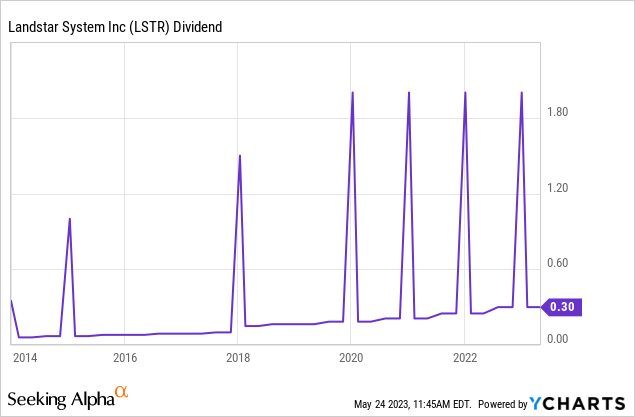
In the past few years, LSTR has consistently paid a $2.00 annual special dividend.
Hence, the current annualized dividend yield isn’t 0.7% but 1.8%, which is above the S&P 500’s dividend yield of 1.6%.
Furthermore, I already briefly touched upon it, but this dividend is backed by a low payout ratio. The cash payout ratio (including the $2 special dividend) is at just 34% if we assume that analysts are right and LSTR generates close to $320 million in annual free cash flow in 2023 and beyond.
Leo Nelissen
Looking at the chart above, we see that free cash flow is expected to be far below 2022 levels in 2023 (and beyond). This is due to very poor economic developments that hurt a company like LSTR.
Economic Update & Valuation
Despite its cyclical business, LSTR is extremely resilient. The LSTR stock price is less than 9% below its 52-week high. This is unusual, as economic growth indicators like the ISM Manufacturing Index are hinting at contraction. The lower part of the chart below compares the total sell-off of LSTR shares (% below its all-time high) to the ISM index. Right now, we’re seeing an unusual divergence.
TradingView (LSTR, ISM Index)
That said, the company’s financials aren’t immune. On April 26, the company announced its 1Q23 earnings. In the first quarter, the company reported a 27.4% decline in revenue.
Furthermore, the company reported a gross profit of $152.9 million, representing a decrease compared to the gross profit of $214.6 million in the same period last year. The gross profit margin was 10.7% in the first quarter of 2023, slightly lower than the 10.9% margin in 1Q22.
Landstar System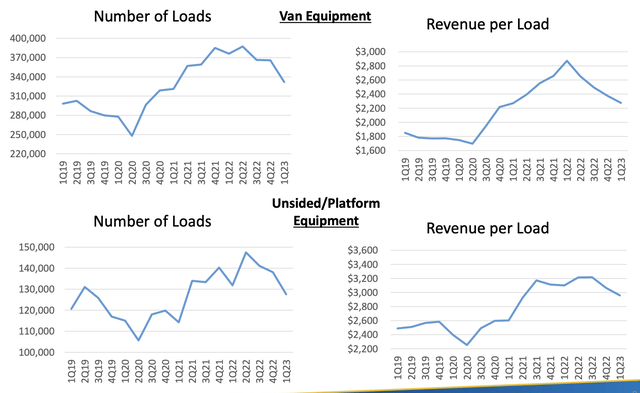
As expected, the company blamed softer demand and more available truck capacity, which is, generally speaking, what drives trucking profitability.
Digging a bit deeper, total loadings on all transportation modes were nearly 13% below the 2022 first quarter, and loadings in the top 25 commodity categories decreased by 10%.
Revenues in all segments were down.
Landstar System
Despite the decrease in loadings, the company assured investors that Landstar’s decrease in truckload volume was primarily driven by changes in the overall freight environment rather than the loss of major accounts.
I agree with that. After all, the evidence is clear. Not only is the ISM index in contraction territory, but we also see that it has hit trucking indicators like the ATA Truck Tonnage Index.
ATA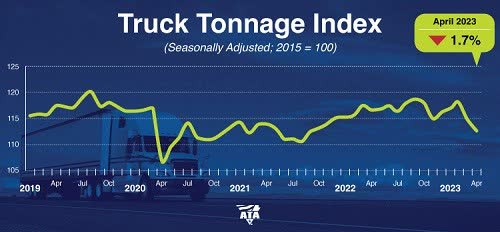
According to the ATA:
While the broader economy continues to surprise and thus far stave off an expected recession, the freight economy is starkly different. The goods-portion of the economy is soft and as a result, even contract truck freight is now falling, albeit not nearly as much as the spot market. The tonnage index hit the lowest level since September 2021 in April and has now fallen on a year-over-year basis for two straight months.
As a result, Landstar just lowered its guidance.
FreightWaves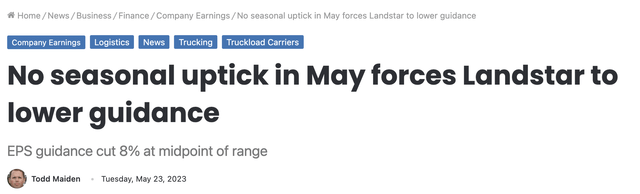
As reported by FreightWaves, Landstar indicated that both its revenue and earnings for the second quarter are expected to fall below the previously provided ranges, which were announced during the aforementioned first-quarter results in late April.
Landstar’s management initially acknowledged a slight deterioration in market conditions in April but anticipated a customary seasonal improvement in May.
Unfortunately, this improvement did not materialize.
The updated guidance now forecasts revenue between $1.325 billion and $1.375 billion, reflecting a 5.3% reduction compared to the midpoint of the previous range.
The downward revision is primarily attributed to a year-over-year decline in trucking loads of 16% to 18% during the first seven weeks of the second quarter, accompanied by a decrease in revenue per load of 14% to 16%. The earlier guidance projected declines of 14% to 16% and 12% to 14%, respectively.
Furthermore, Landstar has adjusted its EPS range to $1.75 -$1.85, representing an 8% reduction at the midpoint (a 15-cent decrease on both ends). The consensus estimate at the time of the announcement on Tuesday was $1.97 per share.
According to data from FreightWaves (and confirmed by the data used in this article), the trucking industry continues to struggle with surplus capacity, while spot rates have not stabilized.
FreightWaves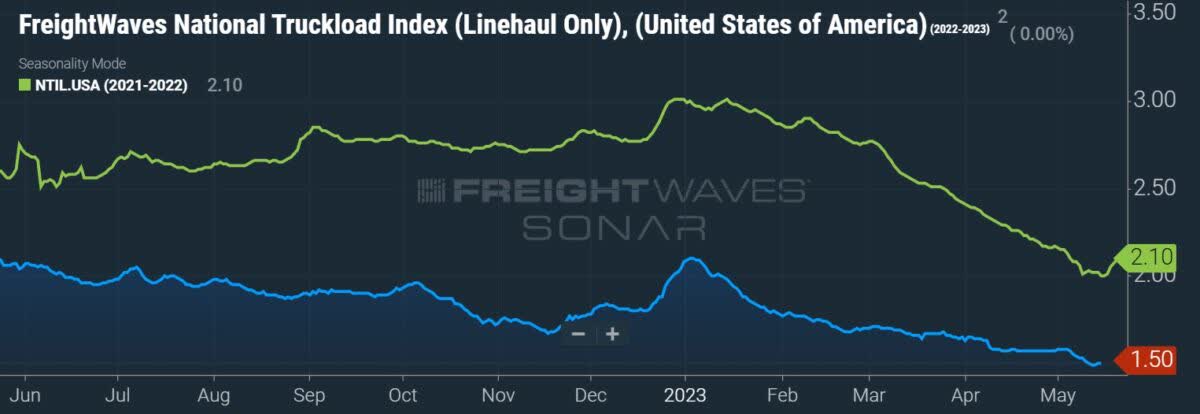
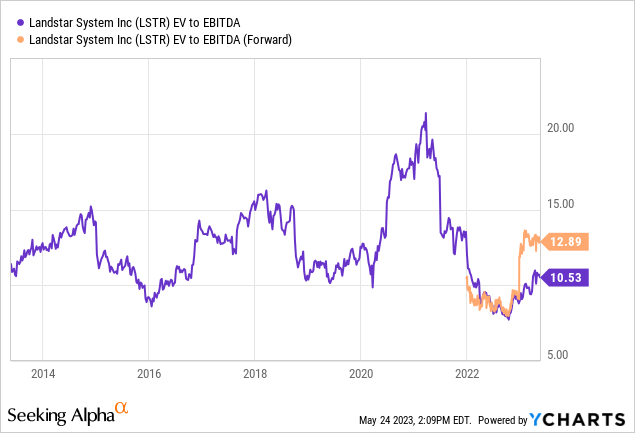
With that said, I do not believe that investors have priced in enough weakness. LSTR shares are trading at 12.9x NTM EBITDA, which is close to the longer-term median.
The same goes for the free cash flow multiple. While LSTR is trading at 9.9x LTM free cash flow, it is trading at roughly 20x NTM free cash flow. This is based on the free cash flow numbers we discussed earlier in this article.
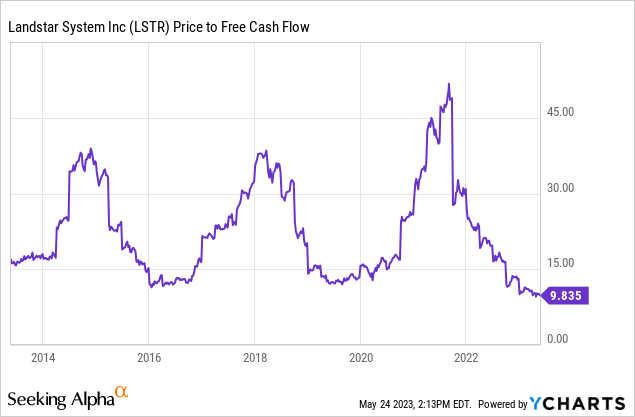
In other words, I’m starting to get interested in LSTR once it drops below $140. That may not happen (a risk of waiting for a better entry). However, given that I have roughly 50% industrial exposure, it’s a risk I’m willing to take.
Takeaway
Landstar System, one of America’s largest transportation companies, presents an attractive long-term risk/reward opportunity for dividend growth portfolios.
While its dividend yield may be low at 0.7%, the company has a track record of consistent dividend growth, with an average annual growth rate of 19% over the past five years.
Additionally, LSTR has a history of paying special dividends, which brings the current annualized dividend yield to 1.8%.
Moreover, the company’s resilience is proven by its strong total return, outperforming the market by over 600 basis points per year with relatively low volatility.
Despite facing headwinds due to slower economic growth, LSTR remains a solid performer. The recent guidance adjustment reflects the challenging freight environment, with a decline in trucking loads and revenue per load.
However, the stock price has not fully priced in this weakness. Trading at reasonable valuation multiples, LSTR becomes an intriguing investment opportunity if it drops below $140.
Overall, for investors seeking a cyclical stock with strong dividend growth potential, Landstar is worth considering, especially at the right price.
Credit: Source link


