

Truckers licensed to service Port of Vancouver face new rules on Dec. 1
Article content
In the 25 years since Tom Johnson started his Delta-based trucking company, he’s endured several port strikes and the uncertainty of the global pandemic.
However, the changes being proposed by the office that oversees B.C.’s container trucking industry could cause unprecedented job losses, Johnson said.
Article content
He and other container truck operators are worried that licensing changes proposed by the Office of the B.C. Container Trucking Commissioner will hurt small- and medium-sized companies that move goods to and from the Port of Vancouver.
Advertisement 2

Article content
Truck companies must be licensed to gain access to the port. Trucks with licences, or tags, often do a short-haul run with the container to a warehouse — which is called drayage. To save on costs, many of the licensed companies will then get so-called “shadow” companies, whose trucks are not licensed, to move containers on long-haul trips.
According to a report released by the commissioner last week, companies will soon be “prohibited from co-operating with any non-licensee performing off-dock work within the Lower Mainland.”
Commissioner Glen MacInnes said the aim is to crack down on companies who are subcontracting to unlicensed container trucks and thereby avoiding the fees that must be paid to his office.
“So one of the things we wanted to stress to the industry is ‘look, you can’t go and get around the (Container Trucking) Act by creating a separate company and then giving business to that company and then paying a lower rate,” he said. “Because that undermines the whole system.”
But Johnson said the changes could kneecap trucking companies by cutting off their access to unlicensed parts of their own businesses such as long-haul shipping.

Sunrise
Article content
Advertisement 3
Article content
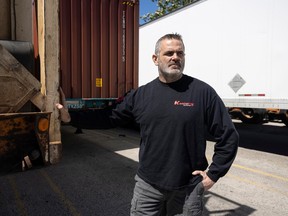
“It will cut my business in half,” said Johnson, who owns Kimberly Transport and is the spokesman for the Port Transportation Association, which represents trucking companies that work out of the Port of Vancouver. “He’s basically telling me to choose a side. You either do port work or you do the unregulated work.”
Johnson said he has 13 trucks that service the port and 20 truck that do unregulated container work.
Johnson also fears he won’t be able to do business with some of the largest freight companies in Canada, including Clarke, Vitran, CN and Fastfrate because they are not licensed port carriers.
MacInnes has also warned companies he could be reducing their tag allotments based on past incidents of rule breaking.
“So reducing those tags mean somebody’s losing their job. That’s what it equates to,” Johnson said. “These are things the companies are upset about. These small and medium companies have got their houses on the line. I get there might be a couple of bad actors out there. But not enough to warrant an upset to the entire industry.”
Johnson said he and other drivers are worried the commissioner will reduce the tag allotments for B.C. container companies in favour of issuing tags to larger companies.
Advertisement 4
Article content
“We are speculating that he’s planning to dump a few companies, get them out of the system systematically, and make room for the Loblaws … and other companies from other provinces to come in,” Johnson said.
MacInnes said it’s not true that he’s trying to open the door to larger companies.
“The goal of my office is to recognize the contribution and the service of those existing licensees … because they’ve got a track record in the industry.”
The commissioner’s office was created in 2014 to oversee the licensing of port container carriers and ensure drivers are paid fairly. It regulates the trucking industry through port truck tag allotments, issuing about 1,600 every two years.
MacInnes said it’s important to match the number of container trucks operating with the number of containers coming through the Port of Vancouver to prevent owner operators from being undercut by their competitors, which he said was a problem before the office was established.
“Ultimately, if we were to allow all these subcontracted trucks into the system, we’d be going back to the same problem where we have too many trucks chasing too few containers and the undercutting would start all over again,” he said.
Advertisement 5
Article content
More than 100 container truck drivers showed their opposition to the changes through a rally that took place on Sunday, organized by the Port Transportation Association. A convoy left from Annacis Island and drove toward downtown Vancouver, but the convoy was blocked by police from driving by Canada Place.
The changes take effect Dec. 1, 2024.
The association is asking for a grandfather clause that would exempt existing small- and medium-sized drayage companies from the new rules.
This would ensure “established port carriers are not removed from the licensing system to make way for large conglomerates or to allow larger companies prosper at the expense of B.C.’s small and mid-sized businesses,” the association said.
Recommended from Editorial
-

Nutty supply chain mixup leads to Loblaw losing truckload of walnuts
-

B.C. cancels trucking company’s ability to operate in province
-

Trucking company suspended, fined after trailer strikes George Massey Tunnel
Bookmark our website and support our journalism: Don’t miss the news you need to know — add VancouverSun.com and TheProvince.com to your bookmarks and sign up for our newsletters here.
You can also support our journalism by becoming a digital subscriber: For just $14 a month, you can get unlimited access to The Vancouver Sun, The Province, National Post and 13 other Canadian news sites. Support us by subscribing today: The Vancouver Sun | The Province.
Article content
Credit: Source link


