COLLINSVILLE — Increased interest in apprenticeship programs was highlighted at several events over the last few days, ranging from a roundtable discussion to recognition by the Madison County Board to celebrate National Apprenticeship Week..
On Wednesday, numerous aspects of apprenticeships, ranging from a nationally recognized program targeting special needs workers to the “good and bad” of apprenticeships, were discussed at an annual roundtable forum sponsored by Madison and St. Clair county workforce officials.
“We like to showcase the apprenticeships we have in our region,” said Tony Fuhrmann, director of Madison County Employment and Training.
There has been an increase in interest about apprenticeships, including a number of non-traditional areas.
Fuhrmann said there are now more than 20,000 active apprentices in Illinois.
“The majority are still in the trades, which is what you’d expect, but we’ve seen those nontraditional opportunities grow and grow,” he said. “In addition, something the state announced this week is the first group of apprenticeship ambassadors.”
On the rise
Lee Reese, director of workforce development for St. Clair County Intergovernmental Grants Department, which oversees workforce development in St. Clair Clinton, Monroe, Randolph and Washington counties, said they are seeing a marked increase in interest in apprenticeship programs.
“Over the last 3 ½ years, working at our partners Madison County Employment and Training, we’re just about to hit the 250 registered apprentice mark,” he said.
He noted that they are also doing very well in targeting underserved segments of the population.
Female apprenticeship participation is about 4 percent and few minorities nationwide, but female participation is running 67 percent and minority participation 52 percent in the Metro East.
He noted the region also has the nation’s first registered food truck apprenticeship program, The Soulcial Kitchen, and a large number of new registered apprenticeships.
“We really appreciate the partnership with the community and the collaboration we have in our region,” he said.
‘Unique’ programs
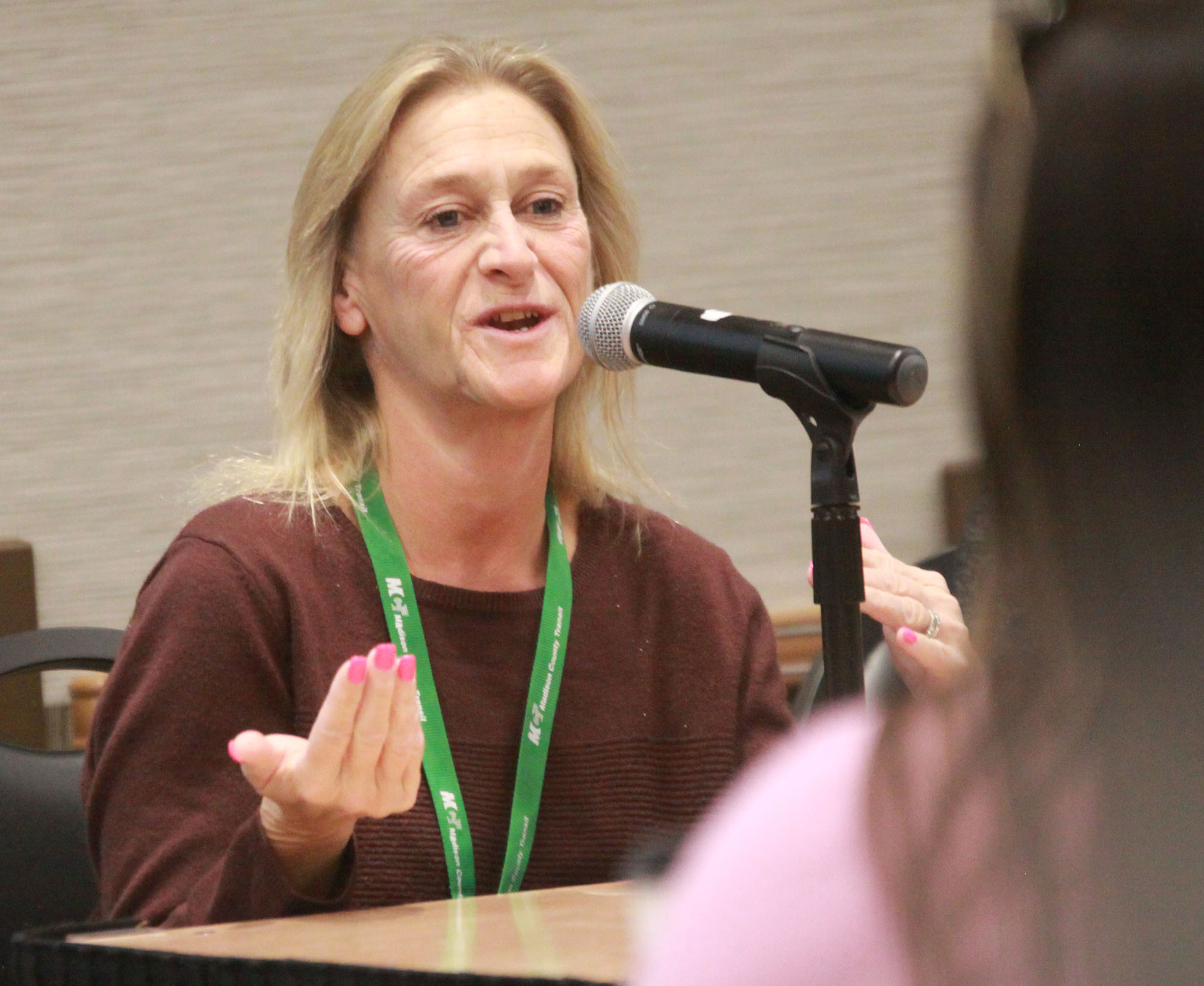
The first of several panels included Eric Wrobbel, director of communications for Holly’s House of Hope, a Highland-based agency; Payton Drury, HR director for the city of Collinsville; and Debbie Barron, director of HR for the Agency for Community Transit.
They talked about apprenticeship programs for special needs clients.
Holly’s House of Hope targets adults, while the others are in conjunction with local high schools.
Fuhrmann noted these programs are “very unique” and they are starting to attract national attention.
“The high school program is unique. We were just in Savanna (Georgia) presenting at an HR conference, and we were in Las Vegas presenting at a workforce conference. We have a meeting this afternoon with a national organization that is looking to do programs like this in seven major cities.”
He also said they got a call from someone in Massachusetts looking to replicate the program.
“It’s all about the partnerships that are involved,” he said.
While the panelists said they consider their programs successful, they were not without challenges and some failures along the way.
Wrobbel said he started Holly’s House of Hope for his daughter, who has Down syndrome. It primarily serves people with Down syndrome or severe autism spectrum disorder.
“These are folks that are often not considered to be especially employable,” he said. “Finding them any kind of an opportunity, much less a competitively paid one, is nearly impossible.”
He said when Holly was growing up, she wanted to work in a clothing store, and when they would go shopping she was encouraged to come back when she was old enough, but when she did nobody would hire her.
“I did what dads do, I built her a clothing store,” he said. “As we grew, we added other people and realized ‘these kids can do anything and everything.’”
Offering support
They started with apprenticeships with the city of Highland.
A large factor in their success is that they provide job coaching.
“I’m literally setting up an employer with an employee that literally comes with their own job coach. “It’s a win-win-win. So far it’s been great for the employees, it’s been great for the city.”
He also noted they start by asking the client what they want to do, something that is unusual in serving special needs workers.
Wrobbel said one worker, Kyle, wanted to be a firefighter. That was not possible because Highland doesn’t have a paid fire department. However, they have a police department.
“He cleans up police cars and every now and then they bring over a fire truck,” Wrobbel said.
He touted the benefit those workers bring to the community.
“Along with creating taxpayers, which is always a good thing, and giving folks a job with a purpose, it creates good will,” he said, noting that most of the positions they fill are very visible in the community.
“People see this,” he said. “As a parent of a 23-year-old with Down’s syndrome I can tell you our kids are invisible most of the time, so having our kids out in the community normalizes them in the community, and that’s valuable.”
Collinsville’s program, started after COVID hit, is on its third group.
Drury said because they jumped right into it, they had some difficulties starting up, but have ironed out many of the issues and consider the program to be a success.
“No one knew what to expect,” she said of the program’s start.
After that, they had discussions about the issues, and for the second group set up a handbook with expectations, added meetings with the parents and students, and added job coach training with supervisors.
The second cohort had four students, who all graduated, and the program is now on its third round.
Seeing growth
Barron said their program just started this year, and is focusing on training bus cleaners.
They started with two students; however, one was unable to finish the program because of various issues, including attendance problems both at work and school.
“Attendance at school was primary,” she said. “We took a stand that school was first. Unfortunately, one of our students didn’t work out. That was tough, because we were enthusiastic and hopeful for that student.”
However, the other student is doing very well and Barron said they expect to offer them a job.
She also said they are considering expanding the program to include other jobs.
“We started small because we were advised by this group to start small,” she said. “We did have challenges, but I think we’ll be able to grow this program for other positions.”
“Those are apprenticeships that have been developed that weren’t there before, and they’re there to work with populations that haven’t been given a chance before,” Reese said.
Fuhrmann noted that West Star Aviation has also started a similar program for a housekeeping position in conjunction with Civic Memorial High School.
“Private industry is the next step,” Fuhrmann said. “We can talk all we want about city government and agencies, but if you move into the business world, that’s the next step.”
People in demand
Later panels included discussion from officials from various agencies, universities and private companies.
One of the later presenters was Katie Johnson, vice president of human resources at West Star Aviation, based at St. Louis Regional Airport in East Alton.
The company recently announced a new “West Star Aviation Academy,” an apprenticeship program in conjunction with Southwestern Illinois College.
SWIC has the region’s only aviation maintenance program, but Fuhrmann and others have said their problem is they can’t put out enough graduates to meet the growing need in the St. Louis region.
Johnson said their solution was to expand apprenticeship programs at West Star.
Through the new program students will be able to receive their FAA airframe certification in about 7 ½ months.
“The best part of that program is, we’re paying the educational cost,” Johnson said. “We’re also paying the apprentices $20 an hour to attend and learn and get their education. We wanted to remove all the financial barriers that are really contributing to a lack of available talent.”
She said they are also looking to start working with local high schools, which could reduce the time to obtain certification by 10 weeks.
A number of other apprenticeship-related activities went on during the week.
That night a proclamation regarding National Apprenticeship Week was approved by the Madison County Board, with Johnson participating.
On Thursday Fuhrmann spoke at a breakfast sponsored by the Chamber of Commerce of Southwestern Madison County in Granite City; and several programs were set for Friday, including a presentation on the special needs high school programs at Gateway Convention Center.
For information about apprenticeship opportunities, call 618-296-4301, visit the Madison County website at https://www.co.madison.il.us/ or visit the Employment and Training Department’s Facebook page at https://www.facebook.com/MCETD.
Credit: Source link